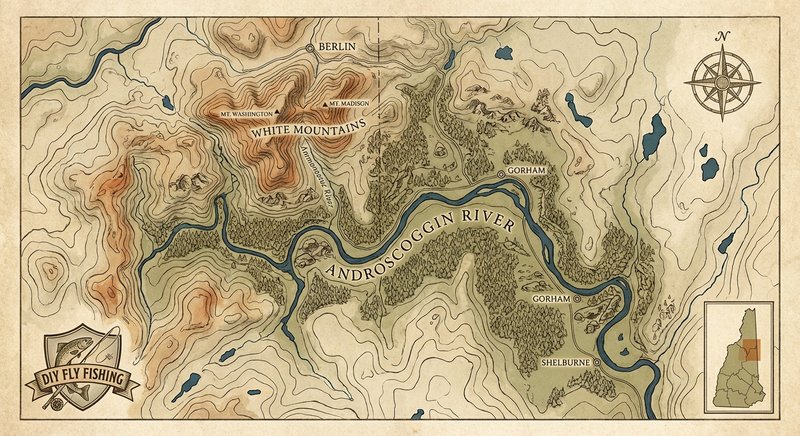
Androscoggin River
Fly fishing in New Hampshire · Intermediate · Best seasons: Spring, Summer, Fall
Target Species
Rainbow Trout, Brown Trout, Brook Trout
About This Water
Northern NH river with excellent trout fishing. Scenic White Mountain setting.
Fishing Recommendations
The "Andro," as locals call it, is one of the premier fly fishing destinations in New England. While it eventually flows into Maine, the New Hampshire stretch—particularly from the Errol Dam down through the Thirteen Mile Woods—is a powerhouse of trout production.
Here is your comprehensive guide to fly fishing the Androscoggin River, NH.
🎣 Location Overview
The Androscoggin is a "big water" river by New Hampshire standards. Unlike the intimate mountain streams found elsewhere in the White Mountains, the Andro offers expansive runs, deep pools, and heavy riffles.
What makes it special is its diversity of water. From the tailwater section below the Errol Dam to the classic freestone feel of the Thirteen Mile Woods, the river provides a variety of habitats. Because it is fed by the bottom-release waters of Umbagog Lake, it stays cooler than many other regional rivers during the heat of the summer, making it a reliable refuge for trout and a consistent producer for anglers.
🐟 Target Species & Behavior
The Androscoggin is famous for the size and "shoulders" of its fish. The heavy current means these fish are strong and know how to use the flow to their advantage.
- Rainbow Trout: These are the river's acrobats. They congregate in the fast, oxygenated "white water" and at the heads of pools. They are aggressive feeders and will often move several feet to smash a fly.
- Brown Trout: The river holds some truly large, "trophy" browns. They are more calculated, typically holding in deeper undercut banks, behind large boulders, or near submerged timber. They become highly active during low-light hours and in the fall.
- Brook Trout: While the main stem holds some large "stockie" brookies, the wilder fish are often found near the mouths of cold-water tributaries or in the upper reaches near Errol. They are opportunistic but wary of heavy pressure.
- Primary Forage: The river is a "caddis factory." It also boasts significant populations of Stoneflies (Golden and Giant), Isonychia, and various Mayflies, along with sculpins and dace.
📅 Best Times to Fish
Spring (Mid-May – June)
The "kick-off." As the spring runoff recedes, the Hendrickson and Alderfly hatches begin. This is the best time for high numbers of fish.
- Conditions: High but fishable water.
- Window: Mid-morning to late afternoon.
Summer (July – August)
While other rivers get too warm, the Andro remains viable due to its depth and dam release.
- Conditions: Low, clear water.
- Window: The "Magic Hour" (the last 90 minutes of light) is legendary for caddis activity.
Fall (September – October)
Perhaps the most beautiful and productive time. The Brown Trout begin to move and become aggressive.
- Conditions: Cooling water, spawning colors.
- Window: All day, with a focus on Isonychia hatches in the afternoon.
🪰 Recommended Flies & Techniques
Nymphing (The Bread and Butter)
The majority of the fish here are caught sub-surface.
- Patterns:
- Girdle Bug / Pat’s Rubber Legs (Size 6-10) in tan/black or olive.
- Prince Nymph (Size 12-16) - a classic for the Andro.
- Pheasant Tail (Size 14-18) for selective fish.
- Technique: Use a heavy two-fly rig with an indicator. You must get the flies deep in the fast runs. High-sticking or Euro-nymphing the pocket water is deadly here.
Dry Fly (The Thrill)
The Andro is famous for the Alderfly (Zebra Caddis) hatch in late June.
- Patterns:
- Elk Hair Caddis (Size 12-16) in tan or olive.
- Zebra Caddis (Black body with white ribbing).
- Isonychia Parachute (Size 10-12) for the fall.
- Stimulators (Orange or Yellow) to mimic large stoneflies.
- Technique: "Skittering" your caddis across the surface at the end of a drift often triggers violent strikes.
Streamers (For the Giants)
If you want a trophy Brown, put away the 5-weight and swing big flies.
- Patterns: Wooly Buggers (Black or Olive), Muddler Minnows, and Bank Robbers.
- Technique: Strip streamers through deep holes or swing them through the tail-outs of pools during overcast days.
💡 Pro Tips & Local Knowledge
- The Thirteen Mile Woods: This stretch along Route 16 is the "holy grail." Focus on the areas where the river bends away from the road; these spots receive less pressure.
- The "Andro Shuffle": The riverbed is notorious for "bowling ball" rocks coated in slick algae. Studded wading boots and a wading staff are not optional—they are safety requirements.
- The Alderfly Hatch: Locally known as the Zebra Caddis. When these are out, the fish go into a frenzy. Look for dark-bodied caddis with white-striped wings.
- Watch the Gauge: The Errol Dam flow can change. Check the USGS gauges before you go. Flows between 800 and 1,500 CFS are generally ideal for wading. Above 2,000 CFS, wading becomes dangerous in most spots.
⚠️ Important Information
- Access: Route 16 follows the river for miles north of Berlin, NH. There are numerous well-marked pull-offs and boat launches.
- Regulations: New Hampshire Fish & Game manages different sections with different rules.
- The stretch from Errol Dam to Seven Islands is generally "Catch and Release only" for certain species or has specific tackle restrictions (Fly Fishing Only in certain zones).
- Always check the current NH Freshwater Fishing Digest before casting, as boundaries are strictly enforced.
- Safety: This is a powerful river. If you aren't sure about a crossing, don't take it. The water is often deeper and faster than it looks.
- License: You need a valid New Hampshire freshwater fishing license.
Guide’s Final Word: The Androscoggin is a river of rewards. It requires technical mending and physical wading, but the sight of a 19-inch Rainbow Trout leaping three feet out of a heavy rapid is an experience you won't soon forget. Tight lines!
Bug Hatches & Matching Flies
| Hatch | Type | Peak months | Time of day | Hook sizes | Matching flies |
|---|---|---|---|---|---|
| Blue-winged Olive Baetis | mayfly | April, May, September, October | Mid-day/Afternoon | #18-22 | BWO Sparkle Dun #18-22, Pheasant Tail Nymph #18-20, RS2 #20-22 |
| Hendrickson Ephemerella subvaria | mayfly | May | Afternoon | #12-14 | Red Quill #12-14, Hendrickson Emerger #14, Gold Ribbed Hare's Ear #12-14 |
| Grannom Caddis Brachycentrus | caddis | May | Morning/Afternoon | #14-16 | Elk Hair Caddis (Olive) #14-16, LaFontaine's Deep Sparkle Pupa #14-16, Holy Grail #14-16 |
| Alderfly Sialis hastata | caddis | June, July | All Day | #10-12 | Alder Fly #10-12, Zebra Midge (Black) #18-20, Black Gnat #12 |
| Golden Stonefly Acroneuria carolinensis | stonefly | June, July | Evening | #8-12 | Golden Pat's Rubber Legs #8-12, Stimulator (Yellow) #10-12, Golden Stone Nymph #8-10 |
| Slate Drake Isonychia bicolor | mayfly | July, August, September | Afternoon/Evening | #10-12 | Iso Parachute #10-12, Isonychia Nymph #10-12, Zug Bug #10-12 |
| Spotted Sedge Hydropsyche | caddis | June, July, August | Evening | #14-18 | Tan Elk Hair Caddis #14-18, Soft Hackle Hare's Ear #14-16, Caddis Larva (Green) #14-16 |
| Trico Tricorythodes | mayfly | August, September | Early Morning | #22-26 | Trico Spinner #22-26, Trico Dun #22-24, WD-40 #22-24 |
| Giant Black Stonefly Pteronarcys dorsata | stonefly | May, June | Night/Early Morning | #4-8 | Black Pat's Rubber Legs #4-8, Black Kaufman Stone #6-8, Chernobyl Ant #6-8 |
| Terrestrials (Ants & Beetles) Formicidae / Coleoptera | terrestrial | July, August, September | All Day | #12-18 | Cinnamon Ant #14-18, Black Foam Beetle #12-16, Flying Ant #16 |