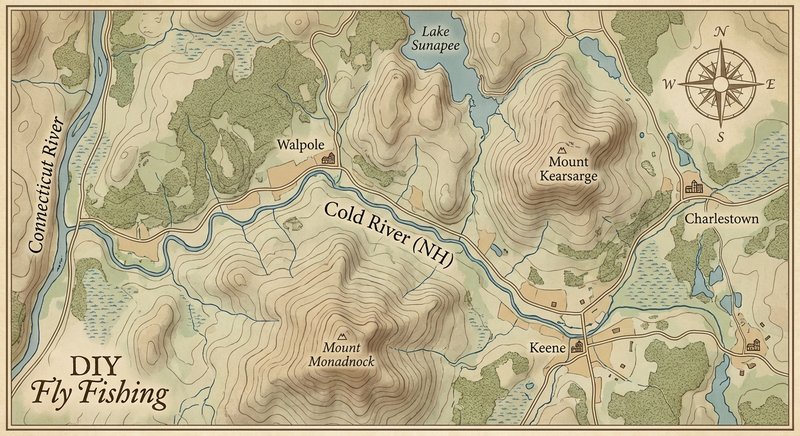
Cold River (NH)
Fly fishing in New Hampshire · Intermediate · Best seasons: Summer, Fall
Target Species
Brook Trout
About This Water
Cheshire County stream with wild brook trout. Remote fishing.
Fishing Recommendations
The Cold River in New Hampshire—specifically the stretch flowing through Alstead, Langdon, and Walpole—is one of the Monadnock region’s best-kept secrets. While it doesn't get the national press of the Androscoggin or the Upper Connecticut, it is a quintessential New England freestone stream that offers a technical and rewarding experience for the dedicated brook trout angler.
🎣 Location Overview
The Cold River is a classic "pocket water" stream. It begins in the highlands of Acworth and winds its way down to the Connecticut River. What makes it special is its name: true to its moniker, the river benefits from numerous cold-water springs and heavy canopy cover, allowing it to maintain trout-friendly temperatures even when other Southern NH rivers are warming up.
The river is characterized by a high gradient in its upper reaches, featuring plunge pools, large granite boulders, and short, bubbly riffles. As it moves toward the Connecticut, it levels out into longer runs and deeper pools. It is a scenic, intimate river where you are more likely to see a blue heron than another angler.
🐟 Target Species & Behavior
While the state stocks Rainbow and Brown trout in the lower sections, the Brook Trout is the star of the show here. You will find a mix of "holdover" stocked brookies and small, vibrant wild fish in the headwaters and tributaries.
- Behavior: In the summer, brookies congregate in the "oxygenated" water—the whitewater at the head of pools or directly under small waterfalls.
- Feeding: They are opportunistic but cautious. Because the water is often crystal clear, these fish have excellent vision. They feed heavily on caddis larvae, stoneflies, and terrestrial insects dropping from the overhanging trees.
- Holding Patterns: Look for the "seams" where fast water meets slow water. In the Fall, they move toward the tail-outs of pools and into gravelly runs as they prepare for spawning.
📅 Best Times to Fish
Summer (June - August)
- Condition: This is "stealth" season. The water is usually lower and very clear.
- Time of Day: Early morning (sunrise to 10:00 AM) and "the witching hour" (the last hour of light).
- Window: Focus on the deepest shaded pools during the heat of the day.
Fall (September - October)
- Condition: This is arguably the best time for Brook Trout. As water temperatures drop, brookies become aggressive and territorial.
- Time of Day: Mid-day becomes very productive as the sun warms the water slightly.
- Window: The foliage peak usually coincides with the best fishing. The fish will be in their stunning spawning colors (vibrant orange bellies).
🪰 Recommended Flies & Techniques
Top Fly Patterns
- Dry Flies:
- Elk Hair Caddis (Size 14-18) – The gold standard for the Cold River.
- Royal Wulff (Size 12-16) – Great for high-visibility in bubbly pocket water.
- Stimulators (Orange or Yellow, Size 12) – Excellent for the "Dry-Dropper" rig.
- Nymphs:
- Pheasant Tail (Size 16-20) – Mimics the small mayflies common here.
- Bead-head Prince Nymph (Size 14-16) – Adds a bit of flash in the deeper holes.
- Terrestrials (Summer Essential):
- Black Ants or Foam Beetles (Size 16-18) – Fish these tight to the banks under overhanging branches.
- Streamers (Fall):
- Black Ghost or Muddler Minnow (Size 10-12) – Classic NH patterns that trigger aggressive strikes from spawning brookies.
Techniques & Presentation
- The Dry-Dropper: Use a buoyant Stimulator as your "indicator" and hang a small Pheasant Tail nymph about 18–24 inches below it. This covers two water columns in the shallow runs.
- Short Line Nymphing: Because the river is tight and "pooly," long casts are your enemy. Keep your rod high and your fly line off the water to avoid drag caused by conflicting currents.
- Stealth: Wade slowly and upstream. Brook trout are notorious for "spooking" if they see a shadow or feel vibrations from heavy-footed wading.
💡 Pro Tips & Local Knowledge
- Focus on the Gorge: The area near the Vilas Pool in Alstead and the stretches upstream towards Acworth offer some of the most rugged and productive pocket water.
- The "Shadow" Factor: If a pool is half-shaded and half-sunlit, the brookies will almost always be tucked just inside the shadow line.
- Read the Bubbles: In the summer, if you see a bubble line (the foam trail from a riffle), your fly needs to be in that line. The bubbles provide cover from birds and carry the most food.
- Light Tackle: A 7.5-foot to 8.5-foot 3-weight or 4-weight rod is perfect. A 5-weight is overkill and might land too heavily on the water.
⚠️ Important Information
- Access: Much of the Cold River runs along Route 123 and 123A. There are several pull-offs near bridges. While much of the river is accessible, New Hampshire law requires respecting "Posted" signs. Always ask permission if you are unsure.
- Regulations: You must have a valid New Hampshire Fishing License. The Cold River is generally subject to general trout regulations (usually 5 fish or 5 lbs), but many local fly anglers practice 100% Catch and Release to protect the wild brookie populations.
- Safety: The rocks in the Cold River can be incredibly "greasy" with algae. Felt-soled boots or studs are highly recommended.
- Check the Flow: After a heavy rain, the Cold River can "blow out" and become dangerous and chocolate-colored. Check the USGS gauges for nearby rivers (like the Ashuelot) to gauge local runoff levels.
Guide’s Final Word: The Cold River rewards the patient angler. Don't try to cover five miles of water; find one good half-mile stretch and fish every pocket, every behind-rock eddy, and every undercut bank. The fish are there—you just have to outsmart them.
Bug Hatches & Matching Flies
| Hatch | Type | Peak months | Time of day | Hook sizes | Matching flies |
|---|---|---|---|---|---|
| Hendrickson Ephemerella subvaria | mayfly | May | Afternoon | #12-14 | Red Quill #12-14, Hendrickson Sparkle Dun #12-14, Pheasant Tail #12-14 |
| Blue Winged Olive Baetis / Pseudocloeon | mayfly | April, May, September, October | Late Morning/Afternoon | #18-22 | Parachute Adams #18-22, RS2 #20-22, BWO Nymph #18-20 |
| Grannom Caddis Brachycentrus | caddis | April, May | Morning/Afternoon | #14-16 | Elk Hair Caddis (Olive/Black) #14-16, Deep Sparkle Pupa #14-16, Peacock Caddis #16 |
| March Brown Maccaffertium vicarium | mayfly | June | Afternoon | #10-12 | March Brown American #10-12, Hare's Ear Nymph #10-12, March Brown Wet Fly #12 |
| Sulphur Ephemerella invaria / dorothea | mayfly | June, July | Evening | #16-18 | Parachute Sulphur #16-18, Sulphur Spinner #16-18, Pheasant Tail #16-18 |
| Golden Stonefly Acronuria | stonefly | June, July | Morning/Evening | #8-12 | Golden Stone Nymph #8-12, Golden Stimulator #10-12, Pat's Rubber Legs #8-10 |
| Light Cahill Stenacron / Stenonema | mayfly | June, July, August | Evening | #12-14 | Light Cahill #12-14, Cream Usual #14, Gold Ribbed Hare's Ear #14 |
| Slate Drake Isonychia bicolor | mayfly | August, September | Afternoon/Evening | #10-12 | Isonychia Parachute #10-12, Zug Bug #10-12, Prince Nymph #10-14 |
| Cinnamon Sedge Hydropsyche | caddis | June, July, August | Evening | #14-18 | Elk Hair Caddis (Tan) #14-16, LaFontaine's Emergent Pupa #14-18, Soft Hackle Hare's Ear #14-16 |