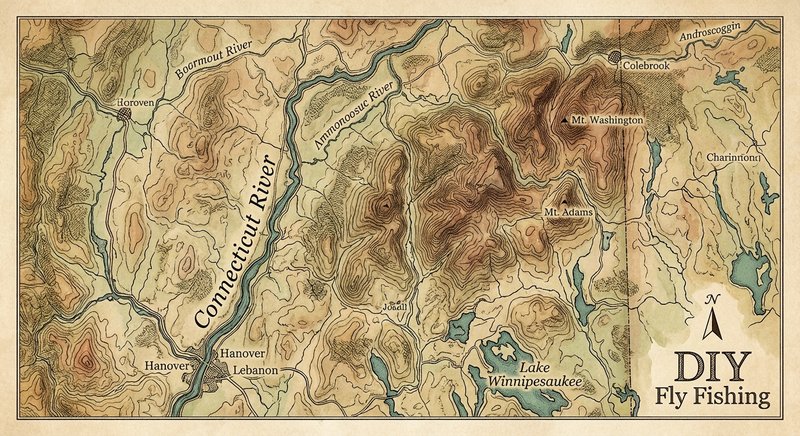
Connecticut River
Fly fishing in New Hampshire · Intermediate · Best seasons: Spring, Summer, Fall
Target Species
Rainbow Trout, Brown Trout, Smallmouth Bass
About This Water
New England's longest river with diverse fishing. Trout in upper reaches, bass and pike below.
Fishing Recommendations
The Connecticut River in New Hampshire is a tale of two rivers. In its northernmost reaches near the Canadian border, it is a world-class trout and landlocked salmon fishery, often called the "Trout Capital of the East." As it flows south toward the Massachusetts border, it transforms into a broad, powerful river known for some of the best Smallmouth Bass fishing in New England.
🎣 Location Overview
The Connecticut River serves as the border between New Hampshire and Vermont. For fly anglers, the "Upper Connecticut" (specifically the stretch between the First Connecticut Lake and Murphy Dam in Pittsburg) is the crown jewel. This area features tailwater sections that keep the water cold and oxygenated even in the heat of summer.
Further south, near Lebanon, Orford, and down to Brattleboro, the river widens and slows, characterized by deep pools, rocky ledges, and bridge pilings—prime habitat for trophy Smallmouth Bass. The diversity of the river—from technical "pocket water" and riffles in the north to big-water streamer stripping in the south—is what makes it a bucket-list destination.
🐟 Target Species & Behavior
Rainbow and Brown Trout
- Behavior: In the Upper Connecticut (the Trophy Stretch), trout are highly educated and often "flow-dependent." They hold in the seams, behind large boulders, and in the deep "buckets" at the base of riffles.
- Feeding: They are opportunistic but can be selective during hatches. They feed heavily on caddis, stoneflies, and small midge larvae. In the fall, Browns become aggressive as they prepare to spawn.
Smallmouth Bass
- Behavior: Found predominantly from the central part of the state southward. They love structure: rocky shorelines, submerged ledges, and the downstream side of islands.
- Feeding: They are visual hunters. They key in on crayfish, hellgrammites, and baitfish (shiners and dace). During summer evenings, they will look up for large surface bugs or frogs.
📅 Best Times to Fish
Spring (May – June)
- Trout: This is the time for the "Smelt Run" below the dams. Streamer fishing is electric.
- Bass: Late spring is pre-spawn; bass are aggressive and move into shallower water.
- Window: Mid-morning to late afternoon as the water warms slightly.
Summer (July – August)
- Trout: Focus on the tailwaters (below the dams) where water stays under 65°F. Early morning and "light-out" evening sessions provide the best dry fly action (Caddis and Blue Winged Olives).
- Bass: Peak season. Use poppers in the early morning or late evening. During the day, fish deep with sinking lines.
Fall (September – October)
- Trout: The most scenic time. Large Brown Trout and Landlocked Salmon move up-river. Use aggressive streamer retrieves or egg patterns.
- Bass: Bass feed heavily to bulk up for winter. Focus on deeper slow-moving pools.
🪰 Recommended Flies & Techniques
For Trout (Upper River)
- Nymphing (The Producer): High-stick or European Nymphing is the most effective way to fish the pocket water.
- Patterns: Pheasant Tail (#14-18), Zebra Midge (#18-22), Pat's Rubber Legs (Stonefly) (#8-12).
- Dry Fly:
- Patterns: Elk Hair Caddis (Tan/Olive), Blue Winged Olive (BWO), Stimulators (Orange/Yellow).
- Streamers:
- Patterns: Grey Ghost (classic for Salmon/Trout), Black or Olive Woolly Bugger, Muddler Minnow.
For Smallmouth Bass (Middle/Lower River)
- Topwater: Hard-body poppers or BoogleBugs in yellow or chartreuse.
- Sub-surface: Clouser Minnows (Chartreuse/White), Near Nuff Crayfish, and Hellgrammite patterns.
- Technique: Use a 6 or 7-weight rod with a sink-tip line to get streamers down into the ledges.
💡 Pro Tips & Local Knowledge
- The "Trophy Stretch": The section between First Lake Dam and Lake Francis is "Fly Fishing Only." It is highly pressured, so use long, fine leaders (9ft–12ft 5X or 6X) to avoid spooking fish.
- Check the Flows: This is a dam-controlled river. Always check the TransCanada or Great River Hydro flow releases before heading out. A sudden increase in CFS (cubic feet per second) can make wading dangerous and shut down the bite.
- The "Smelt" Factor: In the spring, trout and salmon gorge on landlocked smelt flushed through the dams. If you see silver flashes, tie on a long, white, sparse streamer and swing it through the current.
- Bass Ledges: In the southern stretches, look for "staircase" rock formations. Bass sit right on the drop-offs. Cast your fly onto the shallow shelf and "hop" it off the edge into the deep water.
⚠️ Important Information
- Regulations: New Hampshire and Vermont have a reciprocal license agreement on the Connecticut River mainstem, but be careful: this does not apply to tributaries or certain "Fly Fishing Only" zones which may have specific NH state rules. Always carry a printed or digital NH fishing license.
- Wading Safety: The Connecticut has extremely slippery "bowling ball" rocks. Felt-soled boots with studs and a wading staff are highly recommended.
- Conservation: The Upper Connecticut relies on a mix of wild and stocked fish. Practicing Catch and Release is strongly encouraged to maintain the "Trophy" status of the fishery.
- Access:
- North: Numerous pulloffs along Route 3 in Pittsburg.
- South: Public boat launches in Cornish, Hanover, and Orford provide excellent access for wading or drift boats.
Bug Hatches & Matching Flies
| Hatch | Type | Peak months | Time of day | Hook sizes | Matching flies |
|---|---|---|---|---|---|
| Blue-Winged Olive (BWO) Baetis spp. | mayfly | April, May, September, October | Midday | #18-24 | RS2 #20-22, Parachute BWO #18-22, Pheasant Tail Nymph #18-20 |
| Hendrickson Ephemerella subvaria | mayfly | May | Afternoon | #12-14 | Red Quill #12-14, Hendrickson Emerger #14, Hare's Ear Nymph #12-14 |
| Grannom Caddis Brachycentrus spp. | caddis | May | All Day | #14-16 | Elk Hair Caddis (Olive) #14-16, LaFontaine's Deep Sparkle Pupa #14-16, Peacock Caddis #16 |
| Giant Black Stonefly Pteronarcys dorsata | stonefly | June | Morning/Evening | #4-8 | Pats Rubber Legs #6-8, Black Stimulator #8, Kaufmann Stone #4-8 |
| Sulfur Ephemerella dorothea | mayfly | June, July | Evening | #16-20 | Pale Morning Dun #16-18, Sulfur CDC Emerger #18, Pheasant Tail #18 |
| Eastern Green Drake Ephemera guttulata | mayfly | June | Evening/Dusk | #8-12 | Green Drake Cripple #10, Coffin Fly #10, Green Drake Nymph #8-10 |
| Trico Tricorythodes spp. | mayfly | July, August, September | Early Morning | #22-26 | Trico Spinner #22-24, Sunken Trico #24 |
| Isonychia (Slate Drake) Isonychia bicolor | mayfly | August, September | Afternoon/Evening | #10-12 | Iso Parachute #12, Zug Bug #10-12, Prince Nymph #10-12 |