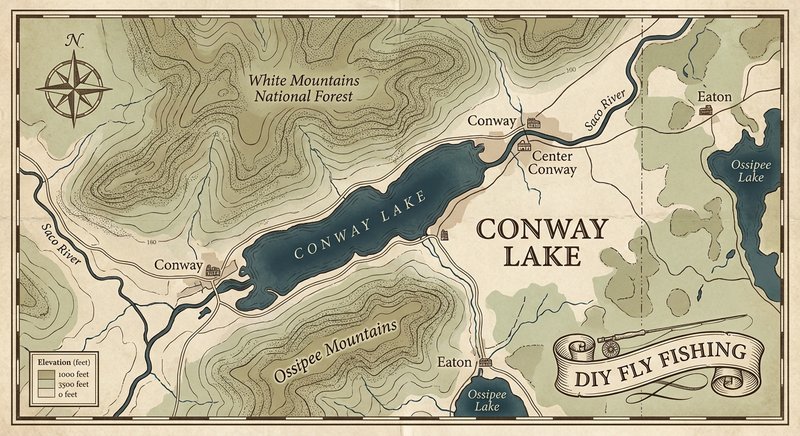
Conway Lake
Fly fishing in New Hampshire · Beginner · Best seasons: Spring, Summer, Fall
Target Species
Smallmouth Bass, Largemouth Bass, Pickerel
About This Water
Carroll County lake with bass and panfish. White Mountain region.
Fishing Recommendations
Welcome to the White Mountains region of New Hampshire. As your guide, I can tell you that Conway Lake is one of the "hidden gems" of the state. While many anglers flock to the massive Lake Winnipesaukee, Conway Lake offers a more intimate, scenic, and manageable fly fishing experience. Its crystal-clear water and views of Mount Washington make it a world-class backdrop for chasing warm-water species.
Here is your comprehensive guide to fly fishing Conway Lake.
🎣 Location Overview
Conway Lake is a roughly 1,300-acre glacial lake situated between the towns of Conway and Eaton. What makes it special is its exceptional water clarity and its diverse shoreline. Unlike many southern NH lakes, Conway remains relatively undeveloped in sections, retaining a wild, Northwoods feel.
The lake is characterized by a "split personality": the northern end and main body feature steep drop-offs and massive granite boulders (classic Smallmouth territory), while the southern end and various coves feature lily pads, submerged timber, and weed beds (Largemouth and Pickerel heaven). Because the water is so clear, it is a "sight-fishing" paradise during the spring, but it requires stealth and long leaders during the summer.
🐟 Target Species & Behavior
Smallmouth Bass
These are the "bronzebacks" of the granite state. In Conway Lake, they are incredibly athletic.
- Behavior: They hold on rocky points, submerged islands (humps), and steep ledge drop-offs.
- Feeding: They primarily target landlocked smelt, yellow perch, and crayfish.
Largemouth Bass
Found in the "mucky" parts of the lake.
- Behavior: They are ambush predators. Look for them under the shade of docks, deep within lily pad fields, or hovering near downed trees.
- Feeding: They are opportunistic, eating frogs, dragonflies, and smaller sunfish.
Chain Pickerel
The "Water Wolf" of New England.
- Behavior: They sit motionless in shallow weed beds waiting for anything to swim by.
- Feeding: Highly aggressive. They love flash and movement.
📅 Best Times to Fish
- Spring (Late May – Mid-June): This is the Prime Window. As the water hits 55–60°F, bass move into the shallows to spawn. Smallmouth will be on "beds" in sandy/rocky flats (3–8 feet deep). Sight fishing with a fly rod is peak during this time.
- Summer (July – August): The water warms up and the fish move deeper or into thick cover.
- Time of Day: You must fish at "civil twilight" (dawn and dusk). The midday sun in such clear water sends the big fish down to 15–25 feet, out of easy reach for most fly lines.
- Fall (September – October): As temperatures drop, bass embark on a feeding binge. Smallmouth return to the rocky points to hunt baitfish schools. The colors of the foliage against the blue water make this the most beautiful time to be on the lake.
🪰 Recommended Flies & Techniques
For Smallmouth (The "Smallie" Special)
- Flies:
- Clouser Minnow: (Chartreuse/White or Blue/White) – Mimics the local smelt.
- Near Nuff Craw: (Rusty Brown) – Smallmouth here love crayfish.
- Murdoch Minnow: Great for mid-column suspension.
- Technique: Use a sink-tip line (Type 3 or 5) to get the fly down the ledges. Strip fast and erratically.
For Largemouth (The "Bucketmouth" Setup)
- Flies:
- Dahlberg Diver: (Frog or Black) – The best topwater action.
- Poppers: (Yellow or Green) – Hard-body poppers with rubber legs.
- Gamechanger: For big fish in the pockets of weeds.
- Technique: Cast into the tightest cover you can find. Let the ripples dissipate before your first twitch.
For Pickerel
- Flies: Flashabou Minnow or Mickey Finn. Anything with high flash and a red throat.
- Technique: A steady, pulsating strip. Note: Use a 20lb fluorocarbon bite tippet or a thin wire trace, or they will snip your fly instantly.
💡 Pro Tips & Local Knowledge
- The "Clear Water" Rule: Because Conway Lake is so clear, use longer leaders than you would in a murky pond. I recommend a 9-foot to 12-foot fluorocarbon leader to avoid spooking the Smallmouth.
- Focus on the Islands: There are several small islands and "humps" in the main body. Use a topographical map or a depth finder to find where a flat suddenly drops from 5 feet to 20 feet. The Smallmouth sit right on that transition line.
- The South End Stealth: The southern end (Eaton side) is shallower. If you are in a kayak or canoe, you can get into the back lily pad sections where powerboats can't reach. This is where the trophy Largemouth hide.
- The Smelt Connection: If you see birds diving in the middle of the lake, Smallmouth are likely "busting" smelt schools on the surface. Keep a rod rigged with a white streamer and a floating line ready for this "blitz" action.
⚠️ Important Information
- Access: There is a public boat launch on Mill Street (off Route 153). Parking is very limited and fills up by 7:00 AM on summer weekends. There is also a small beach area, but launching a motorized boat is best done at the state ramp.
- Regulations:
- New Hampshire Fishing License is required (available online at NH Fish & Game).
- Bass Season: In NH, from May 15 to June 15, it is Catch and Release only for bass to protect the spawning beds. Use barbless hooks during this time to ensure a healthy release.
- Safety: Watch the weather. Conway Lake is long and narrow; a North wind can whip up "whitecaps" quickly, making it difficult for kayaks and small boats.
- Boating Hazard: Be extremely careful of the "granite pillows"—large boulders that sit just 6 inches below the surface in the middle of seemingly deep water.
Guide’s Final Word: Bring your camera. Even if the fish aren't biting, a sunset on Conway Lake with the White Mountains in the background is worth the trip alone. Tight lines!
Bug Hatches & Matching Flies
| Hatch | Type | Peak months | Time of day | Hook sizes | Matching flies |
|---|---|---|---|---|---|
| Giant Mayfly (Hex) Hexagenia limbata | mayfly | June, July | Late Evening/Night | #6-10 | Hexagenia Spinner #6-8, Hexagenia Nymph #8-10, Paradrake Hex #8 |
| Damselfly Enallagma spp. | terrestrial | June, July, August | Late Morning/Afternoon | #10-14 | Adult Damselfly #10-12, Marabou Damsel Nymph #12-14 |
| Midges Chironomidae | midge | May, September, October | Morning/Evening | #18-24 | Griffith's Gnat #18-22, Zebra Midge #18-24, Chironomid Pupa #16-20 |
| Traveling Sedge Phryganea spp. | caddis | June, July | Evening | #8-12 | Goddard Caddis #8-12, Mikulak Sedge #10 |
| Gray Drake Siphlonurus spp. | mayfly | June | Afternoon/Evening | #10-14 | Gray Drake Paradox #12, A.P. Nymph #10-14 |
| Dragonfly Anisoptera | terrestrial | July, August | All Day | #4-10 | Dragonfly Nymph #6-10, Blue Foam Dragonfly #6-8 |
| Black Carpenter Ant Camponotus pennsylvanicus | terrestrial | August, September | Afternoon | #12-16 | Black Foam Ant #14-16, Chernobyl Ant #12 |
| White-Winged Black Tern Tricorythodes spp. | mayfly | August, September | Early Morning | #20-24 | Trico Spinner #20-24, RS2 #20-22 |