Ashuelot River
Fly fishing in New Hampshire · Beginner · Best seasons: Spring, Summer, Fall
Target Species
Brown Trout, Rainbow Trout
About This Water
Cheshire County stream with brown trout. Scenic covered bridge country.
Fishing Recommendations
Greetings. As your guide to the waters of the Monadnock Region, it is a pleasure to break down one of New Hampshire’s most storied and diverse rivers: the Ashuelot River.
The "Ash" is a classic New England freestone stream that offers a "tale of two rivers." From the plunging pocket water and granite boulders of Gilsum to the wide, pastoral bends in Winchester, it provides a variety of technical challenges for the discerning fly angler.
🎣 Location Overview
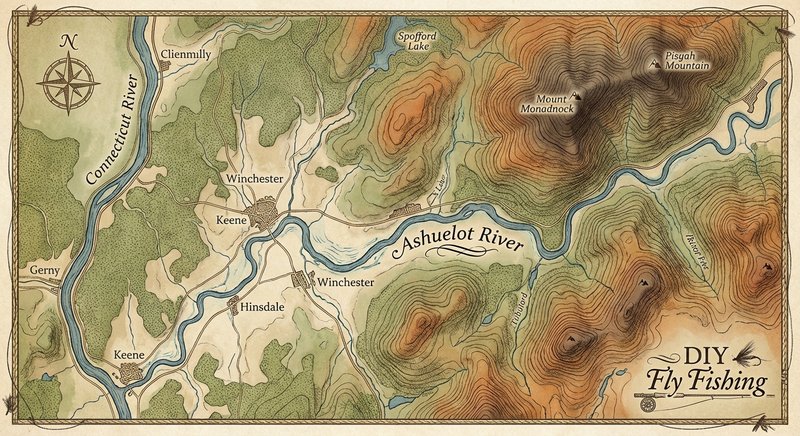
The Ashuelot River flows through southwestern New Hampshire, serving as a primary tributary to the Connecticut River. What makes it special is its diversity of habitat.
- The Upper River (Marlow to Gilsum): This is high-gradient water. It’s characterized by dramatic drops, deep plunge pools, and the famous "Gilsum Gorge." It feels like wild mountain fishing.
- The Middle River (Keene to Swanzey): The river slows down here, becoming more meadow-like with undercut banks and overhanging silver maples.
- The Lower River (Winchester to Hinsdale): The river regains its strength here, broadening out with large riffles and deep runs that hold some of the largest holdover fish in the system.
Anglers love the Ashuelot because it is heavily stocked by NH Fish & Game, yet it possesses enough structure and deep thermal refuge to allow for decent holdover populations of wary Brown Trout.
🐟 Target Species & Behavior
Rainbow Trout
Most Rainbows in the Ashuelot are stocked. They tend to congregate in the faster, highly oxygenated "white water" or at the heads of pools. They are opportunistic and often the first to rise to a dry fly during a hatch.
Brown Trout
The Ashuelot is famous for its Brown Trout. While many are stocked, the river has a reputation for "holdovers"—fish that survived previous seasons and grown large.
- Behavior: Browns are much more light-sensitive and cover-oriented. Look for them under "sweepers" (fallen trees), tucked deep into undercut banks, or behind the largest boulders in the Gilsum section.
- Feeding: They are notorious for feeding most aggressively during low-light periods (dawn/dusk) or immediately following a rain event when the water has a slight "tea" stain.
📅 Best Times to Fish
Spring (Late April – June)
The "Golden Era" on the Ash. As the spring runoff subsides, the water warms into the 50s, triggering massive insect activity.
- Prime Window: Mid-May through Father's Day.
- Conditions: Look for the Hendrickson hatch in late May—it is the highlight of the year.
Summer (July – August)
The Ashuelot is a "warm" trout stream. During heatwaves, the main stem can reach temperatures (70°F+) that are lethal to trout.
- Strategy: Fish the early morning (sunrise to 10:00 AM). Focus on the oxygenated pocket water in Gilsum or near the mouths of cold-water tributaries.
- Pro Tip: Always carry a thermometer. If the water is over 68°F, please head to the pub and give the fish a break.
Fall (September – October)
As water temperatures drop, the Brown Trout begin their pre-spawn aggression.
- Strategy: This is "Streamer Season." The fish are looking for high-protein meals to bulk up for winter.
🪰 Recommended Flies & Techniques
Nymphing (The Bread & Butter)
The Ashuelot has a high population of Stoneflies and Caddis.
- Patterns: Pat’s Rubber Legs (Size 8-12), Bead-head Pheasant Tail (Size 14-18), and Prince Nymphs.
- Technique: "High-sticking" or Euro-nymphing is incredibly effective in the boulder-strewn reaches of Gilsum. You need enough weight to get the fly into the "cushion" in front of the rocks.
Dry Flies (The Match-the-Hatch)
- Patterns: Light Cahill (Size 14), Elk Hair Caddis (Tan/Olive, Size 14-16), and the Parachute Adams. During late May, ensure you have Hendrickson patterns (Red Quill).
- Technique: Use a 9-foot 5X leader. Focus on the "seams" where fast and slow water meet.
Streamers (For the Big Browns)
- Patterns: Black or Olive Woolly Buggers, Mickey Finn (a classic NH fly), and the Kelly Galloup-style articulated streamers for the lower river.
- Technique: "Swing and Strip." Cast toward the opposite bank, let the current swing the fly into the soft water, and give it short, erratic twitches.
💡 Pro Tips & Local Knowledge
- The "Stone Arch Bridge" Area: Located on the Keene/Surry line, this area offers beautiful scenery and excellent holding water. It is a favorite for local guides.
- Stealth in the Meadows: In the Swanzey/Winchester meadow stretches, the fish can see you from a mile away. Stay low, wear drab clothing, and avoid "lining" the fish with your fly line.
- The "Hatchery Trick": Because the river is stocked, freshly released fish often respond to "attractor" patterns like San Juan Worms or Mop Flies for the first week or two after stocking.
- Wading Safety: The rocks in the Ashuelot (especially in Gilsum) are notorious for being "greased lightning." Studded wading boots and a wading staff are non-negotiable here.
⚠️ Important Information
- Access: Much of the river follows Route 10. Look for pull-offs with well-worn paths. In Winchester, access can be found along Route 119.
- Regulations: The Ashuelot is generally open to bait, lures, and flies, but always check the current NH Fish & Game Digest, as certain bridge pools or tributaries may have specific "Fly Fishing Only" or "Catch and Release" designations that change periodically.
- License: You must have a valid New Hampshire Freshwater Fishing License. You can purchase these online or at local shops like Sam’s Outdoor Outfitters in Keene.
- Respect Landowners: While much of the river is accessible, some banks are private property. Always look for "Posted" signs and stay within the high-water mark.
The Ashuelot is a resilient, beautiful river that rewards those who take the time to learn its moods. Tight lines!
Bug Hatches & Matching Flies
| Hatch | Type | Peak months | Time of day | Hook sizes | Matching flies |
|---|---|---|---|---|---|
| Blue-Winged Olive Baetis | mayfly | April, May, September, October | Afternoon | #18-22 | RS2 #18-22, Parachute Adams #18-22, Pheasant Tail #18-20 |
| Hendrickson Ephemerella subvaria | mayfly | May | Afternoon | #12-14 | Red Quill #12-14, Hendrickson Nymph #12-14, Snowshoe Emerger #14 |
| Grannom Caddis Brachycentrus | caddis | May | Morning/Afternoon | #14-16 | Peacock Caddis #14-16, Deep Sparkle Pupa #14-16, Elk Hair Caddis (Olive) #14-16 |
| March Brown Maccaffertium vicarium | mayfly | May, June | Afternoon | #10-12 | March Brown Dry #10-12, Hare's Ear Nymph #10-12, March Brown Wet #12 |
| Sulfur Dun Ephemerella invaria/dorothea | mayfly | June | Evening | #14-18 | Sulfur Parachute #14-18, Pheasant Tail (Flashback) #14-16, Sulfur Emerger #16-18 |
| Common Tan Caddis Hydropsyche | caddis | June, July, August | Evening | #14-18 | Elk Hair Caddis (Tan) #14-18, LaFontaine Pupa #16, Z-Wing Caddis #14-16 |
| Light Cahill Stenonema ithaca | mayfly | June, July | Evening | #12-14 | Light Cahill #12-14, Gold Ribbed Hare's Ear #12-14 |
| Golden Stonefly Acroneuria | stonefly | June, July | Morning/Evening | #8-12 | Pat's Rubber Legs #8-12, Golden Stimulator #10-12 |
| Black Ants & Beetles Formicidae/Coleoptera | terrestrial | July, August, September | All Day | #12-18 | Black Foam Ant #14-18, Cinnamon Ant #16, Fat Albert #12 |