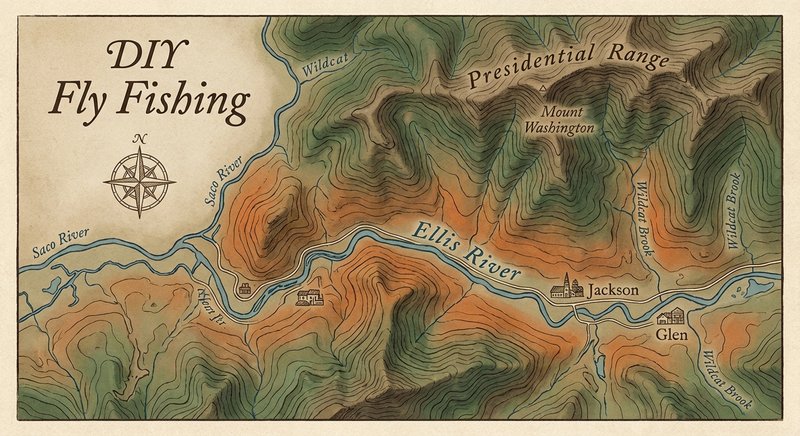
Ellis River
Fly fishing in New Hampshire · Beginner · Best seasons: Spring, Summer, Fall
Target Species
Brook Trout, Brown Trout
About This Water
Jackson area stream with brook trout. Scenic White Mountain village.
Fishing Recommendations
Welcome to the White Mountains. As your guide, I can tell you that the Ellis River is one of the crown jewels of New Hampshire fly fishing. It is a quintessential New England freestone stream, offering everything from tumbling mountain cascades to classic meadow runs.
Whether you are looking for wild brookies in the high country or hefty stocked browns near the village of Jackson, the Ellis delivers a premier mountain fishing experience.
🎣 Location Overview
The Ellis River begins high on the eastern slopes of Mount Washington. It flows south through Pinkham Notch, over the famous Glen Ellis Falls, and winds its way through the town of Jackson before joining the Saco River in Glen.
What makes the Ellis special is its diversity of water. The upper reaches are rugged, characterized by "pocket water" and deep plunge pools carved into granite. As it reaches the Jackson area, the gradient mellows, providing beautiful riffles and deeper pools. The water is exceptionally clear, cold, and well-oxygenated, making it a perfect sanctuary for salmonids even during the heat of summer.
🐟 Target Species & Behavior
The Ellis is primarily managed as a put-and-take fishery by NH Fish and Game, but it also holds a resilient population of wild fish.
- Brook Trout: In the upper sections (above Glen Ellis Falls), you will find smaller, vibrant wild brookies. In the lower sections, the state stocks high numbers of larger brook trout. They are opportunistic feeders, often holding in the "cushion" in front of rocks or in the bubbly "tail-outs" of pools.
- Brown Trout: These are the prizes of the lower Ellis. Stocked browns can be found throughout the Jackson stretch. They are more wary than the brookies and tend to hold in deeper undercut banks, under overhanging brush, or at the very bottom of deep holes during the bright sun.
- Behavior: Because this is a freestone stream, these fish are keyed into the current. They won't move far for a fly in fast water, so your drift must be precise.
📅 Best Times to Fish
- Spring (May – June): This is prime time. Once the snowmelt (freshet) subsides and the water hits 50°F, the fish become highly active. Late May brings the first major hatches.
- Summer (July – August): Unlike many other rivers, the Ellis stays fishable in summer due to its high-altitude headwaters. Focus on the early morning (6:00 AM – 10:00 AM) or the "magic hour" before dusk. Look for oxygenated "white water" areas.
- Fall (September – October): My personal favorite. The brook trout take on spectacular spawning colors, and the brown trout become aggressive. The foliage backdrop is world-class, but the water can be low, requiring a stealthy approach.
🪰 Recommended Flies & Techniques
Top Fly Patterns
- Dry Flies:
- Royal Wulff or Ausable Wulff (Size 12-16): High buoyancy for rough water.
- Elk Hair Caddis (Size 14-18): A staple for the evening rise.
- Stimulators (Orange or Yellow, Size 10-14): Great for "searching" the water.
- Nymphs:
- Bead-Head Pheasant Tail (Size 14-18): Mimics almost anything.
- Prince Nymph (Size 12-16): The flash works well in the dark granite pools.
- Pat’s Rubber Legs (Size 8-12): Effective in high water or deep pools.
- Streamers:
- Black or Olive Woolly Bugger (Size 8-12): Swing these through the deep pools for larger browns.
Effective Techniques
- Dry-Dropper: This is the "bread and butter" on the Ellis. Use a high-vis dry fly (like a Stimulator) with a weighted nymph 18–24 inches below it. This covers two levels of the water column in pocket water.
- Short-Line Nymphing: In the rocky cascades, long casts are your enemy. Keep a short line, high-stick your rod, and keep as much fly line off the water as possible to avoid drag.
- The "Swing": At the tail-end of a run, let your nymph or small streamer swing across the current. The strike often happens just as the fly begins to rise toward the surface.
💡 Pro Tips & Local Knowledge
- Focus on Jackson Falls: Just above the village, the river drops over a series of ledges. Many anglers overlook the small pockets between the drops. There is often a hungry trout in a pocket no bigger than a bathtub.
- The "Covered Bridge" Pool: In the center of Jackson, there is a famous covered bridge. The pool below it is deep and holds some of the largest fish in the river, but they are "educated." Fish this spot with 6X tippet and very small nymphs.
- Watch Your Shadow: The Ellis is incredibly clear. If you stand on a high rock overlooking a pool, the fish will see you before you see them. Stay low and wade slowly.
- The "Upper" Secret: If the lower river is crowded, head north of Jackson toward Pinkham Notch. The fish are smaller, but the pressure is non-existent, and the scenery is spectacular.
⚠️ Important Information
- Access: Much of the Ellis runs along Route 16, making access easy. There are numerous pull-offs between Jackson and Pinkham Notch. In Jackson village, please be respectful of private property and use designated public access points.
- Regulations: NH Fish and Game regulations apply. While much of the river is open to general rules, always check the NH Freshwater Fishing Digest for current length limits and "Lures Only" or "Fly Fishing Only" designations, as these can change by season or specific stretch.
- Safety: The rocks in the Ellis are notoriously slippery (slick granite). Wading boots with felt soles or metal studs are highly recommended. A wading staff is also a smart move in the faster sections.
- Licensing: A valid New Hampshire freshwater fishing license is required for anyone 16 or older. You can buy these online or at local shops like Ragged Mountain Equipment nearby.
Tight lines, and enjoy one of the finest trout streams in the Granite State!
Bug Hatches & Matching Flies
| Hatch | Type | Peak months | Time of day | Hook sizes | Matching flies |
|---|---|---|---|---|---|
| Early Brown Stonefly Strophopteryx fasciata | stonefly | April, May | Midday | #12-16 | Early Brown Stone Dry #14-16, Pats Rubber Legs (Brown/Black) #12-14 |
| Hendrickson Ephemerella subvaria | mayfly | May | Afternoon | #12-14 | Red Quill #12-14, Hendrickson Emerger #14, Pheasant Tail #12-14 |
| Grannom Caddis Brachycentrus | caddis | May | All Day | #14-16 | Elk Hair Caddis (Olive) #14-16, Holy Grail #14-16 |
| March Brown Maccaffertium vicarium | mayfly | June | Afternoon | #10-12 | March Brown American #10-12, Hare's Ear Nymph #10-12 |
| Light Cahill Stenacron canadense | mayfly | June, July | Evening | #14-16 | Light Cahill #14-16, Gold Ribbed Hare's Ear #14-16 |
| Giant Black Stonefly Pteronarcys dorsata | stonefly | June | Night/Evening | #4-8 | Black Stimulator #8-10, Kaufmann's Stone (Black) #6-8 |
| Eastern Green Drake Ephemera guttulata | mayfly | June | Evening | #8-12 | Green Drake Paradox #10, Coffin Fly #8-10 |
| Blue Winged Olive Baetis | mayfly | May, September, October | Afternoon | #18-22 | BWO Sparkle Dun #18-20, RS2 (Grey/Olive) #20-22 |
| Ants and Beetles Formicidae / Coleoptera | terrestrial | July, August, September | All Day | #12-18 | Black Foam Ant #16-18, Crowe Beetle #14-16 |