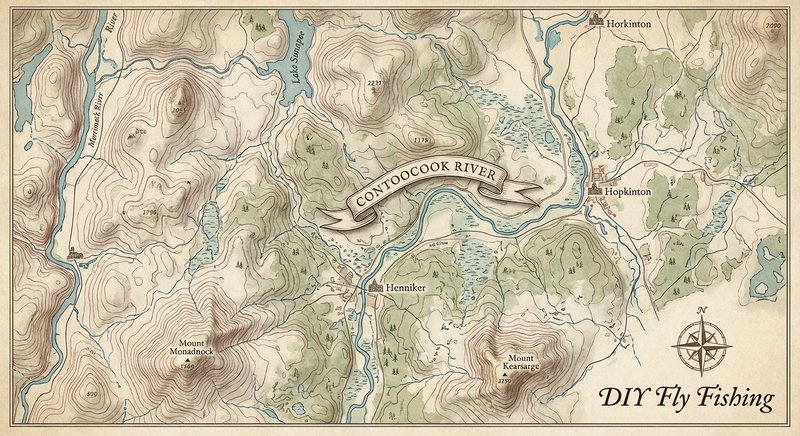
Contoocook River
Fly fishing in New Hampshire · Beginner · Best seasons: Spring, Summer, Fall
Target Species
Brown Trout, Smallmouth Bass
About This Water
Merrimack County stream with trout and bass. Good float fishing.
Fishing Recommendations
The Contoocook River is one of New Hampshire’s most unique and cherished waterways. Known colloquially as "The Cook," it is one of the few rivers in the United States that flows almost due north. It offers a "Jekyll and Hyde" personality that fly anglers love: technical, cold-water trout fishing in the upper reaches and world-class, aggressive smallmouth bass action in the middle and lower sections.
🎣 Location Overview
The Contoocook winds through the southwestern part of the state, stretching from the Monadnock region toward the Merrimack River in Penacook. It is characterized by its diversity of water—ranging from slow, meandering "meadow" sections and deep, dark pools to Class III-IV whitewater rapids near Henniker.
What makes it special is the freestone-meets-tailwater nature. Because of several dams (like the ones in Hillsborough and Henniker), the river maintains decent flows even in drier months. The tea-colored water (tannic) provides excellent cover for fish, making for exciting "visual" takes even if the water isn't crystal clear.
🐟 Target Species & Behavior
Brown Trout
The Contoocook is heavily stocked with Brown Trout, with a decent population of holdovers that grow quite large due to the abundant forage.
- Behavior: They are notorious "bank huggers." In the faster sections near Henniker, they hold in the "cushion" in front of large boulders or in the deep undercut banks.
- Feeding: They focus on heavy caddis hatches in the spring and shift to large streamers (mimicking sculpins and dace) as they get bigger and more territorial.
Smallmouth Bass
Pound-for-pound, the Contoocook smallmouths are some of the hardest-fighting fish in New England.
- Behavior: During the heat of summer, they move into the "white water" or fast riffles to find oxygen. In the spring and fall, they move to the edges of the slower, deeper pools.
- Feeding: Their diet is dominated by crayfish and hellgrammites. If you aren't bouncing the bottom with something leggy, you’re missing fish.
📅 Best Times to Fish
- Spring (May – June): This is the Prime Trout Window. The Hendrickson hatch in May is legendary here. Water levels are high, so heavy sinking tips or weighted nymphs are often required.
- Summer (July – August): This is Smallmouth Heaven. As trout water warms (often exceeding 70°F, at which point you should stop targeting trout), the smallmouth activity hits its peak. Morning and evening topwater action is spectacular.
- Fall (September – October): The "Second Season." As water temperatures drop, Brown Trout become aggressive again before the spawn. Smallmouths begin to school up in deeper holes to gorge themselves before winter.
Best Times of Day:
- Trout: Low light (dawn/dusk) is essential due to the tannic water; Browns feel safer moving out of cover then.
- Bass: Mid-day is fine for subsurface, but the last two hours of light provide the best topwater dry-fly action.
🪰 Recommended Flies & Techniques
For Brown Trout
- Dry Flies: Elk Hair Caddis (Size 12-16), Light Cahill (Size 14), and Stimulators.
- Nymphs: Prince Nymphs, Pheasant Tails, and Pats Rubber Legs (Size 8-10) to mimic the large golden stones found in the riffles.
- Streamers: Black or Olive Woolly Buggers, and the Black Ghost (a classic New England pattern).
For Smallmouth Bass
- Topwater: Hard-body Poppers, Murdich Minnows, or foam "Gurgler" patterns in white or chartreuse.
- Subsurface: Hellgrammite patterns (heavy and black), Clouser Minnows (Red/White or Chartreuse/White), and Crayfish patterns with weighted claws.
Techniques
- The "Contoocook Swing": In the faster water near Henniker, swinging wet flies or small streamers at a 45-degree angle downstream is highly effective for both species.
- Tight-Line Nymphing: Because the river is rocky, traditional indicator nymphing can result in constant snags. A "Euro-style" or tight-line approach allows you to feel the soft take of a trout among the stones.
💡 Pro Tips & Local Knowledge
- Focus on Henniker/Hillsborough: The stretch from the dam in Hillsborough down through the center of Henniker (near New England College) is the "Holy Water." It has the best oxygenation and the most diverse structure.
- The "Reverse" Flow: Remember the river flows North. This confuses many visiting anglers when looking at maps. "Upstream" is South!
- Wade with Caution: The Contoocook is notorious for "bowling ball" rocks. They are slippery and round. Studded wading boots and a wading staff are not optional here—they are safety requirements.
- The "Bridge Trick": Many of the old stone bridge abutments create massive eddies. Smallmouths love to sit right in the seam where the fast water meets the stagnant water behind the pier.
⚠️ Important Information
- Access:
- Henniker: Excellent access behind New England College and along Route 114.
- Hillsborough: Access off Route 202 near the bridge and downstream of the hydro dams.
- Hopkinton/Contoocook Village: Good access for smallmouth bass near the Trestle Bridge.
- Regulations: Always check the NH Fish & Game Freshwater Digest. Sections of the river have different rules regarding "Fly Fishing Only" or "Catch and Release" seasons.
- Dam Releases: The Contoocook is a working river. Keep an eye on the USGS Gauge for Henniker. If the flow is above 1,000 cfs, wading becomes dangerous in the canyon sections.
- Water Temps: In July and August, bring a thermometer. If the water is over 68°F, please leave the trout alone and focus on the smallmouths to ensure the trout survive the summer.
Tight lines on "The Cook!" It’s a rugged, beautiful river that rewards the observant angler.
Bug Hatches & Matching Flies
| Hatch | Type | Peak months | Time of day | Hook sizes | Matching flies |
|---|---|---|---|---|---|
| Hendrickson Ephemerella subvaria | mayfly | April, May | Afternoon | #12-14 | Red Quill #12-14, Hendrickson Emerger #12-14, Pheasant Tail #12-14 |
| Blue-Winged Olive Baetis | mayfly | April, May, September, October | Late Morning/Afternoon | #18-22 | BWO Sparkle Dun #18-22, RS2 #20-22, Cdc BWO #18-20 |
| Grannom Caddis Brachycentrus | caddis | May | Morning/Evening | #14-16 | Elk Hair Caddis (Olive) #14-16, Pupa (Green) #14-16, Peacock Caddis #14-16 |
| Sulphur Ephemerella invaria/dorothea | mayfly | June, July | Evening | #14-18 | Sulphur Parachute #14-18, Sulphur Snowshoe Emerger #16-18, Pheasant Tail #14-18 |
| March Brown Maccaffertium vicarium | mayfly | May, June | Afternoon | #10-12 | March Brown Dry #10-12, Gold Ribbed Hare's Ear #10-12, March Brown Spun Dun #10-12 |
| Isonychia (Slate Drake) Isonychia bicolor | mayfly | June, July, August, September | Late Afternoon/Evening | #10-12 | Iso Parachute #10-12, Isonychia Nymph #10-12, Zug Bug #10-12 |
| Light Cahill Stenacron interpunctatum | mayfly | June, July, August | Evening | #14-16 | Light Cahill #14-16, Cahill Emerger #14-16 |
| Golden Stonefly Acroneuria | stonefly | June, July | Evening/Night | #6-10 | Golden Stone Nymph #8-10, Stimulator (Yellow) #8-12, Pat's Rubber Legs #6-10 |
| October Caddis Pycnopsyche | caddis | September, October | All Day/Evening | #8-12 | Orange Stimulator #8-12, October Caddis Pupa #10-12 |
| Terrestrials Formicidae/Coleoptera | terrestrial | July, August, September | All Day | #12-18 | Black Foam Ant #14-18, Flying Ant #16-18, Cricket/Hopper #10-12 |