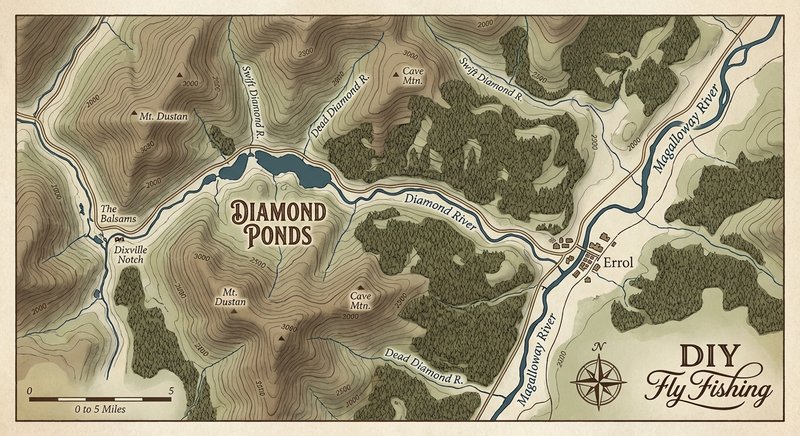
Diamond Ponds
Fly fishing in New Hampshire · Intermediate · Best seasons: Summer, Fall
Target Species
Brook Trout
About This Water
Coos County ponds with brook trout. Remote wilderness fishing.
Fishing Recommendations
Welcome to the "North of the Notches." As a guide in the Great North Woods of New Hampshire, I can tell you that the Diamond Ponds (Big and Little Diamond) represent some of the finest stillwater brook trout opportunities in the state. Located in Stewartstown, these ponds offer a classic New England experience: crisp mountain air, the call of loons, and wild-looking brookies.
Here is your comprehensive guide to fly fishing the Diamond Ponds.
🎣 Location Overview
The Diamond Ponds consist of Big Diamond Pond (approx. 165 acres) and Little Diamond Pond (approx. 18 acres). They are high-elevation glacial ponds that stay significantly cooler than waters to the south.
- Big Diamond is deep (max depth around 100+ feet) and holds both trophy-sized brook trout and a population of lake trout. It is known for its clarity and rocky shoreline.
- Little Diamond is much shallower, more fertile, and behaves like a classic "mountain pond." It is heavily stocked but also holds holdover fish.
- Why Anglers Love It: This is "remote" fishing with relatively easy access. It offers the chance to catch brook trout in their most vibrant spawning colors against the backdrop of NH’s fall foliage.
🐟 Target Species & Behavior
Species: Primary focus is Brook Trout. Big Diamond also contains Lake Trout, but they generally require deep-sinking lines and different tactics.
- Summer Behavior: As surface temps rise, brookies retreat to "spring holes" or the thermocline (usually 15–25 feet down in Big Diamond). In Little Diamond, they congregate near the deepest holes and coldest inlets.
- Fall Behavior: This is the magic window. Brook trout become aggressive as they prepare to spawn. They move from the depths into the shallows, patrolling the rocky shorelines and the areas near the inlets/outlets.
- Feeding: Their diet consists of smelt (in Big Diamond), leeches, dragonfly nymphs, and a variety of aquatic insects including the famous Hexagenia (large yellow mayflies) and caddis.
📅 Best Times to Fish
Summer (July – August)
- Windows: First light and the final 90 minutes of daylight.
- Conditions: Overcast, drizzly days are your best friend. On bluebird summer days, the fish will be deep and inactive by 9:00 AM.
- The Hex Hatch: Late June through mid-July is the "Hex" window. This happens at dusk and can bring the largest trout in the pond to the surface.
Fall (September – October)
- Windows: All day. As the water cools, the "mid-day lull" disappears.
- Conditions: High pressure, crisp mornings. September is arguably the best month of the year here.
- Prime Window: The last two weeks of September provide the best balance of aggressive fish and spectacular fall colors.
🪰 Recommended Flies & Techniques
Dry Flies (The Surface Game)
- Hexagenia Variants (Size 6-8): Essential for July evenings.
- Elk Hair Caddis (Size 12-16): Tan or olive. Great for "skittering" across the surface in the evening.
- Hornberg (Size 10-12): A New Hampshire classic. Fish it as a dry, then let it sink and strip it back like a streamer.
- Royal Wulff (Size 12-14): A great high-visibility attractor for the choppy waters of Big Diamond.
Nymphs & Sub-surface
- Pheasant Tail (Size 14-18): Best fished under an indicator near the weed edges of Little Diamond.
- Dragonfly/Damselfly Nymphs (Size 8-10): Large, olive, and leggy. Retrieve with short, erratic strips.
- Zebra Midge (Size 18-22): When the water is glassy and fish are "sipping," a tiny midge 12 inches under a dry fly is deadly.
Streamers (The Big Fish Strategy)
- Grey Ghost or Mickey Finn (Size 6-10): Classic New England bucktails that mimic the smelt in Big Diamond.
- Woolly Bugger (Size 8-12): Black, Olive, or "Autumn Splendor" (orange/brown) for the fall season.
- Soft Hackles: Swinging a Partridge and Orange in the surface film during a hatch can be more effective than a dry fly.
💡 Pro Tips & Local Knowledge
- Find the Springs: In Big Diamond, the water is deep. If you are fishing in the heat of summer, look for "cold water plumes" where small trickles enter the pond. Fish will stack up there like cordwood to breathe.
- The "Little" Advantage: Don't overlook Little Diamond. While Big Diamond gets the glory, Little Diamond is easier to "read." Focus on the edge of the lily pads and the deeper trough near the center.
- Wind is your Friend: A light "chop" on the water breaks up the fish’s window of vision, making them less spooky. If it’s dead calm, you’ll need 12-foot leaders and 6x tippet.
- The "Slow Roll": When fishing streamers from a boat or float tube, use a counting method (let it sink for 10, 15, or 20 seconds) until you find the depth where the fish are holding.
⚠️ Important Information
- Access: There is a public boat launch on the southern end of Big Diamond Pond (Diamond Pond Rd). Little Diamond has access near the Coleman State Park area.
- Boating: A canoe, kayak, or float tube is highly recommended. You can fish from shore near the bridges and access points, but 90% of the best water requires being on the pond.
- Regulations: Always check the NH Fish & Game Freshwater Digest. Generally, these ponds are open to "Open Water Fishing," but certain tributaries may have different rules. As of the current season, Big Diamond has a two-fish limit for trout, but Catch and Release is strongly encouraged to preserve the trophy fishery.
- Gear: A 9-foot 5-weight rod is the versatile choice. Bring a floating line for Little Diamond and a sink-tip line (Type 3 or 6) for Big Diamond to get streamers down to the trout.
Guide’s Final Word: Bring a camera. A Diamond Pond brook trout in October is one of the most beautiful creatures in nature—deep orange bellies, bright white fin edges, and halos of blue and red. Tight lines!
Bug Hatches & Matching Flies
| Hatch | Type | Peak months | Time of day | Hook sizes | Matching flies |
|---|---|---|---|---|---|
| Chironomids Family Chironomidae | midge | May, June, September | All Day | #18-24 | Zebra Midge #18-22, Griffith's Gnat #20-22, Ice Bud #18-20 |
| Hendrickson Ephemerella subvaria | mayfly | May, June | Afternoon | #12-14 | Red Quill #12-14, Hendrickson Nymph #12-14, Pheasant Tail #14 |
| Speckled Mayfly Callibaetis | mayfly | June, July, August | Morning | #14-16 | Callibaetis Spinner #14-16, Hare's Ear Nymph #14-16, Parachute Adams #14-18 |
| Giant Hex Hexagenia limbata | mayfly | June, July | Dusk/Evening | #6-10 | Hexagenia Dry #6-8, Hex Nymph #6-10, Wiggle Hex #8 |
| Cinnamon Caddis Family Hydropsychidae | caddis | June, July, August | Evening | #14-18 | Elk Hair Caddis (Cinnamon) #14-16, LaFontaine's Deep Sparkle Pupa #16, X-Caddis #14-18 |
| Blue-Winged Olive Baetis | mayfly | May, September, October | Afternoon | #18-22 | BWO Sparkle Dun #18-22, RS2 #20-22, Micro Mayfly Nymph #18-20 |
| Carpenter Ant Camponotus | terrestrial | July, August | Afternoon | #12-16 | Black Foam Ant #12-16, Chernobyl Ant #12-14, Fur Ant #14-16 |
| White Mayfly Ephoron leukon | mayfly | August | Evening/Night | #12-14 | White Wulff #12-14, Ephoron Dun #14 |