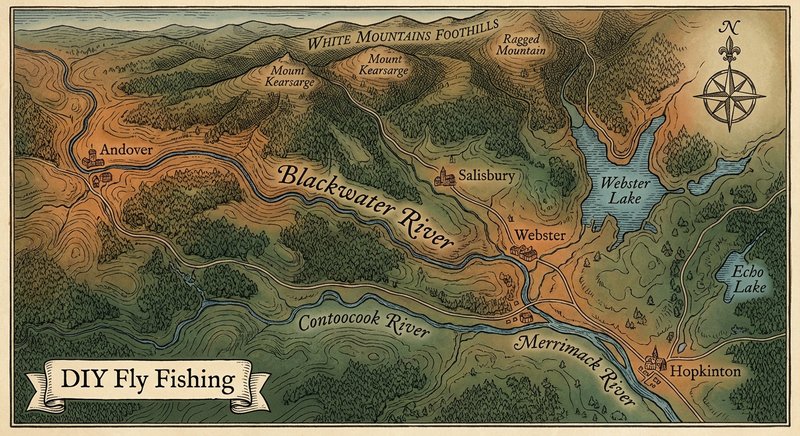
Blackwater River
Fly fishing in New Hampshire · Beginner · Best seasons: Spring, Summer, Fall
Target Species
Brown Trout, Brook Trout
About This Water
Merrimack County stream with trout. Flows through historic Salisbury.
Fishing Recommendations
The Blackwater River is one of New Hampshire’s most underrated gems. While many anglers rush past it on their way to the larger Connecticut or Pemigewasset Rivers, those in the know find a classic New England freestone experience characterized by tannic-stained "black" water, diverse bug life, and a mix of technical and approachable water.
🎣 Location Overview
Located in Merrimack County, the Blackwater River winds through the towns of Wilmot, Andover, Salisbury, and Webster. It is a quintessential New England river—alternating between tumbling pocket water, long glassy glides, and deep, mysterious pools.
What makes the Blackwater special is its Fly Fishing Only (FFO) section and its status as a highly managed trout fishery. The river gets its name from the high tannin content leached from the surrounding forests and wetlands, which gives the water a dark, tea-like color. This provides excellent cover for trout but requires anglers to adjust their fly visibility strategies. It offers a sense of solitude that is hard to find so close to Concord and Manchester.
🐟 Target Species & Behavior
The Blackwater is primarily a Brown Trout and Brook Trout fishery.
- Brown Trout: These are the kings of the Blackwater. While many are stocked, the river has enough deep woody debris and undercut banks to allow some fish to hold over and grow to impressive sizes (16"+). They are notoriously "moody" here; they tend to hold tight to cover during the day and move into the riffles to feed during low-light hours.
- Brook Trout: You will find "stockie" brookies in the main stems, but the headwaters and the mouths of small tributaries hold wild, native brook trout. They are opportunistic feeders but remain very spooky in the clear, shallow upper reaches.
- Behavior: Due to the dark water, trout here often rely more on vibration and silhouette. They hold in "classic" spots: the bubble lines at the head of pools, the soft water behind large boulders, and the deep undercuts beneath overhanging hemlocks.
📅 Best Times to Fish
- Spring (Late April – June): This is the prime window. Once the spring runoff subsides in mid-May, the insect activity explodes. The Hendrickson hatch in May is legendary here.
- Summer (July – August): The Blackwater is sensitive to heat. During dry years, the water can get too warm for ethical fishing. Focus on the early morning (sunrise to 10 AM) or late evening. Look for "thermal refuges" where colder tributaries enter the main stem.
- Fall (September – October): A fantastic time to be on the water. The Brown trout become aggressive and territorial as they prepare for the spawn. The foliage makes this one of the most beautiful places in New Hampshire to cast a fly.
🪰 Recommended Flies & Techniques
Dry Flies
- Hendrickson (Light & Dark): Essential for May.
- Elk Hair Caddis (Sizes 14-18): Tan and Olive versions. The Blackwater has heavy caddis activity throughout the summer.
- Royal Wulff or Stimulator: Great for "searching" the pocket water; these high-visibility flies are easier to track in the dark water.
- Terrestrials: In late summer, Black Ants and Foam Beetles are deadly along the bushy banks.
Nymphs
- Pheasant Tail & Hare’s Ear (Sizes 14-18): The gold standard for New England.
- Pat’s Rubber Legs: Especially effective in the spring when stoneflies are moving.
- Zebra Midges: Necessary for the slow, technical glides during the "dog days" of summer.
Streamers
- Woolly Bugger (Black or Olive): The dark water favors dark flies. A black bugger mimics the many leeches and crawfish in the system.
- Black Ghost: A traditional New Hampshire pattern that works wonders here.
- Muddler Minnow: Great for skittering across the surface or stripping deep.
Technique Tip: In the tannic water, use fluorocarbon leaders when nymphing to stay invisible, but don't be afraid to go slightly larger on your fly size (e.g., a size 12 instead of a 16) to help the fish find the fly in the "tea."
💡 Pro Tips & Local Knowledge
- Focus on the FFO Section: The section of the river in Salisbury/Webster along Route 127 is designated "Fly Fishing Only." This area holds fish longer and generally sees more consistent insect hatches.
- The "Blackwater Dam" Area: Below the dam in Webster, the water is oxygenated and often holds the largest fish, though it can be more difficult to wade.
- Stealth is Key: Because the river isn't massive, your shadow can easily spook fish in the glides. Keep a low profile and cast upstream.
- Swing the Riffles: Don't just dead-drift. Swinging a soft-hackle wet fly through the riffles at dusk is a local secret that often out-produces traditional dry fly tactics.
⚠️ Important Information
- Access: Much of the river is accessible via Route 4 and Route 127. Look for NH Fish & Game pull-offs. Respect private property signs, as some stretches flow through private woodlots.
- Regulations: Always check the current NH Fish and Game Saltwater & Freshwater Digest. Regulations (such as FFO or Catch and Release) can change at specific bridges or landmarks.
- Wading Safety: The Blackwater has a "slippery" bottom. The rocks are often covered in fine silt or algae. Felt soles (where legal) or studded boots and a wading staff are highly recommended.
- Temperature Check: If the water temperature hits 68°F (20°C), stop fishing for the sake of the trout's survival. These fish are a precious resource—handle them with care and keep them in the water!
Guide’s Final Word: The Blackwater River rewards the patient angler. It’s not about high numbers; it’s about the strategy of picking apart a beautiful, dark-water stream in the heart of the Granite State. Tight lines!
Bug Hatches & Matching Flies
| Hatch | Type | Peak months | Time of day | Hook sizes | Matching flies |
|---|---|---|---|---|---|
| Hendrickson Ephemerella subvaria | mayfly | April, May | Afternoon | #12-14 | Red Quill #12-14, Hendrickson Nymph #12-14, Snowshoe Rabbit Foot Emerger #14 |
| Blue Winged Olive Baetis | mayfly | April, May, September, October | Afternoon | #18-22 | RS2 #20-22, BWO Parachute #18-20, CDC Baetis Emerger #20 |
| Sulphur Ephemerella invaria/dorothea | mayfly | May, June, July | Evening | #14-18 | Sulphur Parachute #14-18, Pheasant Tail #16-18, Sulphur Spinner #16-18 |
| Grannom Caddis Brachycentrus | caddis | April, May | Late Morning/Afternoon | #14-16 | Peacock Caddis #14-16, Deep Sparkle Pupa #14-16, Elk Hair Caddis (Olive) #14-16 |
| Light Cahill Stenacron interpunctatum | mayfly | June, July, August | Evening | #12-16 | Light Cahill #12-14, Gold Ribbed Hare's Ear #14-16 |
| March Brown Maccaffertium vicarium | mayfly | May, June | Midday | #10-14 | March Brown American #10-12, March Brown Spun Dun #12 |
| Eastern Green Drake Ephemera guttulata | mayfly | June | Evening | #8-12 | Green Drake Hairwing #8-10, Coffin Fly #10-12, Green Drake Nymph #8-12 |
| Giant Stonefly Pteronarcys dorsata | stonefly | June, July | Night/Early Morning | #4-8 | Pats Rubber Legs #6-8, Stimulator (Orange/Black) #8-10 |
| Trico Tricorythodes | mayfly | August, September | Early Morning | #22-26 | Trico Spinner #22-24, Trico Sunray #22 |