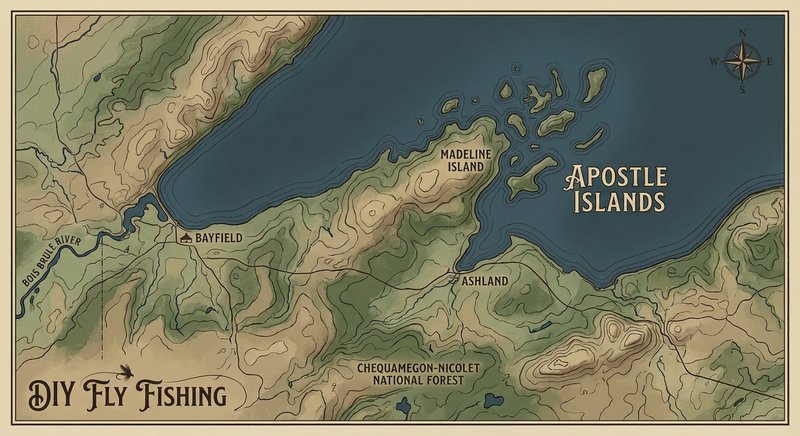
Apostle Islands
Fly fishing in Wisconsin · Advanced · Best seasons: Summer, Fall
Target Species
Lake Trout, Chinook Salmon, Brown Trout
About This Water
Lake Superior island archipelago with trout and salmon. Scenic wilderness fishing.
Fishing Recommendations
Welcome to the "Sixth Great Lake." As a guide in the Apostle Islands, I can tell you that this is one of the most majestic, albeit challenging, fly fishing frontiers in the lower 48. This is "big water" fishing—22 islands scattered across the cold, crystalline expanse of Lake Superior.
While many associate these waters with heavy trolling gear, a fly angler with the right knowledge and gear can have world-class encounters with "silver" and "lakers" in some of the most beautiful scenery on Earth.
🎣 Location Overview
The Apostle Islands National Lakeshore consists of 22 islands (21 of which are part of the park) and a 12-mile strip of mainland shoreline. The water here is oligotrophic—incredibly clear, cold, and nutrient-poor, which means fish are often on the move looking for food.
What makes this special is the geology. You are fishing over ancient sandstone ledges, underwater sea caves, and dramatic drop-offs where the water can plunge from 10 feet to 100 feet in a matter of yards. This is a wilderness experience; once you leave Bayfield or Madeline Island, you are entering a maritime environment that demands respect and rewards persistence.
🐟 Target Species & Behavior
Lake Trout (The Native Kings)
The Apostle Islands are a stronghold for wild Lake Trout. Unlike the sluggish "mud ducks" found in smaller lakes, these are powerful, lean predators.
- Behavior: They love the "thermocline" (the layer where water temperature changes rapidly). In summer, they are deep. In fall, they move onto rocky reefs and shoals (less than 20 feet deep) to spawn.
- Feed: Primarily Cisco (Lake Herring) and Rainbow Smelt.
Chinook Salmon (The Kings)
Known for their reel-screaming runs, Chinooks in Superior are "wilder" and leaner than those in Lake Michigan.
- Behavior: They are pelagic (open water) roamers. They follow baitfish schools relentlessly.
- Feed: Heavily dependent on Alewives and Smelt.
Brown Trout (The "Seiners")
Lake Superior Browns are often called "Seiners." They are massive, buttery, and often cruise the very edges of the rocky shorelines.
- Behavior: They are structure-oriented. You’ll find them patrolling the "whitewater" where waves crash against sandstone cliffs, looking for disoriented baitfish.
📅 Best Times to Fish
Summer (July – August)
- Conditions: The lake is most stable, but fish are deep.
- Fly Strategy: This is the most difficult time for fly anglers unless you have a boat equipped with sonar and heavy sinking lines (350-500 grain).
- Prime Window: First light. The fish move higher in the water column before the sun hits the water.
Fall (September – October) — GUIDE'S CHOICE
- Conditions: The "Magic Window." As water temperatures drop, Lake Trout move onto the shoals and Salmon begin staging near the mouths of tributaries (like the Cranberry or Sioux Rivers).
- Prime Window: Mid-September through October. Overcast, "fishy" days are better than bright bluebird skies. This is when the fish are in reach of a fly line in 5–15 feet of water.
🪰 Recommended Flies & Techniques
Gear Setup
- Rods: 8-weight to 10-weight fast-action rods. You need the backbone to fight the wind and the fish.
- Lines: You must carry a variety. A floating line is rarely used. Bring a Type 5 or Type 7 full-sinking line and a heavy 24-foot sink tip.
Top Fly Patterns
- Game Changers (4-6"): White/Pearl or Blue/White. These mimic the erratic swimming of a Cisco.
- Clouser Minnows: Chartreuse/White or Grey/White with heavy eyes to get deep fast.
- Flashabou Streamers: High-flash flies are essential in the clear water of Superior to draw fish from a distance.
- Egg Patterns/Glo-Bugs: For the fall season when Salmon are staging; fish these behind spawning beds (where legal).
Techniques
- The "Count Down": Cast toward a ledge, count to 20 or 30 seconds to let the sink-tip find the "zone," and use long, aggressive strips.
- The Shoal Strip: In the fall, find a reef (like Gull Island Shoal or Michigan Island Shoal). Position the boat in 20 feet of water and cast into 8 feet. Strip your fly down the "slope."
💡 Pro Tips & Local Knowledge
- Watch the Wind: On Lake Superior, the wind is your boss. A "Northeaster" can create 10-foot swells in hours. Always check the Nearshore Marine Forecast before heading out.
- Find the "Mud Line": After a rain or high wind, look for where the red clay silt from the mainland meets the clear lake water. Big Browns love to sit on the edge of that "cloud" and ambush baitfish.
- The Sea Cave Strategy: During the summer, cast large streamers right into the mouths of the sea caves on Devils Island or Sand Island. Large Browns often hide in the shadows of the caves to stay cool.
- Structure is Key: Look for "cribs" (old logging structures) or submerged rock piles. In water this clear, fish need overhead cover or deep water nearby.
⚠️ Important Information
Access
- Main Hub: Bayfield, WI is the primary jumping-off point.
- Boat Access: A seaworthy boat (18ft minimum, preferably larger) is highly recommended. Kayak fishing is popular near Sand and York Islands but requires extreme caution.
Regulations & Permits
- License: You need a Wisconsin Fishing License AND a Great Lakes Trout & Salmon Stamp.
- National Park Rules: If landing on the islands, be aware of National Lakeshore regulations regarding camping and fires.
- Refuges: Note that certain areas (like Gull Island Shoal) have seasonal closures to protect spawning Lake Trout. Always check the Wisconsin DNR Trout Regulations for the current year.
Safety
- Cold Water: Even in August, Lake Superior can be 45-50°F. Hypothermia is a year-round risk. Always wear a PFD.
- Communication: Cell service is spotty at best once you get past Basswood Island. A VHF marine radio is a safety essential.
Bug Hatches & Matching Flies
| Hatch | Type | Peak months | Time of day | Hook sizes | Matching flies |
|---|---|---|---|---|---|
| Little Black Stonefly Capniidae/Leuctridae | stonefly | March, April | Mid-day | #14-18 | Early Black Stone #16, Prince Nymph #14-18 |
| Blue Winged Olive Baetis spp. | mayfly | May, September, October | Overcast Afternoons | #18-22 | RS2 #20-22, Parachute Adams #18-22 |
| Hendrickson Ephemerella subvaria | mayfly | May | Afternoon | #12-14 | Hendrickson Sparkle Dun #12-14, Pheasant Tail Nymph #12-14 |
| Hexagenia Hexagenia limbata | mayfly | June, July | Dusk/Night | #4-8 | Hexagenia Spinner #6, Large Hex Nymph #4-8 |
| Grannom Caddis Brachycentrus | caddis | May | Morning/Afternoon | #14-16 | Elk Hair Caddis (Olive) #14-16, Deep Sparkle Pupa #14-16 |
| Terrestrials (Ants and Beetles) Formicidae/Coleoptera | terrestrial | July, August | All Day | #12-18 | Black Foam Ant #14-18, trout magnet beetle #12-16 |
| Giant Salmonfly Pteronarcys dorsata | stonefly | June | Evening | #4-8 | Chubby Chernobyl #6-8, Pats Rubber Legs #6-8 |
| White Mayfly Ephoron leukon | mayfly | August | Late Evening | #12-14 | White Wulff #12, Ephoron Spinner #14 |
| Midges Chironomidae | midge | April, May, September | Morning/Evening | #18-24 | Zebra Midge #18-22, Griffith's Gnat #20-24 |