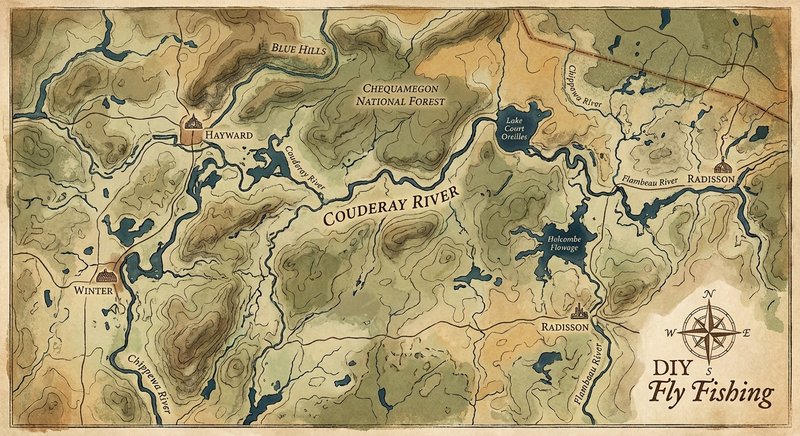
Couderay River
Fly fishing in Wisconsin · Intermediate · Best seasons: Summer, Fall
Target Species
Musky, Smallmouth Bass, Walleye
About This Water
Northern Wisconsin stream with musky and bass. Wilderness float fishing.
Fishing Recommendations
Welcome to the wild waters of Northwest Wisconsin. As your guide, I can tell you that the Couderay River is one of the state's best-kept secrets. Flowing out of the Lac Courte Oreilles chain and eventually joining the Chippewa River, the Couderay is a classic tea-colored, low-gradient Northern Wisconsin stream. It offers an intimate fly fishing experience that feels much smaller and more approachable than the big water of the nearby Chippewa or Flambeau.
Here is your comprehensive guide to tackling the Couderay.
🎣 Location Overview
The Couderay River is a gem of Sawyer County. It is characterized by its "tannic" (tea-colored) water, sandy to cobble bottoms, and heavy woody debris. Unlike the wide-open reaches of larger rivers, the Couderay is often tight and technical, flanked by dense silver maples, alders, and grassy banks.
What makes it special is the connectivity. Because it connects high-quality glacial lakes to the massive Chippewa River system, it acts as a corridor. You get "resident" fish, but you also get "transient" trophies moving through the system. It is a quiet river, perfect for a drift boat or a maneuverable raft, where the silence is only broken by the slap of a beaver’s tail or the explosive strike of a Musky.
🐟 Target Species & Behavior
Musky (The Apex)
The Couderay is prime "small water" Musky territory. These fish are ambush predators here. They hold tight to submerged logs, root balls, and the deeper outside bends.
- Behavior: They are moody. In this dark water, they rely heavily on their lateral lines. They aren’t just looking for a meal; they are looking for a vibration that shouldn't be there.
Smallmouth Bass
The "Bronzebacks" here are scrappy and plentiful. You’ll find them in the swifter riffles during the summer and moved back toward the deeper wood-filled holes as the water cools.
- Behavior: They love current breaks. Look for "seams" where fast water meets slow water. They feed heavily on crayfish and dace.
Walleye
While often thought of as a gear-fishing staple, the Couderay Walleye are highly susceptible to the fly, especially in low light.
- Behavior: They hug the bottom in the deepest holes during the day. In the evening, they move into the shallower tail-outs of pools to hunt minnows.
📅 Best Times to Fish
Summer (June – August)
- Smallmouth: This is peak Smallmouth season. Topwater action is electric during the humid evenings of July.
- Musky: Early morning and late evening are best to avoid the midday heat. Look for "Moon Rise/Moon Set" windows—Musky in this river are very lunar-sensitive.
Fall (September – November)
- The Prime Window: This is arguably the best time for Musky. As water temps drop into the 50s and 40s, the fish go into "bulk-up" mode.
- Walleye: Late fall (October) brings the Walleye into concentrated wintering holes, making them easier to target with sinking lines.
🪰 Recommended Flies & Techniques
For Musky
- Patterns: 8–12 inch articulated streamers. Game Changers in black/orange or firetiger are deadly in tannic water. Double Nickels or Bulkheads that push a lot of water are essential.
- Technique: The "Figure-8" at the end of every cast is non-negotiable. In the Couderay's narrow confines, a Musky will often follow the fly right to the boat.
For Smallmouth Bass
- Topwater: Murdoch’s Wiggle Minnow or a classic BoogleBug popper in yellow or black.
- Sub-surface: Clouser Minnows (Chartreuse/White) and Crawfish patterns (brown/orange) with lead eyes to get down to the wood.
For Walleye
- Patterns: Bunny Leeches in black, purple, or white.
- Technique: Use a Sink-Tip line (Type 3 or 5). You must keep the fly within 6 inches of the bottom. Use a "slow-strip, pause" retrieve to mimic a dying minnow.
💡 Pro Tips & Local Knowledge
- The "Wood" Rule: If you aren't losing a few flies to submerged logs, you aren't fishing where the fish are. The Couderay is a graveyard of fallen timber; the biggest fish live in the heart of the "nasty stuff."
- Color Palette: In the dark, tea-colored water, Black and Gold is the "local favorite" combination. It provides the best silhouette against the surface and the best flash in the depths.
- Stealth Matters: Because the river is relatively small, a heavy-handed approach will spook the pool. Keep the rowing to a minimum and use the current to drift into position quietly.
- The "Radisson" Stretch: The water around the town of Radisson down to the confluence with the Chippewa is legendary for producing larger-than-average Muskies.
⚠️ Important Information
- Access: There are public landings in the village of Couderay and near Radisson. Much of the riverbank is private or part of the Lac Courte Oreilles Reservation; stay in your boat/raft to avoid trespassing issues unless you are at a designated public bridge crossing.
- Regulations:
- Wisconsin fishing licenses are required.
- Musky: Check current size limits (usually 40" or 50" depending on the specific stretch/date), but fly anglers are strongly encouraged to practice 100% Catch and Release for Muskies to preserve the trophy fishery.
- Barbless Hooks: Highly recommended for easier releases, especially when handling toothy critters like Musky and Walleye.
- Safety: The Couderay has many "sleeper" logs just below the surface. If you are using a hard-side drift boat, go slow. A rubber raft (like a Smithfly or Stealthcraft) is the ideal craft for this river.
Final Guide's Note: Bring heavy wire bite tippet (30-40lb) even if you are targeting Smallmouth. In the Couderay, you never know when a 45-inch Musky will decide your bass popper looks like an appetizer. Tight lines!
Bug Hatches & Matching Flies
| Hatch | Type | Peak months | Time of day | Hook sizes | Matching flies |
|---|---|---|---|---|---|
| Blue-Winged Olive Baetis spp. | mayfly | April, May, September, October | Midday | #18-22 | RS2 #18-22, Parachute BWO #18-20, Pheasant Tail Nymph #18-22 |
| Hendrickson Ephemerella subvaria | mayfly | May | Afternoon | #12-14 | Hendrickson Dark #12-14, Red Quill #14, Gold Ribbed Hare's Ear #12-14 |
| Grannom Caddis Brachycentrus | caddis | May | Morning/Afternoon | #14-16 | Elk Hair Caddis (Olive) #14-16, LaFontaine's Deep Pupa #14-16, Holy Grail #14-16 |
| Sulfur Ephemerella invaria | mayfly | June | Evening | #14-18 | Sulfur Parachute #16-18, Sulfur Emerger #14-16, Pheasant Tail #16-18 |
| Giant Hex Hexagenia limbata | mayfly | June, July | Night | #4-8 | Hexagenia Spinner #6-8, Wiggle Hex Nymph #4-8, Paradrake Hex #6 |
| Light Cahill Stenacron interpunctatum | mayfly | June, July | Evening | #12-14 | Light Cahill #12-14, Cream Variant #14, Gold Ribbed Hare's Ear #12-14 |
| Slate Drake Isonychia bicolor | mayfly | August, September | Afternoon/Evening | #10-12 | Isonychia Nymph #10-12, Parachute Adams #12, Iso Emerger #12 |
| Trico Tricorythodes | mayfly | August, September | Morning | #20-24 | Trico Spinner #20-24, Trico Parachute #22, Zebra Midge #20-22 |
| Terrestrials Various | terrestrial | July, August, September | All Day | #8-16 | Fat Albert #8-12, Dave's Hopper #10-12, Black Foam Ant #14-16 |