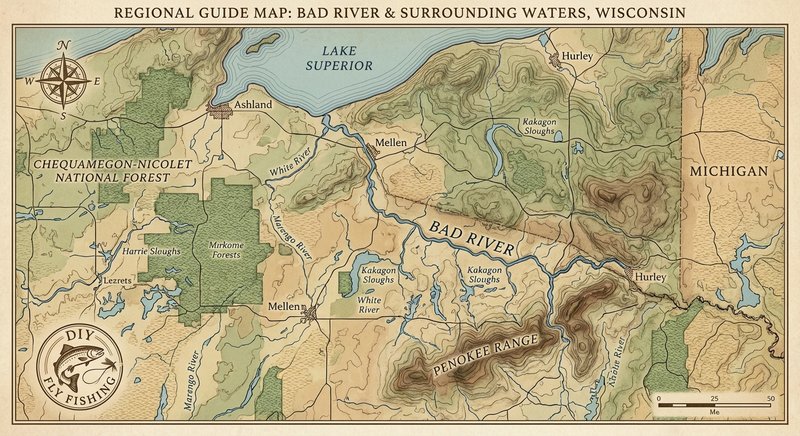
Bad River
Fly fishing in Wisconsin · Intermediate · Best seasons: Spring, Fall
Target Species
Steelhead, Brook Trout
About This Water
Lake Superior tributary with steelhead runs. Flows through Bad River Reservation.
Fishing Recommendations
The Bad River, located in the far northern reaches of Wisconsin and flowing into Lake Superior, is one of the most rugged and rewarding fly fishing destinations in the Great Lakes region. Flowing through the Bad River Indian Reservation and the Copper Falls State Park area, this river is defined by its dramatic drops, sandstone canyons, and wild character.
Here is your comprehensive guide to fly fishing the Bad River.
🎣 Location Overview
The Bad River is a "spate" river, meaning its flows are highly dependent on precipitation and snowmelt. It is famous for its dramatic scenery—most notably at Copper Falls, where the river drops through ancient volcanic rock.
What makes the Bad River special is its wildness. Unlike the more manicured rivers of the driftless area, the Bad is powerful and often stained with tannins (tea-colored) or sediment after rain. It offers a true "Steelhead alley" experience without the massive crowds found on the Salmon River in NY or the Brule in WI. The lower sections meander through deep forests and wetlands, while the upper sections offer pocket water and technical runs.
🐟 Target Species & Behavior
Steelhead (Adfluvial Rainbow Trout)
These are Lake Superior run fish. They are silver, powerful, and notoriously difficult to land.
- Behavior: They enter the river to spawn. Unlike Pacific Steelhead, Lake Superior fish are often smaller (averaging 5–8 lbs) but are incredibly hardy.
- Holding Water: Look for "seams" where fast water meets slow water, the tails of deep pools, and under-cut banks. In the Bad, they often hold behind large boulders that break the heavy current.
Brook Trout (Coaster and Resident)
The Bad River and its tributaries (like the Marengo and Tyler Forks) host beautiful resident Brookies, and occasionally "Coasters"—Brook trout that migrate to Lake Superior and return to the river to spawn.
- Behavior: Brookies are opportunistic. They hold in the cold, oxygenated "heads" of pools and near woody debris.
- Feeding: They focus on stoneflies, caddis, and small baitfish (sculpins).
📅 Best Times to Fish
Spring (Late March – May)
This is Steelhead Season.
- Conditions: Fishing begins as soon as the ice breaks. The "peak" usually occurs in mid-to-late April when water temperatures hit 42°F to 50°F.
- Note: The river can turn into chocolate milk during heavy snowmelt; timing your trip between rain events is critical.
Fall (September – November)
This is for Fall-run Steelhead and Spawning Brook Trout.
- Conditions: September brings the Brook Trout into their vibrant spawning colors. By October, the first "chromer" Steelhead begin to enter the river following Lake Superior's cooling temperatures.
- Prime Window: Late October is often the "magic hour" for big Steelhead.
🪰 Recommended Flies & Techniques
For Steelhead
- Technique: High-stick nymphing or "indicator" nymphing is most effective due to the river's depth and flow. Swinging flies with a Spey rod is popular in the lower, wider sections.
- Flies:
- Eggs: Glo-bugs, Bead-head Estaz Eggs (Orange, Chartreuse, Peach).
- Nymphs: Prince Nymphs (#8-12), Stonefly patterns (black or golden), and Hexagenia nymphs.
- Streamers: Egg-sucking Leeches (purple/black) and Wooly Buggers.
For Brook Trout
- Technique: Dry-drop rigs in the late spring/summer, or small streamers in the fall.
- Flies:
- Dries: Royal Wulff, Elk Hair Caddis, Stimulators (#12-16).
- Nymphs: Pheasant Tails, Hare’s Ears.
- Streamers: Muddler Minnows and small Black Ghosts.
💡 Pro Tips & Local Knowledge
- Read the Color: The Bad River is naturally tannic. If the water looks like "weak tea," fishing is excellent. If it looks like "creamy coffee," go to a smaller tributary or wait 48 hours; visibility is too low for the fish to see your fly.
- The "Copper Falls" Factor: While the state park is beautiful, the fishing is often better below the junction with the Tyler Forks. The water stabilizes slightly there.
- Heavy Lead: The currents here are deceptively strong. To get to the Steelhead "bucket," you often need more split-shot than you think. If you aren't bouncing off the bottom occasionally, you aren't fishing.
- Stealth for Brookies: The resident Brookies in the upper tributaries are spooky. Approach pools from downstream and keep a low profile.
⚠️ Important Information
Access and Tribal Lands
A significant portion of the Bad River flows through the Bad River Band of the Lake Superior Tribe of Chippewa Indians Reservation.
- Requirement: Fishing on Reservation lands requires a Tribal Fishing Permit. State of Wisconsin licenses are generally not sufficient on Tribal land.
- Respect: Always follow Tribal regulations, which can differ from state laws regarding seasons and bag limits.
Regulations & Safety
- Wading: The Bad River has a slippery, rocky bottom. Felt soles (where legal) or studded boots and a wading staff are mandatory for safety.
- Catch & Release: While some harvest is allowed under state/tribal law, the Lake Superior Steelhead population is a fragile resource. Most serious fly anglers practice 100% catch and release here.
- Communication: Cell service is spotty to non-existent in the canyons. Tell someone where you are going and when you expect to return.
Expert Guide Summary: The Bad River is not for the faint of heart. It requires hiking, navigating slippery rocks, and battling the elements. But for the angler who wants a wild Steelhead in a setting that feels like Alaska, there is no better place in Wisconsin.
Bug Hatches & Matching Flies
| Hatch | Type | Peak months | Time of day | Hook sizes | Matching flies |
|---|---|---|---|---|---|
| Blue Winged Olive Baetis spp. | mayfly | April, May, September, October | Midday | #18-22 | RS2 #18-22, BWO Sparkle Dun #18-20, Pheasant Tail #18-20 |
| Hendrickson Ephemerella subvaria | mayfly | May | Afternoon | #12-14 | Hendrickson Dark #12-14, Red Quill #12-14, Hendrickson Emerger #12-14 |
| American Grannom Brachycentrus | caddis | May | All day | #14-16 | Peacock Caddis #14-16, Deep Sparkle Pupa #14-16, Elk Hair Caddis (Olive) #14-16 |
| Giant Black Stonefly Pteronarcys dorsata | stonefly | May, June | Morning/Evening | #4-8 | Pat's Rubber Legs #4-8, Black Stimulator #6-8, Kaufmann's Stone #6-8 |
| Sulfur Ephemerella invaria | mayfly | June | Evening | #14-18 | Sulfur Dun #14-16, CDC Sulfur Emerger #16-18, Sulfur Spinner #14-18 |
| Light Cahill Stenacron canadense | mayfly | June, July | Evening | #12-14 | Light Cahill #12-14, Hare's Ear #12-14 |
| Hex Hexagenia limbata | mayfly | June, July | Late Night | #6-8 | Hexagenia Dun #6-8, Hex Spinner #6-8, Hex Nymph #6-10 |
| Spotted Sedge Hydropsyche | caddis | June, July, August | Evening | #14-16 | Elk Hair Caddis (Tan) #14-16, LaFontaine's Emergent Pupa #14-16, Hydropsyche Larva #14-16 |