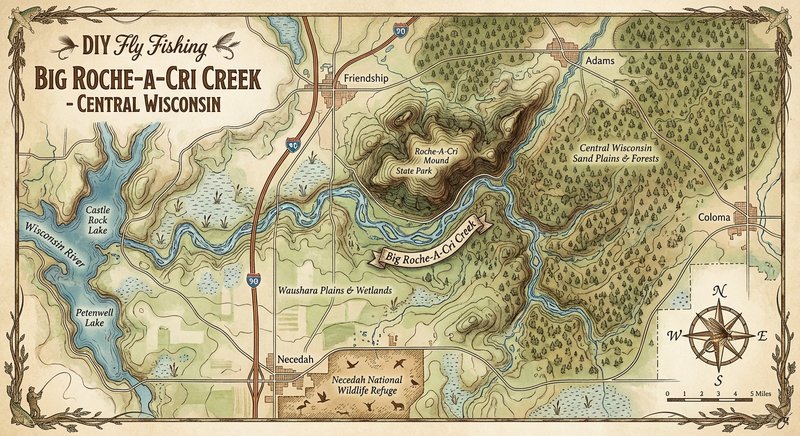
Big Roche-A-Cri Creek
Fly fishing in Wisconsin · Beginner · Best seasons: Spring, Summer, Fall
Target Species
Brook Trout, Brown Trout
About This Water
Central Wisconsin spring creek with wild brook trout. Scenic sand county stream.
Fishing Recommendations
Big Roche-A-Cri Creek is a hidden gem located in the "Central Sands" region of Wisconsin (Adams County). While many anglers flock to the Driftless Area to the west, the Roche-A-Cri offers a distinct, serene, and highly productive spring-fed experience. As a guide, I value this creek for its remarkably cold water temperatures and its ability to remain fishable even during the heat of mid-summer.
🎣 Location Overview
The Big Roche-A-Cri is a classic lowland spring creek. Unlike the rocky, limestone-based streams of the Driftless, this creek winds through glacial outwash sands and pine-oak barrens.
- Water Characteristics: The water is crystal clear and remains cold year-round thanks to heavy groundwater infiltration. The bottom is predominantly sand and gravel, with significant amounts of woody debris (log jams) and undercut banks.
- The Experience: This is "intimate" water. It is generally narrow (10–25 feet wide), requiring stealth and accurate casting rather than long-distance bombs. It feels wilder and more secluded than many other Wisconsin streams.
🐟 Target Species & Behavior
- Brook Trout: The native stars of the upper reaches. They are vibrant, aggressive, and highly opportunistic. They tend to hold in the swifter, colder headwaters and near overhead cover.
- Brown Trout: As you move downstream, the Browns become the dominant species. These fish are more cautious and "moody." They love the deep holes created by scouring around fallen timber.
- Feeding Habits: During the day, they are focused on subsurface nymphs and scuds. However, the creek has excellent hatch activity. Because the water is so clear, these fish are "line shy" and very sensitive to shadows on the water.
📅 Best Times to Fish
- Spring (April – May): This is the window for the first major hatches. Look for Blue-Winged Olives (BWO) on cloudy days and Hendricksons in late May.
- Summer (June – August): While other streams warm up, the Roche-A-Cri stays cool. This is the Trico window (tiny white/black mayflies). Expect world-class dry fly action in the early morning. Terrestrials (ants and beetles) are lethal in the afternoons.
- Fall (September – October): The Brookies are in their spawning colors and become very aggressive. This is the best time to throw larger streamers to trigger "territorial" strikes from big Browns moving up from the lower reaches.
- Prime Window: Early morning (at first light) is almost always the most productive time, especially during the Trico hatch.
🪰 Recommended Flies & Techniques
Dry Flies
- Tricos (#20-24): Essential for summer mornings.
- Elk Hair Caddis (#14-18): A great search pattern; the tan or olive versions work best here.
- Parachute Adams (#16-20): The gold standard for matching sporadic mayfly hatches.
- Terrestrials: Foam Beetles, Cinnamon Ants, and Dave’s Hoppers (#10-14) during the dog days of summer.
Nymphs & Scuds
- Pink Squirrel (#14-16): A Wisconsin legend. The flash triggers strikes in the sandy runs.
- Pheasant Tail Nymph (#16-20): Works year-round to mimic the natural mayfly larvae.
- Scuds (#14-18): In olive or gray. The creek is rich in crustaceans.
Streamers
- Woolly Bugger (#8-12): Olive or Black. Swing these deep under log jams.
- Muddler Minnow (#10): Excellent for imitating the small sculpins and dace found in the creek.
Techniques
- The Stealth Approach: Approach the bank slowly. If you can see the fish, they have likely already seen you. Wear earthy tones (camo/olive) to blend into the brush.
- Bow-and-Arrow Cast: Many spots are overgrown with alders. This cast is a required skill to get your fly under the "canopy."
- Short Leashes: When nymphing, use a small yarn indicator or "euro-style" sighter, as the water is rarely more than 3-4 feet deep.
💡 Pro Tips & Local Knowledge
- Focus on the Wood: In a sandy-bottomed creek, the "structure" is the wood. A single submerged log can hold five or six quality trout. Fish the "cushion" of water just in front of the log and the deep scour hole behind it.
- The "Cottonville" Stretch: The area around Cottonville Avenue and the Roche-A-Cri Fishery Area provides some of the best public access and diverse water types.
- Stay in the Water (Carefully): While wading is generally easy on the sand, be wary of "quick-sand" pockets or deep silt near the banks. Wading upsteam is mandatory to avoid sending a plume of sand/silt down to the fish you are trying to catch.
- Light Tackle: A 7.5-foot to 8.5-foot 3-weight or 4-weight rod is perfect. A 9-foot rod can be cumbersome in the brushy sections.
⚠️ Important Information
- Access: Much of the creek is protected by the Wisconsin DNR as a Fishery Area. Look for the classic yellow "Public Hunting/Fishing Grounds" signs. Always respect private property where easements are not present.
- Regulations: Big Roche-A-Cri is generally managed under Category 5 (Special Regulations) or Yellow/Red coded sections depending on the year.
- Always check the current Wisconsin Trout Regulations pamphlet, as size limits and bag limits (or catch-and-release requirements) can change between the upper and lower sections.
- Permits: A Wisconsin Inland Trout Stamp and a valid Fishing License are required.
- Conservation: This is a fragile ecosystem. Barbless hooks and quick releases are highly encouraged to preserve the wild Brook Trout population.
Guide’s Final Word: If you want a quiet day where you’re more likely to see a deer than another angler, Big Roche-A-Cri is your spot. Bring your "A-game" in terms of stealth, and the creek will reward you with some of the prettiest wild trout in the Midwest.
Bug Hatches & Matching Flies
| Hatch | Type | Peak months | Time of day | Hook sizes | Matching flies |
|---|---|---|---|---|---|
| Blue-Winged Olive (BWO) Baetis spp. | mayfly | April, May, September, October | Mid-day/Afternoon | #18-22 | RS2 #18-22, Parachute Adams #18-22, Pheasant Tail #18-20 |
| Hendrickson Ephemerella invaria | mayfly | May | Afternoon | #12-14 | Hendrickson Sparkle Dun #12-14, Red Quill #14, Gold Ribbed Hare's Ear #12-14 |
| Grannom Caddis Brachycentrus | caddis | April, May | Morning/Afternoon | #14-16 | Elk Hair Caddis (Olive) #14-16, Pupa-can #14-16, Peacock Caddis Larva #14-16 |
| Sulphur Ephemerella dorothea | mayfly | June | Evening | #16-18 | Sulphur Parachute #16-18, Sulphur Spinner #16-18, Sulphur Emerger #16-18 |
| Trico Tricorythodes | mayfly | July, August, September | Early Morning | #22-26 | Trico Spinner #22-26, Sunken Trico Spinner #22-24 |
| Light Cahill Stenacron interpunctatum | mayfly | June, July | Evening/Dusk | #12-14 | Light Cahill #12-14, Cream Variant #14 |
| White Miller Ephoron leukon | mayfly | August | Late Evening/Night | #12-14 | White Wulff #12, White Miller Paradox #14 |
| Terrestrials Formicidae / Orthoptera | terrestrial | July, August, September | Mid-day/Afternoon | #10-18 | Dave's Hopper #10-12, Cinnamon Ant #16-18, Black Foam Beetle #14-16 |