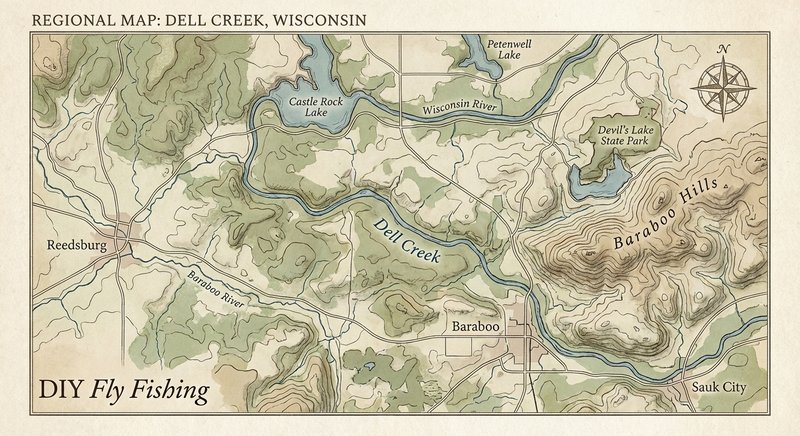
Dell Creek
Fly fishing in Wisconsin · Intermediate · Best seasons: Spring, Summer, Fall
Target Species
Brown Trout
About This Water
Central Wisconsin spring creek near Wisconsin Dells. Wild brown trout.
Fishing Recommendations
Welcome to the Driftless-adjacent waters of Sauk County. As your guide, I’m excited to break down Dell Creek, one of the most significant trout resources in central Wisconsin. While most anglers head further west into the heart of the Driftless Area, Dell Creek offers a unique, spring-fed experience just a stone's throw from the Wisconsin Dells.
🎣 Location Overview
Dell Creek is a classic southern Wisconsin spring stream that flows into Mirror Lake. It is classified as a Class I and Class II trout stream, depending on the reach. What makes it special is its resilience; despite being located in a high-traffic tourist region, the headwaters and middle sections remain remarkably cold and productive due to heavy groundwater influence.
The water characteristics vary from tight, brushy headwaters to meandering meadow sections with deep undercut banks. The substrate is a mix of gravel and sand, common for this part of the state where the terminal moraine of the last glacier meets the unglaciated Driftless region. Anglers love it because it offers a "technical" small-stream experience where stealth and accuracy are rewarded over long-distance casting.
🐟 Target Species & Behavior
The star of the show here is the Brown Trout.
- Behavior: These are primarily wild-spawned fish, supplemented by some historical stocking. They are notoriously spooky. Because the water is often crystal clear and the stream is relatively narrow (10–20 feet wide in most spots), these fish live and die by overhead cover.
- Holding Patterns: Look for them tucked tight under overhanging tag alders, beneath undercut banks, or at the tail-outs of deep pools during low light. In the faster "riffle" sections, they will hold in the depressions behind larger rocks or woody debris.
- Feeding: They are opportunistic but wary. They feed heavily on scuds and crane fly larvae year-round, with intense surface feeding during the May/June hatches. As they grow larger, they transition to a piscivorous diet, eating smaller trout and dace.
📅 Best Times to Fish
Optimal Seasons
- Spring (Late March – May): This is prime time. The water is cool, and the fish are hungry after winter. You'll see the first major hatches (Early Black Stoneflies and Blue Winged Olives).
- Summer (June – August): Excellent for terrestrial fishing (hoppers/ants). However, watch the water temperature. If it climbs above 68°F, give the fish a break. Early mornings are essential.
- Fall (September – October): Brown trout become aggressive as they prepare for the spawn. This is the best time to move a trophy fish with a streamer.
Best Times of Day
- Low Light Windows: The "Golden Hour" (dawn and dusk) is paramount on Dell Creek. Browns are light-sensitive; they feel much more comfortable feeding in the open when the sun is off the water.
- Cloudy Days: A light drizzle or overcast sky is a gift. It breaks the surface glare and masks your presence.
🪰 Recommended Flies & Techniques
Top Fly Patterns
- Dry Flies:
- Adams (Classic or Parachute): Size 16-20.
- Elk Hair Caddis: Size 14-18 (Tan or Olive).
- Hi-Vis Ants & Beetles: Size 14-16 (Crucial for summer).
- Nymphs:
- Gold-Ribbed Hare’s Ear: Size 14-16.
- Flashback Pheasant Tail: Size 16-18.
- Pink Squirrel: Size 14-16 (A Wisconsin Driftless staple—it works everywhere here).
- Scuds: Olive or Orange, size 14-18.
- Streamers:
- Woolly Bugger: Size 8-10 (Black or Olive).
- Muddler Minnow: Size 10 (Great for mimicking sculpins).
Techniques & Presentation
- The "Crouch and Cast": Because the banks are often elevated, you must stay low. If you can see the fish, they have likely already seen you.
- Dries: Use a long, fine leader (9ft 5X or 6X) to avoid lining the fish.
- Nymphing: European-style tight-line nymphing is difficult here due to overhanging brush. Stick to a small "New Zealand style" yarn indicator or a dry-dropper rig.
- The "Dapping" Method: In the brushiest headwaters, you may not be able to cast at all. Simply poke the rod tip through the brush and drop the fly onto the water.
💡 Pro Tips & Local Knowledge
- Focus on the State Natural Area: Look for the Dell Creek State Wildlife Area. This provides the best public access and has benefited from significant habitat restoration, including the installation of "LUNKER" structures (underwater wooden shelf hides for trout).
- Walk Upstream: Always fish upstream. The silt and sand on the bottom can kick up a cloud if you wade downstream, alerting every fish below you of your presence.
- The "Beaver Pond" Factor: Be wary of beaver activity. While beaver ponds can hold large fish initially, they often warm the water and silt up the gravel. Focus your efforts on the moving water sections above or well below these dams.
- Hidden Wood: Dell Creek has a lot of "down timber." Large browns love to sit right in the middle of a submerged log jam. If you’re brave enough to lose a fly, cast right into the woody tangles.
⚠️ Important Information
- Access: Much of the creek is surrounded by private land, but the Dell Creek Wildlife Area (off South Avenue and Coon Bluff Road) offers several miles of public access. Always look for WDNR "Public Fishing Area" signs.
- Regulations: Dell Creek is typically under Category Yellow or Green regulations, but Wisconsin trout regs change frequently. Always check the current Wisconsin DNR Trout Tool before heading out.
- Permits: You need a valid Wisconsin Fishing License AND an Inland Trout Stamp.
- Special Consideration: This area is sandy. Try to stay on the gravel runs to avoid stirring up silt, which can smother trout eggs in the redds during the late fall.
Guide’s Final Word: Dell Creek isn't about high numbers; it's about the quality of the hunt. Bring your 3-weight or 4-weight rod, a stealthy approach, and a pair of polarized sunglasses. Tight lines!
Bug Hatches & Matching Flies
| Hatch | Type | Peak months | Time of day | Hook sizes | Matching flies |
|---|---|---|---|---|---|
| Blue Winged Olive Baetis spp. | mayfly | April, May, September, October | Midday | #18-22 | RS2 #18-22, Parachute BWO #18-22, WD-40 #20 |
| Grannom Caddis Brachycentrus | caddis | April, May | Afternoon/Evening | #14-16 | Elk Hair Caddis (Olive) #14-16, LaFontaine's Deep Sparkle Pupa #14-16, Peacock Caddis #16 |
| Sulfur Ephemerella invaria | mayfly | May, June | Evening | #14-16 | Sulfur Parachute #14-16, Pheasant Tail Nymph #14-18, Sulfur Emerger #16 |
| Trico Tricorythodes | mayfly | July, August, September | Morning | #20-24 | Trico Spinner #20-24, Zebra Midge #20-22, Griffith's Gnat #20-22 |
| Light Cahill Stenacron interpunctatum | mayfly | June, July | Evening | #12-14 | Light Cahill #12-14, Gold Ribbed Hare's Ear #12-14 |
| Chironomids (Midges) Chironomidae | midge | March, April, October, November | Morning/Afternoon | #18-24 | Zebra Midge #18-22, Griffith's Gnat #20-24, Top Secret Midge #20-22 |
| Terrestrials (Ants and Beetles) Formicidae / Coleoptera | terrestrial | July, August, September | Midday | #12-18 | Black Foam Ant #14-18, Crowe Beetle #12-16, Joe's Hopper #10-14 |
| Crane Fly Tipulidae | terrestrial | August, September | Afternoon/Evening | #10-14 | Daddy Long Legs #10-12, Killer Bug #12-14 |