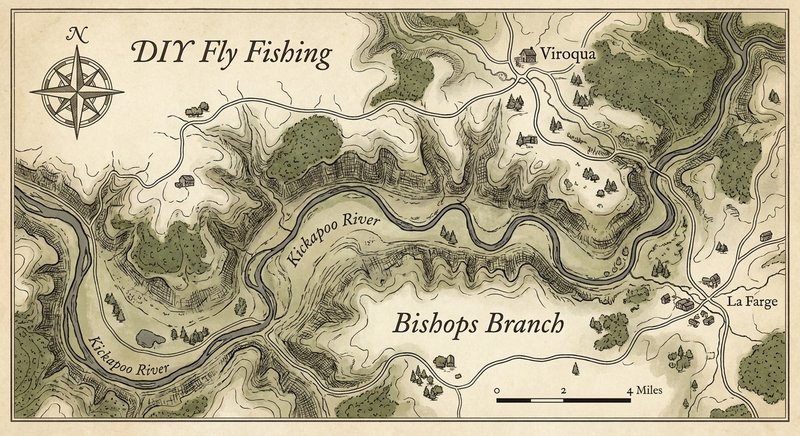
Bishops Branch
Fly fishing in Wisconsin · Advanced · Best seasons: Spring, Summer, Fall
Target Species
Brown Trout
About This Water
Small Driftless spring creek with wild brown trout. Intimate stream fishing.
Fishing Recommendations
Welcome to the heart of the Wisconsin Driftless Area. As your guide, I can tell you that Bishops Branch is one of those quintessential spring creeks that defines fly fishing in the Midwest. Located in Vernon County near Viroqua, it is a tributary of the West Fork of the Kickapoo River.
While it doesn't get the same "fame" as the Kinnickinnic or the Root, serious Driftless anglers know it as a high-quality, cold-water sanctuary with a prolific population of wild trout.
🎣 Location Overview
Bishops Branch is a classic limestone spring creek. Because it is spring-fed, the water remains a constant, cool temperature year-round (roughly 50°F), which allows trout to thrive even when other rivers get too warm in mid-summer.
What makes this water special is the habitat restoration. The Wisconsin DNR and Trout Unlimited have done extensive work here, installing "lunker structures" (submerged wooden platforms) along the banks. The stream flows primarily through pastoral meadows and rolling coulees, featuring tight bends, deep undercut banks, and classic riffle-run-pool sequences. It is intimate, often narrow enough to jump across in spots, requiring stealth and precision.
🐟 Target Species & Behavior
The star of the show here is the Wild Brown Trout.
- Behavior: These fish are wary. Because the water is often crystal clear and the stream is narrow, they are easily spooked by shadows or heavy footsteps.
- Holding Patterns: Look for them tucked tight under "lunker structures" or the deep, carved-out undercut banks on the outside of bends. During hatches, they move into the tail-outs of pools and into the riffles.
- Feeding: They are opportunistic but can become highly selective during a specific hatch (like the Trico or Grannom). They rely heavily on scuds and sowbugs year-round due to the limestone-rich environment.
📅 Best Times to Fish
Seasons
- Spring (April - May): Peak time for the major hatches (Hendricksons, Blue Winged Olives, and Grannom Caddis). The fish are hungry after winter and less cautious.
- Summer (June - August): The "Terrestrial Season." This is the best time for hopper-dropper rigs. Morning and late evenings are best to avoid the midday sun.
- Fall (September - October): Large Brown Trout become aggressive as they prepare for the spawn. This is your best chance to land a "trophy" using streamers.
Time of Day
- Early Morning: Best for Trico hatches in mid-to-late summer.
- Evening: The "Magic Hour" for caddis activity and spinner falls.
🪰 Recommended Flies & Techniques
Dry Flies
- Tricos (Size 20-24): Essential for summer mornings.
- Elk Hair Caddis (Size 14-18): A staple for evening rises.
- Hi-Vis Ant or Chubby Chernobyl (Size 12-16): Excellent for the "Hopper-Dropper" technique in July and August.
- Light Cahill (Size 14-16): Great for late spring/early summer afternoons.
Nymphs & Scuds
- Pink Squirrel (Size 14-18): The legendary Driftless fly. It mimics nothing and everything at once.
- Ray Charles or Scud Patterns (Size 16-20): Grey or olive. These are year-round producers in limestone springs.
- Pheasant Tail Nymph (Size 16-20): For BWO imitations.
Streamers
- Woolly Bugger (Black or Olive, Size 8-12): Strip these along the undercut banks or lunker structures.
- Muddler Minnow: Great for imitating sculpins.
Techniques
- Stealth: Crawl if you have to. If you can see the fish, they have likely already seen you.
- Downstream Dry Fly: On glassy pools, a downstream presentation prevents the fish from seeing your leader/line first.
- Short Line Nymphing: You don't need to cast 40 feet. Often, a 10-15 foot "flick" into a deep hole is more effective.
💡 Pro Tips & Local Knowledge
- The "Lunker" Secret: When you see a man-made wooden bank stabilization, there is a hollow "shelf" underneath it. Drift your nymph or streamer as close to that wood as possible. The biggest Browns live inside those structures.
- Watch the Grass: In late summer, the bank grass gets tall. Trout will wait for grasshoppers to fall in. "Plop" your hopper pattern right against the grass line—don't be afraid to make a little splash.
- Mud Matters: If the water has a slight "tea" stain after a light rain, it’s prime time. The fish lose their wariness and move out into the open to feed.
- Viroqua Basecamp: Stop by the local fly shops in Viroqua. The community there is incredibly welcoming and can give you up-to-the-minute hatch reports.
⚠️ Important Information
- Access: Much of Bishops Branch runs through private farmland. However, thanks to the Wisconsin DNR Easement Program, many stretches are open to public fishing. Look for the green "Public Fishing" signs at bridge crossings. Always stay within the easement (usually 33 feet from the bank).
- Regulations: Wisconsin has specific trout seasons (General season usually starts the first Saturday in May). There is also an early "Catch and Release" season. Check the WI DNR Trout Regulations for the specific "Inland Trout" rules for Vernon County, as many streams are Category 5 (Special Regulations/Barbless Hooks/Size Limits).
- Gear: A 3-weight or 4-weight rod (7.5 to 8.5 feet) is perfect. Use 5x or 6x tippet for dries; the fish are leader-shy.
- Safety: Watch out for wild parsnip in the tall grass—it can cause nasty skin burns if it touches you in the sun. Wear long pants and sleeves.
Tight lines on the Bishops! It’s a true gem of the Driftless.
Bug Hatches & Matching Flies
| Hatch | Type | Peak months | Time of day | Hook sizes | Matching flies |
|---|---|---|---|---|---|
| Blue-Winged Olive Baetis tricaudatus | mayfly | April, May, September, October | Afternoon | #18-22 | RS2 #18-22, Parachute Adams #18-22, Pheasant Tail #18-20 |
| Grannom Caddis Brachycentrus occidentalis | caddis | April, May | Mid-day to Afternoon | #14-16 | Elk Hair Caddis #14-16, LaFontaine Sparkle Pupa #14-16, Peacock Caddis #14-16 |
| Freshwater Scud Gammarus pseudolimnaeus | crustacean | Year-round | All Day | #14-18 | Ray Charles #14-18, Pink Scud #14-16, Rainbow Warrior #16-18 |
| Trico Tricorythodes spp. | mayfly | July, August, September | Early Morning | #20-24 | Trico Spinner #20-24, Sunken Trico #22-24 |
| Sulphur / Pale Evening Dun Ephemerella dorothea | mayfly | May, June, July | Evening | #14-18 | Sulphur Parachute #16-18, Sulphur Cripple #14-16 |
| Terrestrials (Ants and Beetles) Formicidae / Coleoptera | terrestrial | July, August, September | Afternoon | #12-18 | Cinnamon Ant #16-18, Foam Beetle #14-16, Fat Albert #12-14 |
| Cranefly Tipulidae | other | August, September | Afternoon/Evening | #10-14 | Daddy Long Legs #10-12, Killer Bug #12-14 |
| Midges Chironomidae | midge | January, February, March, December | Late Morning/Afternoon | #20-26 | Zebra Midge #20-22, Griffith's Gnat #20-24, Top Secret Midge #22-24 |