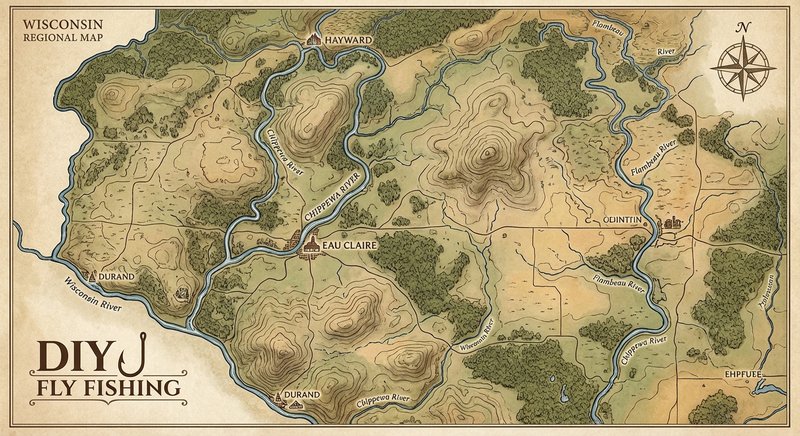
Chippewa River
Fly fishing in Wisconsin · Intermediate · Best seasons: Spring, Summer, Fall
Target Species
Smallmouth Bass, Musky, Walleye
About This Water
Major western Wisconsin river with smallmouth bass and musky. Float trip opportunities.
Fishing Recommendations
The Chippewa River (the "Chip") is a legendary Wisconsin waterway that offers a true Northwoods fly fishing experience. From its origins in the glacial lakes of the north to its confluence with the Mississippi, it provides a diverse landscape of granite boulders, timber-lined banks, and expansive sandbars.
As your guide, here is the comprehensive breakdown for tackling the Chippewa.
🎣 Location Overview
The Chippewa River is a powerhouse of the upper Midwest. What makes it special is its diversity of habitat. In its upper reaches, you’ll find classic "rock garden" river sections with tea-colored, tannin-stained water. As you move south toward Eau Claire, the river widens, featuring massive sandbars and deep holes.
Anglers love the Chip because it feels wild. It is one of the premier destinations in the country for trophy Smallmouth Bass and serves as a world-class Musky corridor. Unlike the manicured trout streams of the Driftless, the Chip is rugged, powerful, and requires a "big game" mindset.
🐟 Target Species & Behavior
Smallmouth Bass (The Main Event)
- Behavior: Known as "bronzebacks," these fish are incredibly aggressive. They love current.
- Holding Water: Look for "seams" where fast water meets slow water, the downstream side of granite boulders, and "wood" (downed trees).
- Diet: Crayfish are the staple. They also gorge on hellgrammites, shiners, and frogs.
Musky (The Apex Predator)
- Behavior: The "Fish of Ten Thousand Casts." They are territorial and moody.
- Holding Water: They lurk near deep wood, weed edges in the flowages, and the mouths of tributary creeks.
- Diet: They eat anything they can fit in their mouths—suckers, panfish, ducklings, and even smaller musky.
Walleye (The Stealth Target)
- Behavior: Often overlooked by fly anglers, the Chip has a massive walleye population. They are light-sensitive.
- Holding Water: Deep runs during the day; they move onto shallow flats or rock bars at dusk to hunt.
- Diet: Primarily baitfish (minnows and shad) and leeches.
📅 Best Times to Fish
- Spring (May - June): This is prime time for Smallmouth. As the water hits 50–55°F, fish move toward spawning flats. Post-spawn (late June) is the most aggressive feeding window of the year.
- Summer (July - August): The "Topwater Window." Low, stable water levels make the river easier to read. Early mornings and late evenings are best to avoid the midday heat. This is the best time for surface Smallmouth action.
- Fall (September - October): The Musky season. As water temperatures drop, Musky go into a "pre-winter gorge." This is also when you’ll find the largest Smallmouth schooling up in deeper wintering holes.
- Conditions: Overcast days are gold on the Chip. It keeps the fish out of the deep shadows and makes them more willing to strike at the surface.
🪰 Recommended Flies & Techniques
For Smallmouth Bass
- Topwater: BoogleBugs (Poppers), Murdich Minnows (fished high), and Umpqua’s Swimming Frogs.
- Subsurface: Clouser Minnows (Chartreuse/White), Game Changers, and any crayfish pattern with heavy lead eyes to "bounce" the bottom.
- Technique: Use an 7wt or 8wt rod. For poppers, use a "pop-and-pause" cadence. Often, the strike happens when the fly is sitting perfectly still.
For Musky
- Flies: Large articulated streamers (8–12 inches). Patterns like the T-Bone, Buford, or Double Barreled Popper. Flash is your friend in the tannin water.
- Technique: Use a 10wt to 12wt rod with a heavy sinking tip. Crucial Tip: Always perform a "Figure-Eight" at the side of the boat at the end of every cast. Musky are famous for following flies and striking right at the rod tip.
For Walleye
- Flies: Weighted wooly buggers in purple or black, and Clouser Minnows in "Electric Chicken" (Pink/Chartreuse).
- Technique: Use a sinking line to get the fly into the "zone" (the bottom 12 inches of the water column). A slow, rhythmic strip-set is more effective than a trout-style trout set.
💡 Pro Tips & Local Knowledge
- Focus on the "Middle Chip": The stretch from Holcombe to Jim Falls and the section below the Eau Claire Dells are legendary for Smallmouth.
- Read the Wood: On the Chippewa, "Wood is Good." If you see a downed tree in the water with current sweeping past it, there is a 90% chance a predator is sitting in the slack water behind it.
- The "Tannin" Factor: The water is the color of strong tea. Bright colors (chartreuse, orange, white) or high-contrast colors (black/purple) show up much better than natural olives or browns.
- Stay Mobile: The Chip is a big river. If a hole isn't producing, move. A drift boat or a jet boat is the best way to cover enough water to find the "active" pods of fish.
⚠️ Important Information
- Access: There are numerous public boat launches (run by the DNR or County). Wading is possible during low summer flows, particularly near the Jim Falls and Chippewa Falls areas, but be wary of sudden water level rises due to dam releases.
- Regulations: Wisconsin fishing licenses are required. Note that there are specific catch-and-release seasons for bass in the spring—always check the Wisconsin DNR Guide before heading out.
- Safety: The Chip has many hidden boulders ("Lower Unit Killers"). If you are rowing or motoring, go slow until you know the channel.
- Gear Note: Always carry heavy fluorocarbon tippet (20lb+ for Bass, 80lb+ wire/fluoro for Musky). These fish have teeth and the rocks are sharp!
Tight lines on the Big Chip!
Bug Hatches & Matching Flies
| Hatch | Type | Peak months | Time of day | Hook sizes | Matching flies |
|---|---|---|---|---|---|
| Blue Winged Olive Baetis | mayfly | April, May, September, October | Midday | #18-22 | RS2 #20-22, Parachute BWO #18-22, BWO Sparkle Dun #18-20 |
| Hendrickson Ephemerella subvaria | mayfly | April, May | Afternoon | #12-14 | Red Quill #12-14, Pheasant Tail #12-14, Hendrickson Cripple #14 |
| Grannom Caddis Brachycentrus | caddis | May | Afternoon/Evening | #14-16 | Elk Hair Caddis (Olive) #14-16, Pupa-Le-Baetis #16, Gold Ribbed Hare's Ear #14 |
| Golden Stonefly Acronuria | stonefly | June, July | Afternoon/Evening | #8-12 | Kaufmann's Stone #8-10, Stimulator (Yellow) #8-12, Pat's Rubber Legs #8-12 |
| Hex Hexagenia limbata | mayfly | June, July | Late Evening/Night | #4-8 | Hexagenia Spinner #4-6, Michigan Night Rider #4-8, Wiggle Nymph #6-8 |
| Light Cahill Stenacron / Stenonema | mayfly | June, July | Evening | #14-16 | Light Cahill #14-16, Gold Ribbed Hare's Ear #14-16, Cahill Emerger #14 |
| White Miller Nectopsyche | caddis | July, August | Evening/Night | #14 | White Elk Hair Caddis #14, White Miller Wet Fly #14, Z-Lon Caddis #14 |
| Trico Tricorythodes | mayfly | July, August, September | Morning | #20-24 | Trico Spinner #20-24, Trico Sunken Spinner #22, Griffith's Gnat #20-22 |
| Grasshopper Orthoptera | terrestrial | August, September | Midday | #8-12 | Dave's Hopper #8-12, Parachute Hopper #10-12, Morrish Hopper #8-10 |