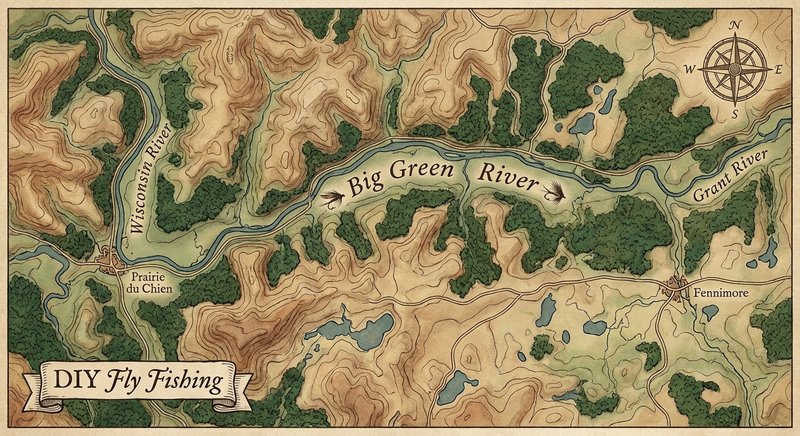
Big Green River
Fly fishing in Wisconsin · Advanced · Best seasons: Spring, Summer, Fall
Target Species
Brown Trout
About This Water
Driftless spring creek with excellent brown trout. Technical fishing in pastoral setting.
Fishing Recommendations
The Big Green River in Grant County, Wisconsin, is a crown jewel of the Driftless Area. Unlike the smaller, more choked-out creeks in the region, the Big Green offers a bit more "breathing room" for the backcast, while still maintaining the classic limestone spring creek characteristics that make Southwest Wisconsin a world-class trout destination.
Here is your comprehensive guide to fishing the Big Green.
🎣 Location Overview
The Big Green River is a classic cold-water spring creek located near Fennimore, Wisconsin. It meanders through lush agricultural valleys and limestone bluffs before eventually flowing into the Wisconsin River.
What makes it special is its size and stability. It is one of the larger systems in the Driftless, meaning it can handle a bit more rain than its smaller neighbors without blowing out completely. The water is nutrient-rich and alkaline, leading to massive populations of crustaceans (scuds/sowbugs) and prolific insect hatches. Anglers love the Big Green because it holds "trophy" potential—brown trout here can reach 20+ inches, which is a giant for a midwestern spring creek.
🐟 Target Species & Behavior
Brown Trout are the primary residents. While you may find an occasional brook trout in the headwaters, the Big Green is a brown trout factory.
- Behavior: These fish are notoriously "spooky." The water is often crystal clear. In the morning and evening, they move into the riffles to feed. During the bright sun of midday, they retreat under undercut banks, root balls, or into the deep, dark bends.
- Feeding: They are opportunistic but highly selective during hatches. Their primary diet consists of scuds and sowbugs year-round, supplemented by heavy hatches of Blue-Winged Olives, Caddis, and Tricos. Large browns are also highly piscivorous (fish-eating), making them suckers for a well-presented sculpin imitation.
📅 Best Times to Fish
The Big Green is a year-round fishery (with catch-and-release seasons), but each season offers a different game:
- Spring (March - May): This is the window for the "Early Season" (Catch & Release). Look for Blue-Winged Olives (BWOs) on cloudy days and the famous Grannom Caddis in April. The water is cool, and the fish are hungry after winter.
- Summer (June - August): The "Terrestrial Season." This is prime time for hoppers, ants, and beetles. Also, the Trico hatch (tiny mayflies) occurs in the early mornings, providing some of the most technical and rewarding dry fly fishing of the year.
- Fall (September - October): Brown trout become aggressive and territorial as they prepare to spawn. This is your best chance to land a "wall-hanger" using large streamers. The colors of the Driftless bluffs during this time are spectacular.
Prime Windows: Low-light conditions (dawn and dusk) are always best, especially for the larger, more cautious fish.
🪰 Recommended Flies & Techniques
Top Fly Patterns
- Nymphs:
- The Pink Squirrel (Size 14-18): A Driftless legend. The hot bead and flash trigger strikes in all conditions.
- Scuds & Sowbugs (Size 16-20): Olive or gray. This is the "bread and butter" of the river.
- Pheasant Tail: Classic imitation for various mayflies.
- Dry Flies:
- Elk Hair Caddis (Size 14-18): Great for searching riffles.
- Hippie Stomper / Fat Angie (Size 12-14): Excellent terrestrial/attractor patterns for summer.
- Trico Spinner (Size 20-24): Essential for summer mornings.
- Streamers:
- Black or Olive Woolly Bugger: A universal producer.
- Near Nuff Sculpin: Mimics the natural forage of the Big Green.
Effective Techniques
- Dry-Dropper: This is the most effective way to cover the Big Green. Hang a Pink Squirrel or Scud 18-24 inches below a buoyant foam terrestrial.
- Stealthy Approach: You must fish "upcurrent." Stay low, move slowly, and avoid casting your shadow over the water. If you see the fish, they have likely already seen you.
- The "Twitch": When fishing terrestrials near undercut banks, give the fly a tiny wiggle to mimic a struggling insect.
💡 Pro Tips & Local Knowledge
- The "Sneak" is Key: Experienced guides will tell you to wear drab colors (olive, tan, or camo). Bright white shirts or hats will spook Driftless browns from 30 feet away.
- Target the "Ledges": The Big Green has incredible limestone shelving. Often, the biggest fish aren't in the deepest holes but are tucked tightly under the rock ledges in only 2 feet of water.
- Don't ignore the Riffles: Many anglers walk right past the shallow, bubbly water to get to the "pretty" pools. In the summer, those riffles are highly oxygenated and full of feeding fish.
- Gear: A 4-weight or 5-weight rod (8'6" to 9') is perfect. Use a long leader (9-12 feet) tapering to 5X or 6X fluorocarbon tippet to avoid detection in the clear water.
⚠️ Important Information
- Access: Wisconsin has an excellent Public Fishing Easement program. Look for the green and white "Public Hunting/Fishing" signs. Much of the Big Green is accessible through these easements, but always respect private property boundaries.
- Regulations: The Big Green usually falls under Wisconsin DNR Category 5 or special regulation status (often a 12-inch minimum length and a bag limit of 2, but many sections are catch-and-release only). Always check the current Wisconsin Trout Regulations map/booklet before fishing.
- Permits: You need a Wisconsin Fishing License AND an Inland Trout Stamp. These can be purchased online or at local bait shops in Fennimore or Boscobel.
- Safety: The banks can be muddy and steep. Watch out for wild parsnip (which causes skin burns) and stinging nettles in the summer—long pants are a must.
Bug Hatches & Matching Flies
| Hatch | Type | Peak months | Time of day | Hook sizes | Matching flies |
|---|---|---|---|---|---|
| Blue-Winged Olive Baetis | mayfly | April, May, September, October | Midday | #18-22 | RS2 #18-22, BWO Sparkle Dun #20-22, Pheasant Tail #18-20 |
| Grannom Caddis Brachycentrus | caddis | April, May | Afternoon/Evening | #14-16 | Peacock Caddis #14-16, LaFontaine's Deep Sparkle Pupa #14-16, Elk Hair Caddis (Olive) #14-16 |
| Sulphur Ephemerella invaria / dorothea | mayfly | May, June | Evening | #14-18 | Sulphur Parachute #16-18, Sulphur Emerger #16-18, Gold Ribbed Hare's Ear #14-16 |
| Trico Tricorythodes | mayfly | July, August, September | Morning | #20-24 | Trico Spinner #20-24, Drowned Trico #22, Griffith's Gnat #20-22 |
| Light Cahill Stenacron interpunctatum | mayfly | June, July | Late Evening | #12-14 | Light Cahill Dry #12-14, Cream Variant #14, Mercer's Missing Link #14 |
| Tan Caddis Hydropsyche | caddis | June, July, August | Evening | #14-18 | Elk Hair Caddis (Tan) #16-18, Holy Grail Caddis Pupa #14-16, X-Caddis #16 |
| Cinnamon Ant Formicidae | terrestrial | July, August, September | All Day | #16-18 | Cinnamon Ant (Parachute) #16-18, Chernobyl Ant #12-14, Transpar-ant #18 |
| Zebra Midge Chironomidae | midge | January, February, March, December | Morning/Midday | #18-24 | Zebra Midge #18-22, Griffith's Gnat #20-22, Black Beauty #20-22 |