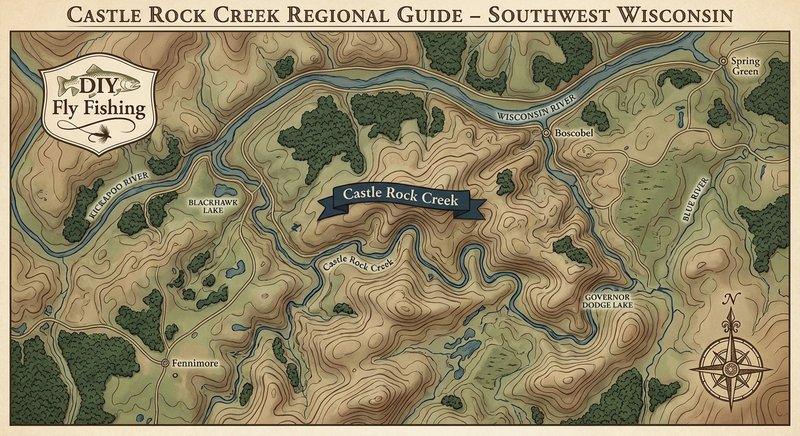
Castle Rock Creek
Fly fishing in Wisconsin · Intermediate · Best seasons: Spring, Summer, Fall
Target Species
Brown Trout
About This Water
Driftless Area spring creek with wild brown trout. Outstanding summer hatches.
Fishing Recommendations
As an expert guide in the Driftless Area, I can tell you that Castle Rock Creek (officially known as Blue River on some maps, but locally as Castle Rock) is a crown jewel of Wisconsin spring creeks. Located in Grant County, it is a classic meadow stream that offers some of the most technical and rewarding fly fishing in the Midwest.
Here is your comprehensive guide to fishing Castle Rock Creek.
🎣 Location Overview
Castle Rock Creek is a spring-fed limestone stream characterized by its cold, nutrient-rich water and classic "Driftless" topography. Unlike the high-gradient streams of the West, Castle Rock meanders through lush valley pastures and coulees.
What makes it special: It is one of the premier "catch and release" stretches in Wisconsin. The water remains a steady 50–55 degrees year-round due to the massive spring heads, making it a biological factory for insects and a sanctuary for trout during hot summers. It is famous for its highly technical sight-fishing and its "big fish" potential—trophy browns here are savvy, long-lived, and require a masterful approach.
🐟 Target Species & Behavior
The primary quarry here is the Brown Trout. While there are some rainbows stocked in certain stretches and a few wild brook trout in the headwaters, the "Castle Rock Experience" is defined by large, wild, and holdover Brown Trout.
- Behavior: These fish are notoriously "spooky." The water is often gin-clear and the surface is glass-calm in the meadow sections.
- Holding Patterns: Look for fish tucked tight under undercut banks, behind mid-stream clumps of Elodea (water weeds), and in the deep "buckets" at the bends of the river.
- Feeding: They are opportunistic but highly selective during hatches. Large browns here also have a taste for sculpins and crayfish.
📅 Best Times to Fish
Optimal Seasons
- Spring (Late March – May): This is prime time for the Grannom Caddis and Blue Winged Olive (BWO) hatches. The fish are hungry after winter and less pressured.
- Summer (June – August): While other streams get too warm, Castle Rock stays cold. This is Terrestrial Season. Fishing hoppers and beetles along the tall grass banks is exhilarating.
- Fall (September – October): The pre-spawn period. Large browns become aggressive and territorial. This is your best chance to land a 20+ inch fish on a streamer.
Best Times of Day
- Early Morning: Best for trico hatches in mid-summer.
- Overcast Days: The absolute best condition for Castle Rock. Clouds mask your shadow and encourage fish to leave the undercut banks to feed in the open.
- Evening: The "magic hour" for caddis activity and spinner falls.
🪰 Recommended Flies & Techniques
Top Fly Patterns
- Dry Flies:
- Tricos (Size 20-24) – Essential for summer mornings.
- Crane Flies – A local favorite; orange or tan bodies.
- Elk Hair Caddis (Size 14-18) – Tan or olive.
- Hi-Vis Hippie Stomper or Fat Albert (Size 10-14) – For the terrestrial bite.
- Nymphs:
- Pink Squirrel (Size 14-16) – A Driftless staple invented nearby.
- Scuds/Sowbugs (Size 16-18) – Gray or olive; the primary food source year-round.
- Pheasant Tail (Size 18-20).
- Streamers:
- Black or Olive Wooly Buggers (Size 8-10).
- Sculpin Patterns (Size 4-6) – Fish these deep and slow near the banks.
Presentation Tips
- The "Reach Cast": Essential to manage drag on the micro-currents.
- Light Tackle: Use a 3-weight or 4-weight rod with a long leader (9–12 feet) tapering to 6X or 7X tippet for dry flies.
- Stealth: If you can see the fish, they can see you. Kneel in the grass and stay back from the bank.
💡 Pro Tips & Local Knowledge
- The "Castle Rock Bend": Focus on the area near the Castle Rock Spring. The water is coldest here, and the weed growth provides excellent cover for massive browns.
- Observe Before Casting: Spend 5-10 minutes just watching a pool. You’ll often see a "ghost" of a brown trout move from under a bank to a feeding lane.
- The "Dredge" Technique: In the heat of the day, if nothing is rising, use a heavy weighted scud or sowbug and "tumble" it right along the edges of the weed beds.
- Mind the Weeds: The stream is full of aquatic vegetation. Learn to "hook set" upward rather than to the side to avoid burying your fly in the Elodea.
⚠️ Important Information
Access
- There is excellent public access via the Wisconsin DNR easements. Look for the wooden "Public Fishing" signs.
- Main access points are off County Highway Q and Church Road.
Regulations
- Catch and Release Only: The most famous stretch (from the spring head downstream to the second bridge on County Q) is strictly catch and release with artificial lures/flies only.
- Wisconsin Fishing License: You must have a valid Wisconsin fishing license and an Inland Trout Stamp.
Special Considerations
- Cow Pastures: Much of the creek runs through active cattle pastures. The farmers are gracious enough to allow access; please close all gates behind you and do not disturb the livestock.
- Wading: The bottom can be very silty and soft in places (the "Driftless Muck"). Move slowly to avoid getting stuck or sending a plume of silt downstream that will spook the fish.
Guide’s Final Word: Castle Rock Creek is a "Ph.D. stream." Don't be discouraged if you get skunked your first time. The rewards of fooling a wild Castle Rock brown are among the highest in the sport of fly fishing.
Bug Hatches & Matching Flies
| Hatch | Type | Peak months | Time of day | Hook sizes | Matching flies |
|---|---|---|---|---|---|
| Blue-Winged Olive Baetis | mayfly | April, May, September, October | Afternoon | #18-22 | RS2 #18-22, Parachute BWO #18-22, BWO CDC Emerger #20-22 |
| Sulphur Ephemerella invaria | mayfly | May, June | Evening | #14-18 | Sulphur Parachute #14-18, Pheasant Tail Nymph #14-16, Sulphur Snowshoe Emerger #16-18 |
| Trico Tricorythodes | mayfly | July, August, September | Morning | #20-24 | Trico Spinner #20-24, Sunken Trico Spinner #22-24, Trico Drowned Spinner #20-22 |
| Grannom Caddis Brachycentrus | caddis | April, May | Afternoon | #14-16 | Elk Hair Caddis (Olive) #14-16, LaFontaine's Deep Sparkle Pupa #14-16, Peacock Caddis #16 |
| Crane Fly Tipulidae | midge | August, September | Evening | #10-14 | Daddy Long Legs #10-12, Skating Crane Fly #12-14, Crane Fly Larva #10-12 |
| Terrestrials (Ants and Beetles) Formicidae/Coleoptera | terrestrial | July, August, September | Mid-day | #12-18 | Cinnamon Ant #16-18, Foam Beetle #12-16, Chernobyl Ant #10-14 |
| Light Cahill Stenacron | mayfly | June, July | Evening | #12-14 | Light Cahill #12-14, Gold Ribbed Hare's Ear #12-14, Cahill Emerger #14 |
| Midges Chironomidae | midge | January, February, March, December | Late Morning | #20-26 | Zebra Midge #20-24, Griffith's Gnat #20-24, Mercury Midge #22-26 |