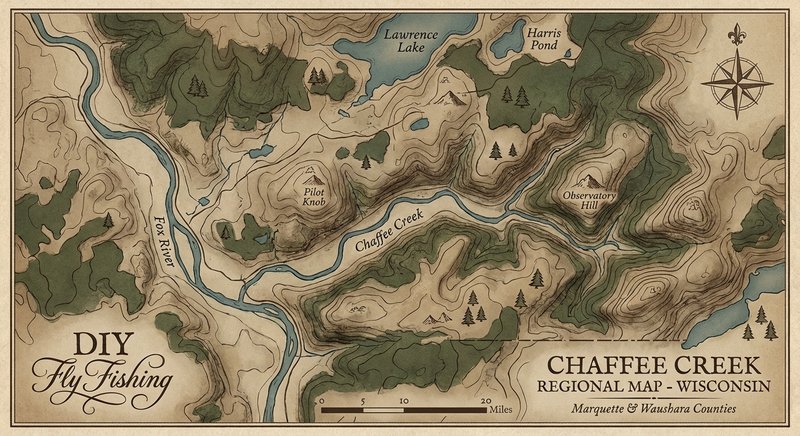
Chaffee Creek
Fly fishing in Wisconsin · Beginner · Best seasons: Spring, Summer, Fall
Target Species
Brook Trout
About This Water
Central Wisconsin Class I trout stream. Wild brook trout in pristine water.
Fishing Recommendations
As an expert guide who has spent countless hours navigating the spring-fed gems of the Midwest, I can tell you that Chaffee Creek is a quintessential Central Wisconsin trout stream. Located primarily in Marquette and Waushara counties, it is a delicate, spring-fed tributary of the Mecan River.
If you are looking for technical, small-stream stalking for wild Brookies, this is your hallowed ground.
🎣 Location Overview
Chaffee Creek is a classic "Central Sands" stream. Unlike the rocky, limestone bluffs of the Driftless Area to the west, Chaffee flows through a landscape of glacial outwash.
What makes it special: The water is remarkably clear and remains cold even in the heat of July, thanks to heavy groundwater seepage. It features a mix of sandy flats, deep undercut banks, and sections of gravelly runs. It is an intimate stream—rarely more than 15–20 feet wide—demanding stealth, short casts, and a high degree of precision. Anglers love it because it feels like a secret; it’s a place where you can get lost in the tag alders and find wild, vibrant Brook Trout that look like jewels.
🐟 Target Species & Behavior
The primary draw here is the Wild Brook Trout. While you may occasionally hook a stray Brown Trout (especially closer to the confluence with the Mecan), the upper and middle reaches are a Brookie stronghold.
- Behavior: These are wild fish, not stockers. They are incredibly spooky. If they see your shadow or feel the vibration of a heavy footstep on the bank, the pool is "done" for the next hour.
- Holding Spots: Look for them tucked tight against undercut banks, under overhanging tag alders, or at the very head of deep pools where the bubble line begins.
- Feeding: They are opportunistic but cautious. In the spring, they focus on midges and scuds. As the season warms, they become aggressive surface feeders, keying in on terrestrials and small mayflies.
📅 Best Times to Fish
- Spring (Late April – June): This is the prime window. The aquatic insect hatches (Blue Winged Olives and Hendricksons) are consistent, and the fish are hungry after the winter lean months.
- Summer (July – August): While many streams get too warm, Chaffee stays cool. This is "Terrestrial Time." Fishing ants and beetles against the banks in the heat of the afternoon can be explosive.
- Fall (September – October): The Brook Trout begin to dawn their spawning colors (vibrant oranges and reds). They become more aggressive as they prepare for the spawn. Note: Be mindful of redds (spawning beds) in late October.
- Best Time of Day: Early morning (dawn until 10:00 AM) and "the golden hour" before sunset. On cloudy, drizzly days, the fish will often feed comfortably all day long.
🪰 Recommended Flies & Techniques
Top Fly Patterns
- Dry Flies:
- Elk Hair Caddis (Size 14-18) – A workhorse for this creek.
- Para-Adams (Size 16-20) – Perfect for the slow, glassy flats.
- Hi-Vis Ant or Foam Beetle (Size 14-16) – Essential for summer.
- Nymphs:
- Pink Squirrel (Size 14-16) – A Wisconsin legend. The flash triggers strikes in the sandy runs.
- Gold-Ribbed Hare’s Ear (Size 16-18) – Mimics the various nymphs found in the gravel.
- Streamers:
- Black or Olive Woolly Bugger (Size 10-12) – Best used on a "swing" into deep holes during high water or low light.
Techniques & Presentation
- Stealth is Step One: Wear earthy colors. Kneel when approaching the bank. If possible, fish upstream to stay behind the fish’s line of sight.
- The "Bow and Arrow" Cast: Much of Chaffee is overgrown with brush. You won't have room for a traditional backcast. Mastering the bow-and-arrow cast is mandatory to get your fly under the overhanging branches.
- Dry-Dropper: A high-vis dry fly with a small nymph tied 18 inches below is the most effective way to cover Chaffee’s varied depths.
💡 Pro Tips & Local Knowledge
- The "Silt" Factor: The bottom of Chaffee Creek is a mix of sand and silt. If you wade aggressively, you will send a plume of mud downstream that warns every fish of your presence. Tread lightly and try to fish from the bank whenever possible.
- Focus on the DNR Land: There are excellent public access points via the Chaffee Creek Wildlife Area. The sections near 11th Road and 9th Ave offer classic Brookie water.
- The "Small Fly" Rule: While Brookies are known for being aggressive, the clarity of Chaffee often requires you to downsize your tippet to 6X or even 7X to avoid "lining" the fish.
⚠️ Important Information
- Access: Much of the creek is surrounded by private land, but there are significant stretches of State-owned land managed by the WDNR. Always look for the green "Public Hunting and Fishing" signs.
- Regulations: Chaffee Creek falls under Wisconsin’s trout regulations, which can change by section. Generally, it is a Category Blue or Green stream, but always check the current WDNR Trout Tool for size and bag limits.
- Gear Recommendation: A 2-weight or 3-weight rod (7’ to 7’6”) is the perfect tool. Anything longer will get tangled in the trees; anything heavier will overpower these delicate fish.
- Ticks and Brush: The tall grass and alders are prime habitat for ticks. Wear long pants and consider permethrin-treated clothing.
Guide’s Final Word: Chaffee Creek isn't about catching "trophy" sized fish—a 10-inch Brookie here is a king. It’s about the quiet, the technical challenge, and the beauty of a wild fish in a pristine Wisconsin spring creek. Tight lines!
Bug Hatches & Matching Flies
| Hatch | Type | Peak months | Time of day | Hook sizes | Matching flies |
|---|---|---|---|---|---|
| Blue-Winged Olive Baetis spp. | mayfly | April, May, September, October | Midday | #18-22 | RS2 #18-22, Parachute BWO #18-22, Pheasant Tail #18-20 |
| Grannom Caddis Brachycentrus | caddis | April, May | Afternoon | #14-16 | Elk Hair Caddis (Olive) #14-16, LaFontaine's Deep Sparkle Pupa #14-16, Peacock Caddis #16 |
| Hendrickson Ephemerella subvaria | mayfly | May | Afternoon | #12-14 | Hendrickson Sparkle Dun #12-14, Red Quill #14, Hendrickson Nymph #12-14 |
| Sulphur Ephemerella invaria/dorothea | mayfly | May, June | Evening | #14-18 | Comparative Dun #16-18, Sulphur Parachute #14-18, Pheasant Tail (Flashback) #16-18 |
| Spotted Sedge Hydropsyche | caddis | June, July, August | Evening | #14-18 | Elk Hair Caddis (Tan) #14-18, Iris Caddis #16, Holy Grail #14-16 |
| Trico Tricorythodes spp. | mayfly | July, August, September | Morning | #20-24 | Trico Spinner (Poly Wing) #20-24, Griffith's Gnat #20-22, Trico Nymph #22 |
| Light Cahill Stenacron / Stenonema | mayfly | June, July | Evening | #12-14 | Light Cahill #12-14, Cream Usual #14, Gold Ribbed Hare's Ear #12-14 |
| Terrestrials Various | terrestrial | July, August, September | All Day | #10-18 | Black Foam Ant #16-18, Morrish Hopper #10-12, Foam Beetle #14-16 |