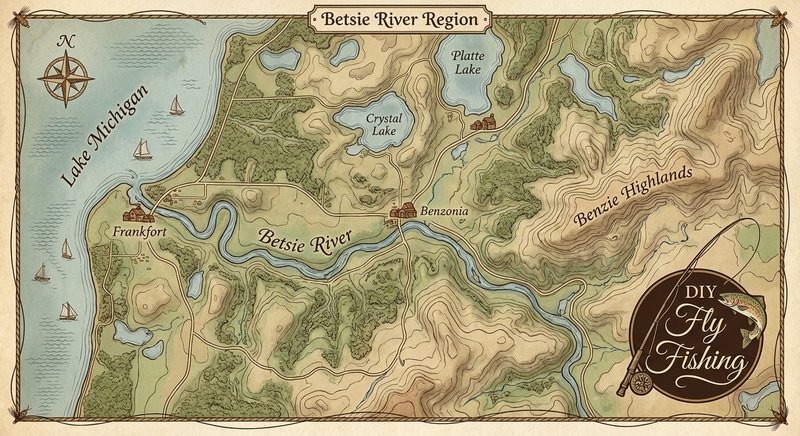
Betsie River
Fly fishing in Michigan · Intermediate · Best seasons: Spring, Fall
Target Species
Steelhead, Salmon, Brown Trout
About This Water
Scenic northwest Michigan river. Excellent steelhead and salmon fishing near Frankfort.
Fishing Recommendations
The Betsie River in Northwest Lower Peninsula, Michigan, is a legendary destination for Great Lakes fly anglers. It is often overshadowed by its larger neighbor, the Manistee, but the Betsie offers a more intimate, rugged, and technical experience. Known for its prolific runs of Chinook Salmon and Steelhead, this is a river that rewards persistence and patience.
🎣 Location Overview
The Betsie is a relatively small, narrow, and winding river. It flows through Benzie County, eventually emptying into Betsie Lake and Lake Michigan at Frankfort. Unlike the wide-open gravel runs of the Muskegon, the Betsie is characterized by heavy woody debris, tight bends, and a mix of sand and gravel substrate.
What makes the Betsie special is its "wild" feel. It is a "spready" river—meaning it reacts quickly to rainfall. A good autumn rain can pull thousands of fish into the system overnight. It is not a river for the faint of heart; the "wood" (sunken logs and sweepers) that provides cover for the fish also makes it a graveyard for flies and a challenge for landing large fish.
🐟 Target Species & Behavior
Chinook (King) & Coho Salmon
- Behavior: Kings enter the river in massive numbers in late August and September. They are aggressive when they first enter but become focused on spawning as they hit the gravel.
- Holding: Look for them in deep "dark" holes during the day and on shallow gravel runs at dawn and dusk.
- Feeding: They aren't feeding to survive, but they strike out of aggression or territorial instinct.
Steelhead
- Behavior: The Betsie gets both a Fall and a Spring run. Fall Steelhead follow the salmon to gorge on eggs. Spring Steelhead enter to spawn themselves.
- Holding: They sit behind salmon "redds" (spawning nests) in the fall. In the spring, look for them in the "seams" of the current and in deeper pools near spawning gravel.
Brown Trout
- Behavior: While mostly known for anadromous runs, the Betsie has a decent population of resident Brown Trout.
- Feeding: They are opportunistic. During the "Hex" hatch (late June), they become surface-focused. The rest of the year, they are predatory, eating salmon fry and eggs.
📅 Best Times to Fish
- Fall (Late August – Early November): This is the prime window.
- September: Peak Chinook Salmon run.
- October: Coho Salmon and the arrival of "Fall Chrome" (Steelhead).
- Spring (March – May):
- Late March/April: The peak of the Spring Steelhead run. This is arguably the best time for fly purists.
- Time of Day: Early morning (pre-dawn) is critical on the Betsie. Once the sun hits the water, the fish move into the heavy log jams and become very difficult to coax out.
- Prime Conditions: A "falling" barometer and a recent rain. If the river is slightly stained (the color of weak tea), the fishing is usually world-class.
🪰 Recommended Flies & Techniques
Techniques
- Indicator Nymphing: The most effective way to fish the Betsie. Use a floating line, a long leader (9–12ft), and enough split shot to get the fly to the "zone" quickly.
- Swinging Streamers: Effective for fresh Salmon and Steelhead in the lower river. Use a sink-tip line and "swing" the fly across the current.
- Chuck-and-Duck: A traditional Michigan technique using a thin running line and heavy weight to get deep in fast, snag-heavy holes.
Recommended Fly Patterns
- Eggs/Beads: 8mm and 10mm glass or acrylic beads in "Oregon Cheese," "Mottled Orange," or "Cream." Glo-bugs and Estaz eggs in similar colors.
- Nymphs: Hexagenia nymphs (large), Black Stoneflies, and Prince Nymphs.
- Streamers: Egg-Sucking Leeches (Purple/Pink), Wooly Buggers (Olive/Black), and "Intruders" for swinging.
- Salmon Specific: Green Weenie, Blue/Silver streamers for Coho.
💡 Pro Tips & Local Knowledge
- The "Homestead" Area: The area around the former Homestead Dam site is the most popular (and crowded) stretch. It offers the most gravel, but if you want solitude, hike a mile upstream or downstream from the main access points.
- Master the "Wood": On the Betsie, if you aren't losing flies, you aren't fishing where the fish are. You must drift your flies tight to the log jams. Use a heavier tippet (10lb–12lb fluorocarbon) than you think you need to pull fish away from the snags.
- Stealth Matters: Because the river is narrow, fish are easily spooked. Avoid heavy wading; if you can reach the spot from the bank or by standing in the shallows, do so.
- The "Rain Rule": If the weather forecast calls for an inch of rain in Frankfort, drop everything and get to the river 24 hours later. The "push" of fish after a rain event is legendary.
⚠️ Important Information
Access Points
- Homestead Dam: Located at the end of Homestead Rd. High pressure but high fish density.
- US-31 Bridge: Good access for those looking to fish the middle river.
- River Road: Offers several pull-offs for walk-in access to lower sections.
- Kurick Rd: Provides access to the upper, more "trout-centric" water.
Regulations & Safety
- Check the MI DNR Guide: Much of the Betsie is Type 4 water, but regulations regarding "all-species" seasons and "lure only" stretches can change.
- Hook Size: During the salmon run, there are specific rules about hook gap size (to prevent snagging). Ensure your flies are tied on legal-sized hooks.
- Safety: The sand bottom can be unstable, and the "wood" creates hidden deep holes. A wading staff and a life jacket (if using a drift boat) are highly recommended.
- Private Property: While the river is navigable, the banks are often private. Stay in the water or on clearly marked public land.
Guide’s Final Word: The Betsie is a "character" river. It will frustrate you with snags and lost tackle, but when you hook a 15lb Steelhead in a 20-foot-wide stream surrounded by old-growth cedars, you’ll understand why we keep coming back.
Bug Hatches & Matching Flies
| Hatch | Type | Peak months | Time of day | Hook sizes | Matching flies |
|---|---|---|---|---|---|
| Blue-Winged Olive (BWO) Baetis | mayfly | April, May, September, October | Mid-day | #18-22 | RS2 #18-20, Parachute BWO #18-22, BWO CDC Emerger #20 |
| Hendrickson Ephemerella subvaria | mayfly | May | Afternoon | #12-14 | Red Quill #12-14, Hendrickson Nymph #12-14, Light Hendrickson #14 |
| Grannom Caddis Brachycentrus | caddis | April, May | Late Morning/Afternoon | #14-16 | Peacock Caddis #14-16, Elk Hair Caddis (Olive) #14-16, Deep Sparkle Pupa #16 |
| Sulphur Ephemerella dorothea | mayfly | June | Evening | #16-18 | Sulphur Parachute #16-18, Sulphur Emerger #16-18, Pheasant Tail #16-18 |
| Brown Drake Ephemera simulans | mayfly | June | Dusk/Night | #10-12 | Brown Drake Spinner #10-12, Brown Drake Cripple #10-12, Hare's Ear (Large) #10 |
| Hex Hexagenia limbata | mayfly | late June, July | Late Night | #4-8 | Hexagenia Spinner #4-6, Roberts Yellow Drake #6-8, Hex Wiggle Nymph #6 |
| Isonychia (Slate Drake) Isonychia bicolor | mayfly | June, July, September | Late Afternoon | #10-12 | Iso Parachute #10-12, Zug Bug #10-12, Prince Nymph #10-14 |
| Cinnamon Caddis Hydropsyche | caddis | June, July, August | Evening | #14-18 | Elk Hair Caddis (Tan) #14-16, LaFontaine Sparkle Pupa #16, Holy Grail #14-16 |
| Trico Tricorythodes | mayfly | July, August, September | Early Morning | #22-26 | Trico Spinner #22-24, Trico Drowned Spinner #24, Griffith's Gnat #22 |
| Terrestrials Formicidae / Orthoptera | terrestrial | July, August, September | All Day | #8-16 | Chernobyl Ant #8-12, Black Foam Ant #14-18, Dave's Hopper #10-12 |