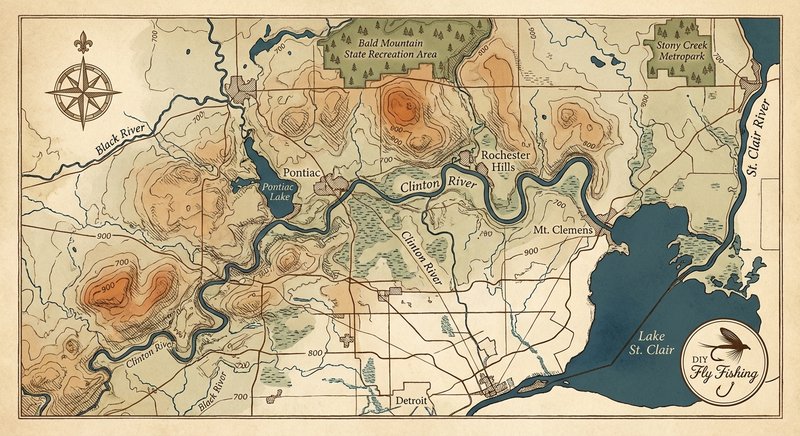
Clinton River
Fly fishing in Michigan · Beginner · Best seasons: Spring, Fall
Target Species
Brown Trout, Smallmouth Bass, Steelhead
About This Water
Metro Detroit area stream with surprising trout fishing. Coldwater tributaries hold browns.
Fishing Recommendations
The Clinton River is one of Southeast Michigan’s most underrated gems. Flowing through the heart of the metro Detroit suburbs, it offers a surprisingly wild experience with diverse habitats ranging from cold-water trout runs to rocky smallmouth stretches and heavy-current steelhead waters.
As your guide, here is the comprehensive breakdown for fishing the Clinton.
🎣 Location Overview
The Clinton River is a tale of two rivers. The Upper Clinton (above Yates Dam) is characterized by gravel runs, tighter banks, and cooler water temperatures suitable for resident trout. The Lower Clinton (below Yates Dam to Lake St. Clair) is larger, more powerful, and serves as a major highway for migratory Great Lakes salmonids.
What makes it special is the accessibility. You can find world-class steelhead runs just minutes from major suburban centers. The river has undergone significant restoration, turning it from an industrial drainage into a productive fishery with deep pools, woody debris, and limestone ledges.
🐟 Target Species & Behavior
Steelhead (Adfluvial Rainbow Trout)
- Behavior: These are "chromers" coming in from Lake St. Clair and Lake Huron. They are aggressive but spooky in the Clinton’s often-clear water.
- Holding: They favor the "seams" between fast and slow water, deep holes below riffles, and "tail-outs" just before a drop-off.
- Feeding: They aren't actively feeding to grow, but they strike out of instinct or aggression. They focus on eggs, nymphs, and small baitfish.
Brown Trout
- Behavior: Mostly found in the colder tributaries (like Paint Creek) and the upper main stem. They are notoriously wary.
- Holding: Look for "undercut banks" and heavy submerged wood. Clinton Browns love overhead cover.
- Feeding: Early season they hit nymphs; during summer evenings, they rise for Hexagenia or Sulphurs; in the fall, they turn aggressive toward streamers.
Smallmouth Bass
- Behavior: The "bronzebacks" take over the middle and lower sections as the water warms. They are the pound-for-pound kings of the river.
- Holding: Rock piles, bridge pilings, and the edges of weed beds.
- Feeding: They are opportunistic, keying in on crayfish and emerald shiners.
📅 Best Times to Fish
Spring (March – May)
- Primary Target: Steelhead.
- Conditions: This is the peak. As the ice melts and the spring rains hit, the "run" begins. Look for water temps to hit 42°F–50°F.
- Time of Day: Mid-day as the sun warms the water slightly, making fish more active.
Fall (September – November)
- Primary Target: Steelhead and aggressive Brown Trout.
- Conditions: As water temps drop back into the 50s, steelhead begin their fall push. This is also when Brown Trout become territorial and aggressive before spawning.
- Time of Day: Early morning and "golden hour" before sunset.
🪰 Recommended Flies & Techniques
For Steelhead (Spring/Fall)
- Technique: Indicator Nymphing or "Centerpin-style" fly fishing.
- Flies:
- Eggs: Estaz Eggs, Glo-Bugs (Orange, Pink, Chartreuse).
- Nymphs: Stoneflies (Size 8-12, black or golden), Prince Nymphs.
- Streamers: Wooly Buggers (Black or Olive) swung on a sink tip.
For Brown Trout (Year-round)
- Technique: Tight-line nymphing or dry-fly during hatches.
- Flies:
- Dries: Adams, Elk Hair Caddis, Sulphurs (June).
- Nymphs: Pheasant Tails, Hare’s Ear (Size 14-18).
For Smallmouth Bass (Summer/Early Fall)
- Technique: Stripping streamers or popping surface bugs.
- Flies:
- Streamers: Clouser Minnows (White/Chartreuse), Near Nuff Crayfish.
- Surface: Hard-body poppers or Boogle Bugs.
💡 Pro Tips & Local Knowledge
- The "Yates" Factor: Yates Cider Mill is the most famous access point. While it's great, it gets crowded. If you want a more solitary experience, head downstream to River Bends Park or Dodge Park. The water there is more technical but holds plenty of fish.
- Watch the Gauge: The Clinton is "flashy"—it rises and muddies quickly after rain. Check the USGS gauge at Sterling Heights. If it's spiking vertically, stay home. If it's on a "slow drop" and clearing, it’s prime time.
- Stealth Matters: Because the river isn't huge, your shadow can ruin a hole. Wade slowly and wear earthy tones. For Steelhead, use fluorocarbon leaders (8lb - 10lb) as the water is often very clear.
- Paint Creek: Don't overlook this tributary. It is a premier cold-water trout stream that flows into the Clinton in Rochester. It’s strictly "artificial lures only" and is perfect for a 3-weight rod.
⚠️ Important Information
Access Points
- Yates Cider Mill (Rochester): High pressure, but classic steelhead water.
- River Bends Park (Shelby Twp): Miles of hiking trails provide access to secluded bends.
- Dodge Park (Sterling Heights): Great for Smallmouth and late-run Steelhead.
- Buddy Moorehouse Memorial Park: Good for upper river trout access.
Regulations & Permits
- A Michigan All-Species Fishing License is required for Trout and Steelhead.
- Type 3 & Type 4 Water: The Clinton has different designations depending on the stretch. Generally, the lower river is Type 4 (open all year for Rainbows/Steelhead).
- Always check the MDNR Fishing Guide before heading out, as trout seasons and possession limits vary by section.
Special Considerations
- Wading Safety: The Clinton has some deep "clay holes" and slippery limestone. A wading staff and felt-soled boots (or studs) are highly recommended.
- Catch and Release: While many keep fish, the Clinton is a fragile ecosystem. Releasing Brown Trout helps maintain the resident population.
Bug Hatches & Matching Flies
| Hatch | Type | Peak months | Time of day | Hook sizes | Matching flies |
|---|---|---|---|---|---|
| Blue-Winged Olive Baetis spp. | mayfly | April, May, September, October | Midday/Afternoon | #18-22 | BWO Sparkle Dun #18-22, RS2 #20-22, Pheasant Tail #18-20 |
| Hendrickson Ephemerella subvaria | mayfly | April, May | Afternoon | #12-14 | Hendrickson Parachute #12-14, Red Quill #14, Hare's Ear Nymph #12-14 |
| Grannom Caddis Brachycentrus | caddis | April, May | Midday/Evening | #14-16 | Elk Hair Caddis (Olive) #14-16, Grannom Pupa #14-16, Peacock Caddis #16 |
| Sulphur Ephemerella invaria/rotunda | mayfly | May, June | Late Afternoon/Evening | #14-18 | Sulphur Parachute #14-18, Sulphur Emerger #16-18, Pheasant Tail (Flashback) #16-18 |
| Cinnamon Caddis Hydropsyche spp. | caddis | June, July, August | Evening | #16-18 | Tan Elk Hair Caddis #16-18, LaFontaine's Deep Sparkle Pupa #16-18 |
| Trico Tricorythodes spp. | mayfly | July, August, September | Early Morning | #22-26 | Trico Spinner #22-24, Trico Parachute #22-24 |
| Zebra Midge Chironomidae | midge | January, February, March, December | All Day | #18-24 | Zebra Midge (Black/Silver) #18-22, Griffith's Gnat #20-24, Mercury Midge #20-22 |
| Terrestrials (Ants & Beetles) Hymenoptera / Coleoptera | terrestrial | July, August, September | All Day | #12-18 | Black Foam Ant #14-18, Crowe Beetle #14-16, Chernobyl Ant #12-14 |