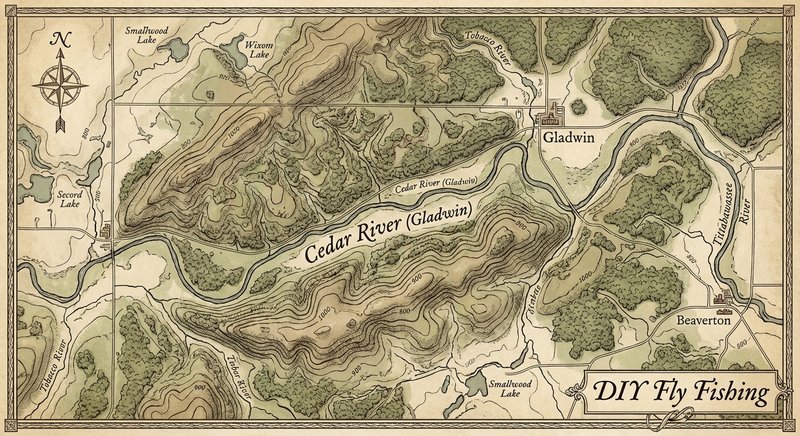
Cedar River (Gladwin)
Fly fishing in Michigan · Beginner · Best seasons: Spring, Summer, Fall
Target Species
Brook Trout, Brown Trout
About This Water
Scenic trout stream in central Michigan. Wild brook trout and stocked browns.
Fishing Recommendations
The Cedar River in Gladwin County is one of Michigan’s true "sleeper" trout streams. While crowds flock to the famous Au Sable or Manistee rivers just an hour further north, the Cedar offers a more intimate, secluded, and technically rewarding experience for the discerning fly angler.
As your guide, here is the comprehensive breakdown of how to fish this hidden gem.
🎣 Location Overview
The Cedar River is a tributary of the Tittabawassee River system. It is a classic Northern Michigan "sand and wood" stream. Characterized by its relatively small size, cold water, and abundance of submerged timber, it provides the perfect habitat for wild trout.
What makes the Cedar special is its intimacy. In many stretches, you can easily cast across it, but don't let the size fool you—the heavy cover provided by overhanging alders and fallen cedar logs protects some surprisingly large resident fish. The water is generally tea-colored (tannin-stained), which allows for slightly shorter leaders than the gin-clear Au Sable, but the fish remain highly wary.
🐟 Target Species & Behavior
The Cedar is primarily a Brook and Brown Trout fishery.
- Brook Trout: Found predominantly in the upper reaches and smaller tributaries. They are aggressive, beautiful, and thrive in the coldest water. Look for them in the "bubbly" water—at the heads of pools and tucked right against the bank.
- Brown Trout: As the river gains volume moving toward Gladwin, the Brown Trout become the dominant species. These fish are structure-oriented. They hold deep under "sweepers" (fallen trees) and undercut banks.
- Feeding Behavior: During the day, they are opportunistic nymph feeders. However, the Cedar is famous for its terrestrial activity in the summer. Big Browns here are notorious for coming out of the wood for a well-placed hopper or a late-night streamer.
📅 Best Times to Fish
Spring (Late April – June)
The "Classic" window. The season opens the last Saturday in April. This is when you’ll see the best aquatic insect hatches (Hendricksons, Sulphurs). Water levels are usually high but clear.
Summer (July – August)
The most fun for dry-fly enthusiasts. While midday heat can slow things down, the "Hopper-Dropper" game is elite here. Focus on the early mornings and the "magic hour" just before sunset.
Fall (September)
The Brown Trout begin to get aggressive and territorial ahead of the spawn. This is prime time for stripping streamers. The colors of the Brookies are also at their peak.
🪰 Recommended Flies & Techniques
Dry Flies
- Adams (Parachute): Sizes 14–18. The universal Michigan fly.
- Elk Hair Caddis: Sizes 14–16. Tan or Olive. Great for skating across riffles.
- Terrestrials: Dave’s Hopper (10–12), Black Ants (16), and Foam Beetles. These are essential from July through September.
Nymphs
- Bead-Head Pheasant Tail: Sizes 16–18.
- Gold-Ribbed Hare’s Ear: Sizes 14–16.
- Prince Nymph: Size 14 (works great in the darker, tannin water).
Streamers
- Woolly Buggers: Black or Olive (Size 6–10).
- Muddler Minnow: Excellent for mimicking sculpins or grasshoppers.
Techniques
- The "Poke and Hope": Because of the heavy brush, traditional backcasts are often impossible. Master the Roll Cast and the Bow-and-Arrow cast to get flies into tight pockets.
- Stealth Wading: Move slowly upstream. The Cedar is sandy; if you stomp, the vibrations and "sand plumes" will alert fish 50 yards ahead of you.
💡 Pro Tips & Local Knowledge
- Focus on the Wood: In the Cedar, "If you aren't losing flies, you aren't fishing." The biggest fish live in the absolute gnarliest log jams. You have to be willing to cast into the shadows.
- Upper vs. Lower: For Brookies, focus on the stretches north of Gladwin near the headwaters. For larger Browns, fish the stretches between River Road and Wiggins Lake.
- The "Twitch": When fishing a terrestrial or a caddis, give the fly a tiny "micro-twitch" just as it enters a soft pocket of water. It often triggers a strike from a skeptical Brown Trout.
- Light Rods: A 3-weight or 4-weight rod (7'6" to 8'6") is perfect. Anything heavier is overkill and difficult to maneuver in the brush.
⚠️ Important Information
Access
Public access is available at most road crossings. However, much of the riverbank is private property. In Michigan, you are legally allowed to fish as long as you stay in the water (the "feet wet" rule). Use public launch points or road right-of-ways to enter.
Regulations
- Classification: Most of the Cedar River is designated as Type 1 Trout Water.
- Season: Last Saturday in April – September 30.
- License: A valid Michigan Fishing License is required.
- Check DNR Maps: Always check the current Michigan DNR Trout Sidewall Maps for specific boundary changes or special gear restrictions.
Safety
- Cell Service: Can be spotty in the Cedar River valley. Let someone know where you are parking.
- Wading: Be careful of "stump holes." The sandy bottom can scour out deeply around fallen logs, turning 2 feet of water into 5 feet instantly.
Guide’s Final Word: The Cedar River doesn't give up its secrets easily. It requires patience and accurate casting. But when you land a buttery-gold Brown Trout in a stream no wider than a sidewalk, you’ll understand why this river is a local treasure.
Bug Hatches & Matching Flies
| Hatch | Type | Peak months | Time of day | Hook sizes | Matching flies |
|---|---|---|---|---|---|
| Blue-Winged Olive (BWO) Baetis | mayfly | April, May, September, October | Afternoon | #18-22 | RS2 #18-22, Parachute BWO #18-22, BWO Emerger #20 |
| Hendrickson Ephemerella subvaria | mayfly | April, May | Afternoon | #12-14 | Red Quill #12-14, Hendrickson Nymph #12-14, Hendrickson Spinner #12-14 |
| Grannom Caddis Brachycentrus | caddis | April, May | Morning/Afternoon | #14-16 | Peacock Caddis #14-16, Deep Sparkle Pupa #14-16, Elk Hair Caddis (Dark) #14-16 |
| Sulphur Ephemerella invaria/dorothea | mayfly | May, June | Evening | #14-18 | Sulphur Parachute #16-18, Pheasant Tail #14-18, Sulphur Spinner #14-18 |
| Brown Drake Ephemera simulans | mayfly | June | Evening/Night | #10-12 | Brown Drake Paradrake #10-12, Brown Drake Nymph #10-12 |
| Hex Hexagenia limbata | mayfly | June, July | Night | #4-8 | Hexagenia Spinner #6-8, Great Lakes Hex Nymph #4-8, Roberts Yellow Drake #6-8 |
| Trico Tricorythodes | mayfly | July, August | Morning | #20-24 | Trico Spinner #20-24, Trico Drown Spinner #22 |
| Terrestrials Formicidae/Gryllidae | terrestrial | July, August, September | Afternoon | #10-18 | Chernobyl Ant #10-14, Foam Beetle #14-18, Flying Ant #16-18 |
| White Miller Ephoron leukon | mayfly | August | Evening | #12-14 | White Wulff #12-14, Ephoron Spinner #12-14 |