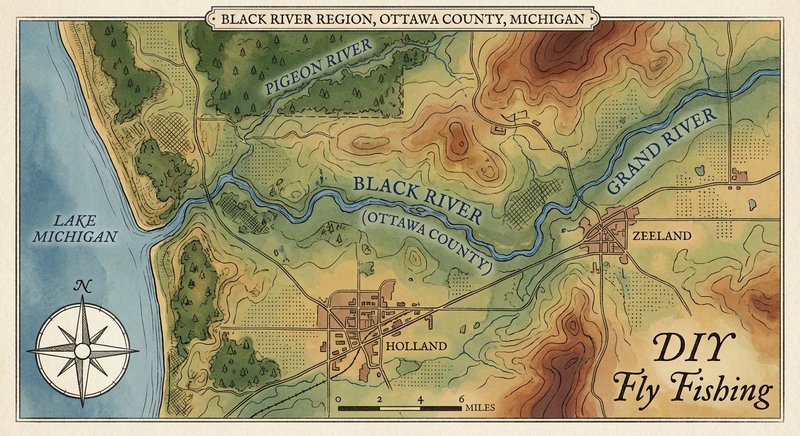
Black River (Ottawa County)
Fly fishing in Michigan · Beginner · Best seasons: Spring, Fall
Target Species
Steelhead, Brown Trout
About This Water
Spring steelhead runs near Lake Michigan. Good public access and consistent fishing.
Fishing Recommendations
As an expert guide who has spent decades navigating the river systems of the Great Lakes, I can tell you that the Black River in Ottawa County (specifically the portion flowing through Holland and out into Lake Macatawa) is a unique, often overlooked gem in the West Michigan fly fishing circuit.
While most anglers flock to the high-profile Muskegon or Grand Rivers, the Black River offers a more intimate, tactical experience for those chasing lake-run species.
🎣 Location Overview
The Black River in Ottawa County is a classic West Michigan lowland stream. Unlike the rocky, high-gradient rivers of the West, the Black is characterized by a sandy and silty bottom, heavy woody debris (log jams), and slower, deeper runs.
What makes it special is its connection to Lake Macatawa and subsequently Lake Michigan. It serves as a vital corridor for migratory salmonids. Anglers love it because it is manageable; you aren't fighting the massive flows of the Grand River. It offers a "small water" feel for "big water" fish. The water is often stained (tannic or turbid), which allows anglers to get a bit closer to the fish without spooking them, provided they stay stealthy.
🐟 Target Species & Behavior
Steelhead (Adfluvial Rainbow Trout)
These are the primary draw. They enter the river from Lake Michigan to spawn.
- Behavior: They are highly migratory. They use the deep holes and undercut banks to rest as they move upstream.
- Holding: Look for "inside bends" with some depth, or just downstream of major log jams. In the spring, they will move onto gravel patches (if you can find them) to spawn.
Brown Trout
The Black River holds a modest population of resident browns, but the real prizes are the "lake-run" browns that enter in the fall.
- Behavior: These fish are predatory and aggressive. They are often found tucked tight against wood cover.
- Feeding: Resident fish key in on hexagenia and caddis in the summer, but the big lake-run fish are there to feast on salmon eggs in the fall or small baitfish (emerald shiners).
📅 Best Times to Fish
Spring (March – Early May)
- The Window: Late March through mid-April is the peak for Steelhead.
- Conditions: Look for rising water temperatures. When the water hits 42°F–48°F, the fish become very active. A slight "stain" to the water after a rain is perfect to hide your tippet.
Fall (October – December)
- The Window: Late October through November is prime for Lake-run Browns and the first push of "winter-run" Steelhead.
- Conditions: After the first few hard frosts, the lake-run browns move in. Overcast, drizzly days are statistically the most productive for streamers.
Best Time of Day: First light is paramount. On a river this size, the first person through a hole usually has the best chance.
🪰 Recommended Flies & Techniques
Steelhead Techniques
- Indictor Nymphing: The most effective method here. Use a float to keep your fly just above the snag-heavy bottom.
- Flies:
- Eggs: Glo-bugs, Estaz Eggs, or beads (8mm or 10mm) in "Oregon Cheese" or "Mottled Roe."
- Nymphs: Stonefly imitations (size 6-10) in black or golden, and the "Prince Nymph."
Brown Trout Techniques
- Streamer Stripping: Use a sink-tip line and cast toward the opposite bank, stripping back across the current.
- Flies:
- Streamers: Sex Dungeon (White or Olive), Wooly Buggers (Black), and Zonkers to mimic shiners.
- Dry Flies: During June/July, look for the Hexagenia Limbata hatch at dusk.
💡 Pro Tips & Local Knowledge
- The "Wood" Factor: The Black River is full of "sweepers" (fallen trees). If you aren't losing a few flies, you aren't fishing where the fish are. Learn to "roll cast" accurately; overhead casting is often blocked by canopy.
- Stealth over Distance: You don't need 60-foot casts. You need 15-foot drifts with perfect mending. Approach the holes quietly; the vibration on the banks can spook fish in this smaller system.
- The Lower Reach: Focus on the stretches between Adams St. and the entry into Lake Macatawa. This area acts as a "staging ground" for fish waiting for a rain surge to push further upstream.
- Water Clarity: If the river looks like chocolate milk after a heavy storm, give it 48 hours. It clears slower than rocky rivers.
⚠️ Important Information
Access
Access can be tricky as much of the river flows through private land.
- Public Access: Check the Upper Macatawa Natural Area. There are trails and boardwalks that provide decent bank access to the river.
- Kayaking: A small kayak or canoe is an excellent way to reach the less-pressured "middle" sections of the river.
Regulations
- Type 4 Stream: Much of the Black River is designated as a Type 4 stream. This means it is open all year to fishing, but you must adhere to specific size and possession limits for trout and salmon.
- License: A standard Michigan All-Species Fishing License is required.
- Check the Digest: Always check the current Michigan DNR Fishing Guide before heading out, as rules regarding "snagging" and hook sizes are strictly enforced during salmon/steelhead runs.
Safety
The bottom can be "mucky." Be careful wading in areas where you cannot see the bottom, as silt pockets can be deep. A wading staff is highly recommended.
Bug Hatches & Matching Flies
| Hatch | Type | Peak months | Time of day | Hook sizes | Matching flies |
|---|---|---|---|---|---|
| Giant Michigan Mayfly (Hex) Hexagenia limbata | mayfly | June, July | Dusk/Night | #6-10 | Hexagenia Spinner #6-8, Wiggle Nymph #8-10, Hex Emerger #8 |
| Blue-Winged Olive Baetis | mayfly | April, May, September, October | Midday | #18-22 | BWO Sparkle Dun #18-20, Pheasant Tail #18-22 |
| Spotted Sedge Hydropsyche | caddis | May, June, July, August | Evening | #14-18 | Elk Hair Caddis #14-16, LaFontaine's Deep Sparkle Pupa #14-18 |
| Common Damselfly Enallagma | terrestrial | June, July, August | All Day | #10-14 | Adult Damselfly #10-12, Marabou Damsel Nymph #12-14 |
| White Miller Ephoron leukon | mayfly | August | Evening/Late Night | #12-14 | White Wulff #12-14, Snowshoe Mayfly #14 |
| Midges Chironomidae | midge | March, April, October, November | Morning/Evening | #18-24 | Zebra Midge #18-22, Griffith's Gnat #20-22 |
| Trico Tricorythodes | mayfly | July, August, September | Early Morning | #20-24 | Trico Spinner #22-24, RS2 #20-22 |
| Terrestrial Ants and Beetles Formicidae / Coleoptera | terrestrial | July, August, September | All Day | #12-18 | Chernobyl Ant #10-14, Foam Beetle #14-16 |