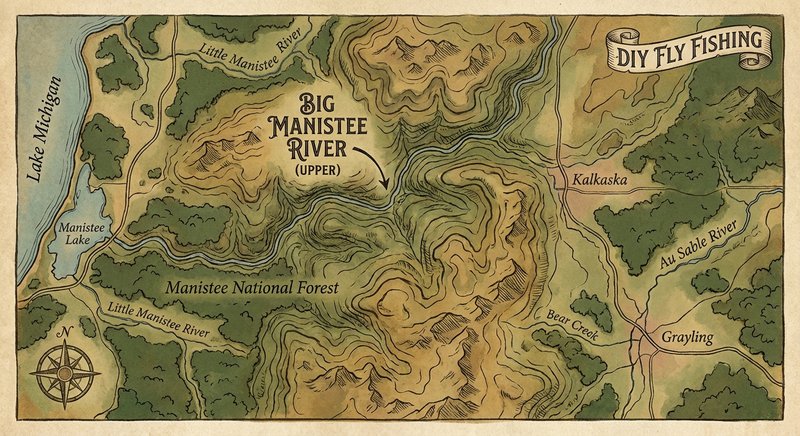
Big Manistee River (Upper)
Fly fishing in Michigan · Intermediate · Best seasons: Spring, Summer, Fall
Target Species
Brown Trout, Steelhead, Rainbow Trout
About This Water
Above Tippy Dam with excellent wade fishing. Brown trout and steelhead opportunities.
Fishing Recommendations
Welcome to the Upper Manistee River, one of the crown jewels of Michigan’s "mitten." As a guide, I consider the Upper Manistee (specifically from the headwaters down to Smithville) to be the quintessential Midwestern trout stream. It is a river of sand, cedar sweeps, and some of the most prolific insect hatches in the United States.
Note on Steelhead: Geographically, the "Upper" Manistee (above Tippy Dam and Hodenpyl Dam) is a landlocked trout fishery. Steelhead are found in the Lower Manistee (below Tippy Dam). This guide focuses on the Upper Manistee's resident trout, but I will include a note on the Lower River for your steelhead interest.
🎣 Location Overview
The Upper Manistee is a low-gradient, cold-water river that flows through glacial outwash sands. It is famous for its "sweepers"—fallen cedar trees that line the banks and provide complex overhead cover for large trout.
What makes it special is its stability. Being spring-fed through the sandy soil, it remains cold in the summer and rarely gets "blown out" by rain compared to freestone rivers. The section from Deward to Sharon Road is legendary, offering a remote, wilderness feel where the river meanders through state forest land. It is the birthplace of many classic dry flies and the heart of Michigan’s "Holy Waters" tradition.
🐟 Target Species & Behavior
- Brown Trout: The undisputed kings of the Upper Manistee. They are wild, wary, and highly structure-oriented. They hold tight to the "wood" (log jams). During the day, they are cautious, but they become aggressive predators during high-water streamer events or during the famous night-time hatches.
- Rainbow Trout: Found in the faster riffles and gravel sections. They are often more willing to rise to general attractor patterns than the browns.
- Brook Trout: In the far upper reaches (Deward area), you will find beautiful, wild Brookies in the colder, smaller water.
- Steelhead (Lower Manistee): If you are targeting Steelhead, you must head below Tippy Dam. These fish are Lake Michigan chrome that enter the river in the Fall (October–December) and Spring (March–May). They hold in deep runs and behind spawning gravel.
📅 Best Times to Fish
Spring (Late April – Early June)
This is "Hatch Season." The Hendrickson hatch in late April/early May kicks off the dry fly year. This is followed by Sulphurs and the Mother’s Day Caddis.
- Conditions: Water is high but clear.
- Time of Day: Mid-afternoon for hatches.
Summer (Mid-June – August)
The main event is the Hexagenia Limbata (The Hex) hatch, usually occurring from mid-June to early July. These are giant mayflies that bring the largest browns in the river to the surface at night.
- Conditions: Low, clear water.
- Time of Day: Late evening and "the midnight hour" for Hex; mornings for Tricos and terrestrials.
Fall (September – October)
The time for Streamer Fishing. As the browns prepare to spawn, they become territorial and aggressive.
- Conditions: Cooler air temperatures, changing leaves.
- Time of Day: All day, especially overcast or drizzly days.
🪰 Recommended Flies & Techniques
Dry Fly (The Purist’s Choice)
The Manistee is a dry fly river.
- Patterns: Roberts Yellow Drake (a local legend), Borchers Special, Adams (Parachute), and the Hex Parasol. For terrestrials, use Chernobyl Ants or Foam Grasshoppers along the grassy banks in August.
- Technique: "Reach casts" are essential to avoid drag caused by the complex currents around log jams.
Nymphing
- Patterns: Prince Nymphs, Pheasant Tails, and Hex Nymphs (wigglers).
- Technique: High-sticking through the short gravel runs between the deep bends.
Streamers (The Trophy Hunter’s Choice)
- Patterns: Kelly Galloup’s Dungeon, Sparkle Minnows, and Sculpin patterns in olive, black, or tan.
- Technique: "Pounding the wood." Cast your streamer as close to the sunken logs as possible and strip aggressively.
Steelhead (Lower River Only)
- Patterns: Egg patterns (beads), Black Stones, and large intruders in purple/pink.
- Technique: Indicator nymphing or swinging flies with a Spey rod.
💡 Pro Tips & Local Knowledge
- Fear the Wood: If you aren't losing a few flies to the sunken cedar logs, you aren't fishing where the big Browns live. You must cast into the shadows.
- The "Deward" Section: For a wilderness experience, fish the Deward area. It is a "Quality Trout Water" section with special regulations (strictly catch and release, flies only). It is shallow and very wadeable.
- Night Fishing: If you fish the Hex hatch, bring a red-lens headlamp. White light scares the fish. Listen for the "gulp"—big fish don't make a splash; they sound like a bowling ball dropping into the water.
- Stealth is Key: The water is often crystal clear and the bottom is sandy. Wear drab clothing and move slowly. The sand transmits vibrations; don't "stomp" while wading.
⚠️ Important Information
Access Points
- Deward: North of M-88. Remote and beautiful.
- 612 Bridge: A popular starting point for waders.
- Sharon Road: Good for launching drift boats or kayaks.
- Smithville: Where M-66 crosses; the transition point from upper to middle river.
Regulations
- Check the MI DNR Guide: Much of the Upper Manistee is designated as "Type 1" or "Type 2" trout water, but specific stretches (like Deward to Sharon Road) have Gear Restrictions (Flies Only) and specific size limits.
- License: You must have a valid Michigan Fishing License (all-species).
Safety
- The Sand: While the bottom is sand, it can be "soft" or "quick." Be careful of drop-offs near log jams where the current has scoured out deep holes.
- Sweepers: If you are in a boat, the Manistee is dangerous for beginners. The "sweepers" can easily flip a canoe or drift boat. Always scout downstream.
Guide’s Final Word: The Upper Manistee isn't about high fish counts; it's about the quality of the environment and the challenge of the "hunt." Respect the river, pinch your barbs, and enjoy the Michigan silence. Tight lines!
Bug Hatches & Matching Flies
| Hatch | Type | Peak months | Time of day | Hook sizes | Matching flies |
|---|---|---|---|---|---|
| Hendrickson Ephemerella subvaria | mayfly | April, May | Afternoon | #12-14 | Red Quill #12-14, Hendrickson Emerger #12-14, Pheasant Tail #12-14 |
| Grannom Caddis Brachycentrus | caddis | May | Morning/Afternoon | #14-16 | Elk Hair Caddis #14-16, Holy Grail #14-16, Peacock Caddis Larva #14-16 |
| Sulfur Ephemerella invaria/dorothea | mayfly | May, June | Late Afternoon/Evening | #14-18 | Sparkle Dun #14-18, Sulfur Parachute #16-18, Mercer's Poxyback Sulfur #14-18 |
| Brown Drake Ephemera simulans | mayfly | June | Evening/Night | #10-12 | Brown Drake Cripple #10-12, Brown Drake Spinner #10-12, Brown Drake Nymph #10-12 |
| Hex (Giant Michigan Mayfly) Hexagenia limbata | mayfly | June, July | Night | #4-8 | Hexagenia Spinner #4-6, Robert's Yellow Drake #6-8, Hex Wigglers #6-8 |
| Isonychia (Slate Drake) Isonychia bicolor | mayfly | June, July, August | Afternoon/Evening | #10-12 | Iso Parachute #10-12, Zug Bug #10-12, Isonychia Cripple #10-12 |
| Trico Tricorythodes | mayfly | July, August, September | Morning | #20-24 | Trico Spinner #20-24, Sunken Trico Spinner #22-24 |
| Blue Winged Olive Baetis | mayfly | April, September, October | Afternoon | #18-22 | BWO Parachute #18-22, RS2 #20-22, WD-40 #20-22 |
| Cinnamon Caddis Hydropsyche | caddis | June, July, August | Evening | #14-18 | Cinnamon Ant #14-16, Iris Caddis #14-16, Hare's Ear #14-18 |
| Grasshoppers Orthoptera | terrestrial | July, August, September | Late Morning/Afternoon | #8-12 | Dave's Hopper #8-12, Joe's Hopper #10-12, Charlie Boy Hopper #8-10 |