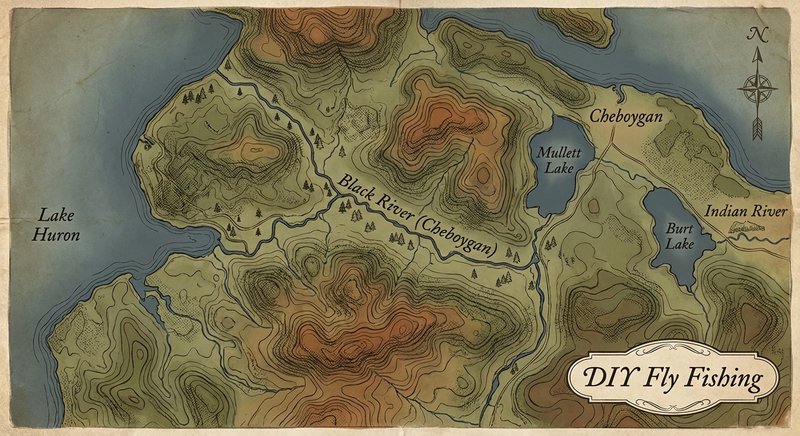
Black River (Cheboygan)
Fly fishing in Michigan · Beginner · Best seasons: Spring, Summer, Fall
Target Species
Brown Trout, Brook Trout
About This Water
Northern Michigan stream with good brown trout fishing. Less pressured than famous rivers.
Fishing Recommendations
The Black River in Cheboygan and Otsego Counties is one of the crown jewels of Michigan’s "Tip of the Mitt" fly fishing. Flowing through the vast, wild expanse of the Pigeon River Country State Forest (often called "The Big Wild"), the Black River is a classic freestone-style stream characterized by cold, groundwater-fed flows, abundant woody debris, and a prolific insect population.
Unlike the larger, more famous Au Sable, the Black is intimate, moody, and requires a stealthy approach. It is widely considered one of the finest wild Brook Trout fisheries in the Lower Peninsula.
🎣 Location Overview
The Black River is a quintessential Michigan trout stream. Its upper and middle reaches are defined by a mix of sandy flats, gravel runs, and an incredible amount of "sweepers" (fallen trees). This wood provides the primary overhead cover for trout and the primary habitat for the river's famous bug life.
The river is relatively small and wading-friendly, though the bottom can be "mucky" in the slower bends and extremely "stumpy" in others. What makes it special is the isolation. Because it flows through the 100,000-acre Pigeon River Country, you are more likely to see an elk or a black bear than another angler. It is a "purist’s" river where technical casting and stealth outweigh long-distance bombing.
🐟 Target Species & Behavior
Brook Trout
The Black is famous for its high density of wild, native-strain Brook Trout.
- Behavior: They are opportunistic but wary. In the upper reaches, they dominate the faster water and the heads of pools.
- Feeding: They love terrestrials in the summer and small nymphs year-round. They will rise readily to a well-presented dry fly.
Brown Trout
As you move downstream toward the "Lower" sections (above Kleber Pond), the Brown Trout become more prevalent.
- Behavior: These are the "ghosts" of the river. They hold tight to deep undercut banks and the darkest shadows of log jams.
- Feeding: Large Browns here are primarily nocturnal or low-light feeders. They transition to a fish-based diet (minnows, sculpins) once they cross the 12-inch mark.
📅 Best Times to Fish
Spring (Late April – June)
- The Window: This is "Hatch Season." Late May and June are the pinnacle of the year.
- Conditions: Water levels are high but clearing. Look for the Hendrickson hatch in May, followed by the Sulfurs and Gray Drakes in June.
Summer (July – August)
- The Window: The "Night Game."
- Conditions: This is the time for the legendary Hexagenia limbata (Hex) hatch. The Black has a tremendous Hex emergence, usually peaking in late June or early July. During the day, focus on "Hopper-Dropper" rigs.
Fall (September)
- The Window: Pre-spawn aggression.
- Conditions: Brook Trout turn brilliant shades of orange and red. They become very territorial. This is the best time to swing or strip small-to-medium streamers to trigger aggressive strikes.
🪰 Recommended Flies & Techniques
Dry Flies
- Borchers Special: A classic Michigan pattern that kills on the Black.
- Adams (Parachute or Standard): The gold standard for matching various mayflies.
- Roberts Yellow Drake: Essential for the late June evening hatches.
- Hexagenia Patterns: Size 4–6, deer hair or foam, for those dark summer nights.
- Terrestrials: Chernobyl Ants, Foam Beetles, and Dave’s Hoppers (July–Sept).
Nymphs & Streamers
- Prince Nymph / Pheasant Tail: Sizes 14–18 for dropper rigs.
- Rubber Legged Stoneflies: Great for high-water spring fishing.
- Muddler Minnow: A versatile fly for the Black; fish it as a grasshopper, a sculpin, or even skated on the surface.
- Woolly Bugger (Olive or Black): The go-to for searching deep wood for Browns.
Presentation Tips
- The "Side-Cast": Overhanging cedars make overhead casting difficult. Master the side-arm cast and the roll cast.
- Stealth is Vital: The water is often crystal clear. Wear earthy colors, stay low, and wade upstream to avoid sending silt and "pressure waves" to the fish.
💡 Pro Tips & Local Knowledge
- Focus on the "Pigeon River Country" Stretch: Focus your efforts between Tin Shanty Bridge and Saunders Dam (site). This is high-quality trout water with excellent public access.
- The Wood is the Key: On the Black River, if there isn't wood, there probably isn't a fish. Target the "soft water" right behind a submerged log or the dark "gully" underneath a sweeper.
- Night Fishing: If you are hunting a trophy Brown, you must be comfortable fishing after the sun goes down. The Hex hatch on the Black is a sensory experience—you often hear the fish gulping the bugs before you see them.
- The "Black River Hair Wing": Ask local shops about specific hair-wing patterns; they tend to float better in the turbulent pockets of the Black's upper sections.
⚠️ Important Information
Access
- Most of the prime water is within the Pigeon River Country State Forest. There are numerous marked access points (bridges and forest campgrounds).
- Be prepared for seasonal two-track roads that can be muddy in the spring.
Regulations
- Check the MI DNR Trout Map: The Black River has different regulations by section.
- Upper Black (Above Saunders): Generally falls under "Type 1" or "Type 2" regulations, but parts are strictly Gear Restricted (Artificial Lures Only). Always check the current Michigan Fishing Guide for the specific stretch you are fishing.
- Elk Awareness: You are in elk country. Give them space, especially during the fall rut.
Gear Recommendations
- Rod: A 7’6” to 9’ rod in a 4-weight or 5-weight is perfect. A shorter rod helps with tight overhead canopy.
- Leader: 9ft 4X or 5X for dries. If fishing streamers for Browns, don't be afraid to go up to 2X or 3X.
- Essentials: High-quality bug spray (the mosquitoes and "no-see-ums" are legendary) and a good headlamp for the hike back out of the woods.
Bug Hatches & Matching Flies
| Hatch | Type | Peak months | Time of day | Hook sizes | Matching flies |
|---|---|---|---|---|---|
| Blue-Winged Olive Baetis | mayfly | April, May, September, October | Late Morning/Afternoon | #18-22 | BWO Sparkle Dun #18-20, Pheasant Tail #18-22, RS2 #20-22 |
| Hendrickson Ephemerella subvaria | mayfly | May | Afternoon | #12-14 | Hendrickson Parachute #12-14, Red Quill #14, Hendrickson Wet Fly #12-14 |
| American Grannom Brachycentrus | caddis | May | Late Morning/Afternoon | #14-16 | Elk Hair Caddis (Olive) #14-16, LaFontaine's Deep Pupa #14-16, Peacock Caddis #14-16 |
| Sulphur Ephemerella invaria/dorothea | mayfly | June | Late Afternoon/Evening | #14-18 | Sulphur Parachute #16-18, Sulphur Snowshoe Emerger #14-16, Pheasant Tail (Flashback) #16-18 |
| Brown Drake Ephemera simulans | mayfly | June | Dusk/Evening | #10-12 | Brown Drake Spinner #10-12, Brown Drake Cripple #10-12 |
| Giant Michigan Mayfly Hexagenia limbata | mayfly | June, July | Late Evening/Night | #4-8 | Hex Parachute #6-8, Robert's Yellow Drake #6-8, Hex Nymph (Wiggle) #4-8 |
| Little Yellow Sally Isoperla | stonefly | June, July | Afternoon/Evening | #14-16 | Yellow Stimulator #14-16, Little Yellow Sally Nymph #14-16 |
| White Miller Ephoron leukon | mayfly | August | Evening/Night | #12-14 | White Wulff #12-14, Ephoron Spinner #12-14 |
| Trico Tricorythodes | mayfly | July, August, September | Early Morning | #22-26 | Trico Spinner (Poly Wing) #22-24, Trico Dun #22-24 |
| Terrestrials Formicidae/Orthoptera | terrestrial | July, August, September | All Day | #8-18 | Chernobyl Ant #8-12, Black Foam Ant #16-18, Joe's Hopper #10-14 |