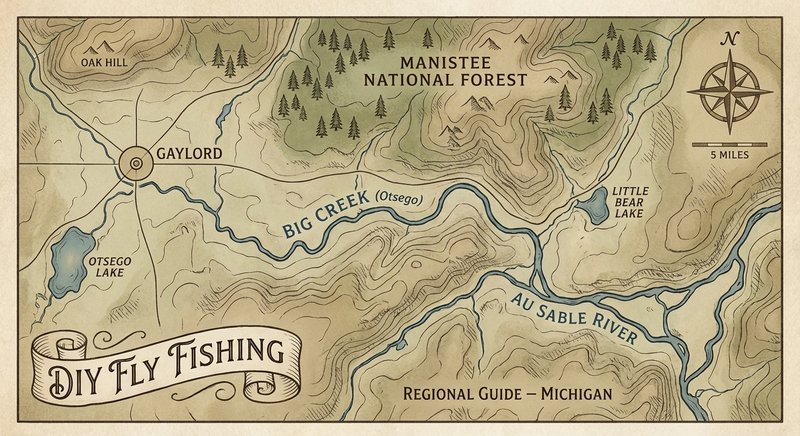
Big Creek (Otsego)
Fly fishing in Michigan · Intermediate · Best seasons: Spring, Summer, Fall
Target Species
Brook Trout
About This Water
Northern Michigan creek with wild brook trout. Cold spring-fed waters.
Fishing Recommendations
As an expert guide familiar with the "Holy Waters" region of Michigan, I can tell you that Big Creek, a major tributary to the Mainstream of the Au Sable River in Otsego and Crawford counties, is a gem for the purist. While many anglers rush to the big water of the Au Sable, those in the know head to Big Creek for a more intimate, challenging, and rewarding experience with Michigan’s state fish.
Here is your comprehensive guide to fly fishing Big Creek.
🎣 Location Overview
Big Creek is the epitome of a Northwoods trout stream. It is a cold, spring-fed system characterized by its crystal-clear water, sandy bottom punctuated by gravel runs, and an abundance of "LWD" (Large Woody Debris).
What makes it special is its stability. Because it is fed by groundwater through the deep glacial sands of Otsego County, it remains cold even during the hottest Michigan summers. It is a narrow, brushy, and winding stream that demands technical precision. This isn't a place for long, soaring casts; it’s a place for "trout hunting" in the shadows of cedar swamps.
🐟 Target Species & Behavior
The primary draw here is the Wild Brook Trout. While you may find an occasional brown trout near the confluence with the Au Sable, Big Creek is a stronghold for native-strain brookies.
- Behavior: These fish are notoriously "spooky." In the clear, shallow water, they can see an angler from a distance. They are light-sensitive and spend the midday hours tucked deep under undercut banks or "sweepers" (downed cedar trees).
- Feeding: They are opportunistic but cautious. They feed heavily on nymphs in the drift, but they are most famous for their willingness to rise to a well-placed dry fly or smash a terrestrial dropped near a log jam.
📅 Best Times to Fish
Seasons
- Spring (Late April – May): The season opener (last Saturday in April) can be cold, but this is when the Hendrickson hatches begin. As the water hits 50°F, the brookies shake off their winter lethargy.
- Summer (June – August): This is the prime window. While other rivers get too warm, Big Creek stays in the 50s and low 60s. This is the time for classic dry fly action and terrestrials.
- Fall (September): This is "Pre-Spawn" season. The Brook Trout take on magnificent fiery orange colors. They become more aggressive and will strike larger patterns to protect territory.
Time of Day
- Early Morning: Best during the heat of mid-summer for Trico hatches.
- Evening: The "Magic Hour" before dusk is when the largest fish lose their caution and move out from under logs to feed on the surface.
🪰 Recommended Flies & Techniques
Top Fly Patterns
- Dry Flies:
- Standard: Parachute Adams (Size 14-18), Royal Wulff (14-16).
- Local Classics: Roberts Yellow Drake, Au Sable Wulff.
- Terrestrials: Foam Ants (Black/Cinnamon), Dave’s Hopper, or small Beetles.
- Nymphs:
- Pheasant Tail (16-20), Gold-Ribbed Hare’s Ear (14-18), and Prince Nymphs.
- Streamers:
- Muddler Minnows or small Black Wooly Buggers (Size 8-10) to mimic sculpins.
Techniques & Presentation
- The "Bow-and-Arrow" Cast: In many stretches, the alders and cedars are so thick you cannot overhead cast. Learning to load the rod by holding the fly and "shooting" it into tight pockets is essential.
- Upstream Approach: Always fish moving upstream. Because the water is clear and slow, fishing downstream will send ripples and silt toward the fish, alerting them to your presence.
- Light Tackle: Use a 2-weight to 4-weight rod, no longer than 7.5 feet. A 9-foot rod is a liability in this brush. Use long, fine tippets (5X or 6X) to avoid spooking fish.
💡 Pro Tips & Local Knowledge
- Focus on the Wood: In Big Creek, Wood = Fish. If you see a submerged log with a bit of a bubble line or foam on the upstream side, there is almost certainly a brook trout underneath it.
- The "One Cast" Rule: On these small creeks, you usually get one shot. If you slap the water or drag the fly, the fish will go "down" (stop feeding) for an hour. Observe the pool for a minute before casting.
- Stealth is Everything: Wear drab colors (olive or tan) to blend in with the cedars. Avoid "shiny" gear that might flash in the sun. If you can see the fish, they have likely already seen you.
- The West Branch vs. North Branch: Explore the different branches within the Otsego/Crawford area. The smaller the water, the higher the percentage of Brook Trout vs. Browns.
⚠️ Important Information
- Access: Much of Big Creek flows through private land, but there are several key public access points via State Forest land and county road bridges (e.g., Big Creek Road crossings). Always check the Michigan DNR Trout Trails map for specific public access points.
- Regulations: Big Creek is generally classified as Type 1 Trout Water.
- Season: Last Saturday in April – Sept. 30.
- Size Limit: 7 inches for Brook Trout.
- Daily Limit: 5 fish (though most serious anglers here practice 100% Catch & Release to preserve the fishery).
- Special Considerations:
- Bugs: In June and July, the "Cedar Gnats" (black flies) and mosquitoes can be brutal. Bring heavy-duty repellent or a head net.
- Wading: The bottom is mostly sand, but watch out for "muck holes" and deep pockets created by current around log jams. A wading staff is highly recommended.
Guide’s Final Word: Big Creek isn't about the size of the fish—a 10-inch Brookie here is a trophy. It’s about the silence of the swamp, the smell of the cedars, and the jewel-like colors of a wild Michigan trout. Respect the water, and it will reward you.
Bug Hatches & Matching Flies
| Hatch | Type | Peak months | Time of day | Hook sizes | Matching flies |
|---|---|---|---|---|---|
| Hendrickson Ephemerella subvaria | mayfly | May | Afternoon | #12-14 | Red Quill #12-14, Hendrickson Emerger #14, Pheasant Tail Nymph #12-14 |
| Sulphur Ephemerella invaria/dorothea | mayfly | May, June | Evening | #14-18 | Sulphur Parachute #16-18, Sparkle Dun #14-16, Sulphur Nymph #16 |
| Brown Drake Ephemera simulans | mayfly | June | Evening/Dusk | #10-12 | Brown Drake Spinner #10-12, Brown Drake Cripple #10-12 |
| Hex Hexagenia limbata | mayfly | June, July | Night | #4-8 | Hex Spinner #4-6, Robert's Yellow Drake #6-8, Hex Nymph #6 |
| Blue Winged Olive Baetis spp. | mayfly | April, May, September, October | Afternoon | #18-22 | BWO Sparkle Dun #18-20, RS2 #20-22 |
| Grannom Caddis Brachycentrus | caddis | May | Morning/Afternoon | #14-16 | Elk Hair Caddis (Olive) #14-16, Peacock Caddis #16, Deep Sparkle Pupa #14 |
| Isonychia Isonychia bicolor | mayfly | July, August, September | Late Afternoon/Evening | #10-12 | Iso Parachute #12, Prince Nymph #10-12, Iso Nymph #10-12 |
| Trico Tricorythodes spp. | mayfly | July, August, September | Morning | #20-24 | Trico Spinner #22-24, Trico Drowned Spinner #22 |
| Terrestrials Formicidae / Orthoptera | terrestrial | July, August | Mid-day | #8-16 | Chernobyl Ant #8-12, Black Foam Beetle #14-16, Cinnamon Ant #16 |