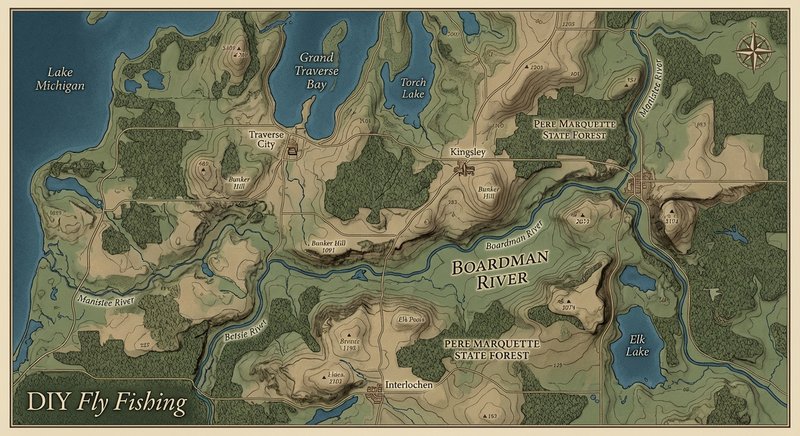
Boardman River
Fly fishing in Michigan · Beginner · Best seasons: Spring, Summer, Fall
Target Species
Brown Trout, Brook Trout
About This Water
Near Traverse City with excellent brown and brook trout. Multiple sections with varied water.
Fishing Recommendations
The Boardman River is the crown jewel of Traverse City, Michigan. It is a river of history, resilience, and classic "spring creek" characteristics. Often cited as the birthplace of the Adams Fly (first fished on the Boardman’s tributary, Cassidy Creek), this river offers a quintessential Michigan trout fishing experience.
Following the massive restoration project involving the removal of three dams (Brown Bridge, Boardman, and Sabin), the river has returned to a more natural, free-flowing state, opening up miles of cold-water habitat and pristine gravel.
🎣 Location Overview
The Boardman is divided into several distinct personalities. The Upper Boardman (above the former Brown Bridge Dam site) and its forks (North and South) are intimate, brushy, and cold—perfect for the minimalist angler. As it moves toward Traverse City, the river widens, offering classic riffles, deep pools, and significant woody debris.
What makes it special is the water quality. It is exceptionally clear and stays cold even in the heat of summer. The bottom is a mix of gravel and sand, providing excellent spawning grounds. Anglers love the Boardman because it offers "technical" dry fly fishing; it demands accuracy and stealth, rewarding the patient angler with some of the most beautiful wild trout in the Midwest.
🐟 Target Species & Behavior
Brook Trout
- Where they hold: Dominant in the Upper Boardman and the North/South Forks. They love "pockets" and the upstream side of log jams.
- Behavior: Aggressive and willing to rise. They are the first to hit a dry fly in the morning.
- Feed: Heavily reliant on aquatic insects (Stoneflies, Caddis) and terrestrials.
Brown Trout
- Where they hold: Found throughout, but larger specimens dominate the middle and lower stretches (the "restored" sections). Look for them under "sweepers" (fallen trees) and in the deep undercut banks.
- Behavior: Highly wary and often nocturnal. During the day, they require a perfect drift. During a hatch, they will move into the tail-outs of pools to sip duns.
- Feed: Opportunistic. They love big meals—crayfish, sculpins, and the massive Hexagenia mayflies.
📅 Best Times to Fish
- Spring (May - June): This is the "Hatch Master" window. Late May brings the Hendricksons, followed by Brown Drakes and Isonychia in June. This is the best time for high-volume dry fly action.
- Summer (July - August): The time for Terrestrials (ants, beetles, and grasshoppers) during the day and the legendary Hex Hatch (late June through early July) at night. Mousing at night is also highly effective in July.
- Fall (September - October): As the water cools, Brown trout become aggressive ahead of the spawn. This is prime Streamer Season. You are hunting for the "Alpha" fish during this window.
- Prime Window: Low light is your friend. The "Grey Drake" and "Spinner" falls at dusk are often the most productive 60 minutes of the day.
🪰 Recommended Flies & Techniques
Dry Flies
- The Adams (Parachute or Traditional): Sizes 12-18. It’s a local law to have one in your box!
- Roberts Yellow Drake: A Michigan staple for the evening Drake hatches.
- Hexagenia Patterns: Large (size 4-6) foam or deer hair patterns for the midnight madness.
- Chernobyl Ant / Foam Hoppers: Excellent for "pounding the banks" in August.
Nymphs
- Pheasant Tail & Hare’s Ear: Sizes 14-18. The gold standards.
- Prince Nymph: Effective in the faster riffles of the restored sections.
- Rubber-Legged Stoneflies: Great for high-water spring conditions.
Streamers
- Sculpin Patterns (Zoo Cougar or Sculpzilla): Fish these tight to the wood.
- Woolly Buggers: Black or Olive. Never leaves a guide’s box.
Technique Tip
"The Reach Cast": Because the Boardman has many micro-currents caused by submerged logs, a standard overhead cast will result in instant drag. Use a reach cast to place your line upstream of your fly, giving you those extra 2–3 seconds of a dead drift that a Boardman Brown demands.
💡 Pro Tips & Local Knowledge
- The "Brown Bridge Quiet Area": This is the holy grail of the river. Since the dam removal, the river here has carved a beautiful new path. It is wade-friendly and holds a high density of fish.
- Wood is King: In Michigan, we say, "If you aren't losing flies, you aren't fishing where the fish are." The Boardman is full of timber. You must be brave enough to cast within inches of the logs.
- The "Boardman Twitch": When fishing a dry fly and the drift is nearly over, give the fly a tiny, microscopic twitch. Sometimes this triggers a strike from a Brown trout that has been tracking the fly for ten feet.
- Stealth: The water is gin-clear. Wear natural colors (camo, tan, or olive), move slowly, and avoid splashing. If you see the fish, they have likely already seen you.
⚠️ Important Information
- Access: Much of the Boardman is accessible via public land. Key access points include the Forks Campground, Brown Bridge Quiet Area, and various bridge crossings (Schumsky, Cass Rd).
- Regulations: The Boardman has different regulations depending on the section.
- Most of the upper river is Type 1 (Open last Saturday in April – Sept 30).
- Some lower sections are Type 4.
- Always check the current Michigan DNR Trout Sidwell maps before heading out.
- Safety: Watch out for "silt pockets" in the recently restored dam sections. The bottom can be soft in spots where the old ponds used to be. A wading staff is highly recommended.
- Permits: A standard Michigan Fishing License is required.
The Boardman is a river that rewards technical skill and a deep respect for the environment. Tight lines!
Bug Hatches & Matching Flies
| Hatch | Type | Peak months | Time of day | Hook sizes | Matching flies |
|---|---|---|---|---|---|
| Hendrickson Ephemerella subvaria | mayfly | April, May | Afternoon | #12-14 | Red Quill #12-14, Hendrickson Emerger #14, Pheasant Tail #12-14 |
| Sulphur Ephemerella invaria / dorothea | mayfly | May, June | Evening | #14-18 | Sulphur Parachute #16-18, CDC Sulphur Emerger #16, Yellow Haze #14-16 |
| Brown Drake Ephemera simulans | mayfly | June | Evening/Dusk | #8-12 | Brown Drake Spinner #10-12, Brown Drake Paradrake #10, Hare's Ear Nymph #8-10 |
| Hex Hexagenia limbata | mayfly | June, July | Night | #4-8 | Hexagenia Spinner #4-6, Robert's Yellow Drake #6-8, Hex Nymph #6-8 |
| Blue Winged Olive Baetis / Drunella | mayfly | April, May, September, October | Afternoon | #18-22 | BWO Sparkle Dun #18-20, RS2 #20-22, Baetis Nymph #18-20 |
| Trico Tricorythodes | mayfly | July, August, September | Morning | #20-24 | Trico Spinner #22-24, Griffith's Gnat #20-22 |
| Cinnamon Caddis Hydropsyche | caddis | June, July, August | Evening | #14-16 | Elk Hair Caddis (Cinnamon) #14-16, LaFontaine's Deep Sparkle Pupa #14-16 |
| Isonychia Isonychia bicolor | mayfly | July, August, September | Late Afternoon | #10-12 | Iso Parachute #10-12, Prince Nymph #10-12, Zug Bug #10-12 |
| Terrestrials Formicidae / Gryllidae | terrestrial | July, August, September | All Day | #10-16 | Chernobyl Ant #10-12, Black Foam Ant #14-16, Dave's Hopper #10-12 |