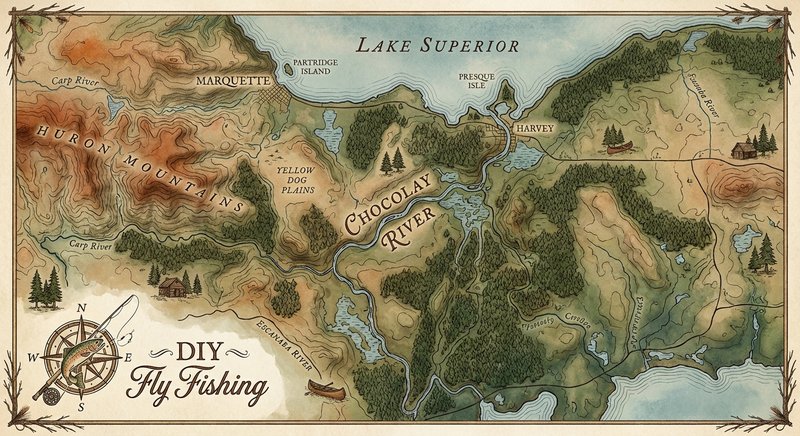
Chocolay River
Fly fishing in Michigan · Intermediate · Best seasons: Spring, Summer, Fall
Target Species
Steelhead, Brook Trout, Brown Trout
About This Water
Upper Peninsula river near Marquette. Steelhead runs and resident brook trout.
Fishing Recommendations
The Chocolay River, located just south of Marquette in Michigan’s Upper Peninsula (U.P.), is a gem of the Lake Superior watershed. While it may not have the national fame of the Au Sable or the Manistee, for those in the know, the "Choc" offers a diverse, rugged, and rewarding fly fishing experience.
🎣 Location Overview
The Chocolay River is a medium-sized stream that flows through the heart of the U.P. before emptying into Lake Superior at Harvey. It is characterized by its tannic, tea-colored water and a diverse substrate that transitions from gravel and cobble in the upper reaches to deeper, sandy runs near its mouth.
What makes the Chocolay special is its dual personality: it serves as a critical spawning tributary for Lake Superior’s migratory salmonids (Steelhead and Coho) while maintaining a healthy resident population of native Brook Trout and Brown Trout. Unlike the high-pressure rivers of Lower Michigan, the Chocolay offers a more intimate, "Northwoods" feel where you can often find a stretch of water all to yourself.
🐟 Target Species & Behavior
Steelhead (Adfluvial Rainbow Trout)
- Behavior: These are Lake Superior "chrome." They enter the river in both fall and spring. They are incredibly hardy and known for their aerial acrobatics.
- Holding: In the lower river, look for deep holes and undercut banks. On the spawning grounds (further upstream), look for the "tail-outs" of pools and the edges of gravel runs.
- Feeding: They generally stop feeding heavily once in the river, but they strike out of aggression or instinct.
Brook Trout
- Behavior: These are the native crown jewels of the river. They are found primarily in the colder upper reaches and tributaries (like Silver Lead Creek).
- Holding: They love "structure"—fallen logs, overhanging brush, and the heads of deep pools.
- Feeding: Opportunistic feeders. They thrive on aquatic insects (caddis, mayflies) and terrestrial insects like grasshoppers and ants in the summer.
Brown Trout
- Behavior: The resident Browns can be elusive and tend to be more nocturnal or low-light active. There are also "lake-run" Browns that enter from Superior in the fall.
- Holding: They are the kings of the undercut banks and deep, woody debris.
- Feeding: Large Browns are piscivorous; they want meat. Streamers mimicking sculpins or small trout are key.
📅 Best Times to Fish
- Spring (Late March – May): This is Steelhead prime time. As the ice breaks and the snowmelt begins, the main run enters the river. Look for water temperatures to hit the 42–50°F range for peak activity.
- Summer (June – August): Focus on Brookies and Browns. Evening hatches can be spectacular. This is the best time for "dry-fly-or-die" anglers. Early mornings and late evenings are essential as the sun stays high and bright in the U.P. summer.
- Fall (September – November): A "Choose Your Adventure" season. September brings the Coho Salmon, October sees the Fall Steelhead follow them in to eat eggs, and the resident Brown Trout become aggressive as they prepare to spawn.
🪰 Recommended Flies & Techniques
For Steelhead
- Patterns: Egg patterns (Glo-Bugs, Hevi-Beads in chartreuse or peach), Stonefly nymphs (Size 6-10, black or gold), and "Swing" flies like the Egg-Sucking Leech or Intruders in purple/black.
- Technique: High-stick nymphing or indicator nymphing is most effective here. If you enjoy the "swing," use a Spey or switch rod in the lower, wider sections of the river near Harvey.
For Brook & Brown Trout
- Dry Flies: Elk Hair Caddis (size 14-18), Adams (size 12-16), and the "Chernobyl Ant" or other foam terrestrials in July and August.
- Streamers: The Muddler Minnow is a local legend here (fished dry or wet). Also, Sparkle Minnows and Woolly Buggers in olive or black.
- Technique: "Pound the banks." Accuracy is more important than distance. For Browns, use a "strip-and-pause" retrieve with streamers near submerged wood.
💡 Pro Tips & Local Knowledge
- Find the Wood: The Chocolay is a "woody" river. If you aren't losing a few flies to submerged logs, you aren't fishing where the big fish are. Use a slightly heavier tippet (3x or 4x) than you think you need to pull fish away from the snags.
- The Tannic Tint: Because the water is tea-colored, high-visibility colors often work better than you'd expect. Fluorescent oranges and pinks for eggs, and dark black silhouettes for streamers, show up well in the dark water.
- Tributary Secrets: Don't just fish the main stem. Small tributaries flowing into the Chocolay often hold the highest concentrations of native Brook Trout, especially when the main river warms up in mid-July.
- Stealth Matters: Despite the dark water, these fish are spooky. Avoid wading deeply if you can cast from the bank, and keep your shadow off the water.
⚠️ Important Information
Access Information
- M-28 Bridge: A popular spot in Harvey for those targeting lake-run fish entering the system.
- Kawbawgam Road: Provides access to several stretches of the lower/middle river.
- Public Lands: Much of the upper river flows through State Forest land—look for dirt two-tracks off US-41 or County Road 480.
Regulations & Permits
- License: A standard Michigan Fishing License is required.
- Regulations: The Chocolay is generally classified under Type 4 Regulations. This means it is open all year for catch and release, but specific seasons apply for harvest. Always check the current Michigan DNR Fishing Guide as rules regarding Steelhead limits have recently seen changes.
- Wading Safety: The bottom can be "mucky" or sandy in spots, which can create "sinkholes." Use a wading staff and be cautious of shifting sandbars near the mouth.
Special Considerations
- Bug Spray: The U.P. is famous for its mosquitoes and black flies (the "state bird"). From June through August, DEET or Permethrin-treated clothing is not optional—it’s a necessity.
- Respect the Resource: The native Brook Trout are a fragile resource. Please practice Catch and Release for resident trout to ensure the Choc remains a world-class fishery.
Bug Hatches & Matching Flies
| Hatch | Type | Peak months | Time of day | Hook sizes | Matching flies |
|---|---|---|---|---|---|
| Blue-Winged Olive Baetis | mayfly | May, September, October | Afternoon | #18-22 | BWO Sparkle Dun #18-20, Pheasant Tail #18-22, RS2 #20 |
| Hendrickson Ephemerella subvaria | mayfly | May | Afternoon | #12-14 | Hendrickson Pink Lady #12-14, Hare's Ear #12-14, Hendrickson Emerger #14 |
| Grannom Caddis Brachycentrus | caddis | May | Morning/Afternoon | #14-16 | Peacock Caddis #14-16, Deep Sparkle Pupa #14-16, Elk Hair Caddis (Olive) #14-16 |
| Sulphur Ephemerella invaria | mayfly | June | Evening | #14-16 | Sulphur Parachute #14-16, Split Case Sulphur #16, CDC Sulphur Emerger #14-16 |
| Brown Drake Ephemera simulans | mayfly | June | Late Evening | #10-12 | Brown Drake Spinner #10-12, Brown Drake Paradrake #10, Gold Ribbed Hare's Ear #10 |
| Giant Michigan Mayfly (Hex) Hexagenia limbata | mayfly | July | Night | #6-8 | Hexagenia Parachute #6-8, Hex Hagen #6-8, Michigan Wigglers #6-8 |
| Golden Stonefly Acroneuria | stonefly | June, July | Morning/Evening | #8-12 | Kaufmann's Stimulator (Yellow) #8-12, Pat's Rubber Legs #8-12, Golden Stone Nymph #10 |
| Terrestrials (Grasshoppers/Ants) Formicidae/Acrididae | terrestrial | July, August, September | Mid-day | #10-16 | Chernobyl Ant #10-14, Parachute Hopper #10-12, Black Foam Ant #14-16 |
| White Miller Ephoron leukon | mayfly | August | Evening/Night | #12-14 | White Wulff #12-14, Ephoron Spinner #14 |