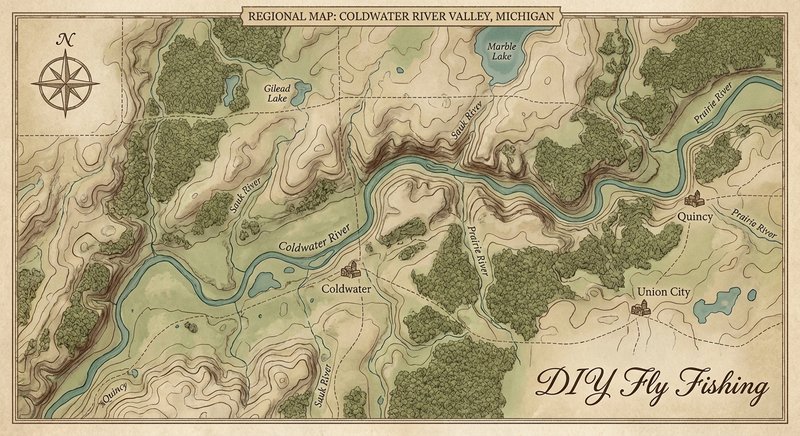
Coldwater River
Fly fishing in Michigan · Beginner · Best seasons: Spring, Summer, Fall
Target Species
Brown Trout, Brook Trout
About This Water
Spring-fed stream with excellent water temperatures. Quality brown trout fishing.
Fishing Recommendations
The Coldwater River (specifically the one located in Kent and Barry Counties, near Freeport and Middleville) is one of West Michigan’s hidden gems. While the region is famous for the mighty Muskegon and Pere Marquette, the Coldwater is a intimate, spring-fed tributary of the Thornapple River that offers a classic "chalk-stream" feel in the heart of the Midwest.
Here is your comprehensive guide to fly fishing the Coldwater River.
🎣 Location Overview
The Coldwater River is a rare treasure in Southern Michigan—a true cold-water ecosystem capable of supporting wild trout in a landscape dominated by warm-water agriculture. It is characterized by its narrow width (15-30 feet in most places), crystal clear water, and a mix of sandy flats, gravel runs, and deep, undercut banks.
What makes it special is its intimacy. This is not a river for long casts or drift boats; it is a "technical" wading river. Anglers love it because it requires stealth, precision, and a "stalking" mentality. The heavy overhead canopy and fallen timber provide excellent cover, creating a sanctuary for wild fish that are surprisingly weary for their size.
🐟 Target Species & Behavior
- Brown Trout: The "kings" of the Coldwater. These are primarily wild or long-term holdover fish. They are nocturnal and predatory. They hold tight to the "wood"—fallen trees and log jams—and deep under the overhanging banks.
- Brook Trout: Found more frequently in the upper reaches and near the mouths of cold feeder creeks. They are opportunistic but shy. Look for them in the faster, oxygenated riffles and at the heads of pools.
Feeding Behavior: In the early season, they focus on subsurface nymphs. As the water warms, the Coldwater becomes a dry-fly paradise. Because it is a smaller stream, the trout are very sensitive to "pressure" and shadow—if they see you, the fishing is over for that hole.
📅 Best Times to Fish
- Spring (Late April – June): This is the prime window. The Hendrickson hatch in late April/early May kicks off the dry fly season, followed by Sulphurs and the legendary Michigan Hexagenia (though the Hex hatch here is more sporadic than on the Au Sable).
- Summer (July – August): The river stays remarkably cool due to groundwater, but fishing is best in the early morning or late evening. Terrestrial fishing (hoppers/ants) becomes the main event during the heat of the day.
- Fall (September – October): Brown trout become aggressive and territorial as they prepare to spawn. This is the best time to throw streamers to entice a strike from the largest fish in the system.
🪰 Recommended Flies & Techniques
Top Fly Patterns
- Dry Flies: Adams (Parachute and Traditional) #14-18, Sulphurs #16, Elk Hair Caddis #14-16, and Roberts Yellow Drake.
- Terrestrials: Fat Albert (Tan/Black) #10, Cinnamon Ants #16, and Dave’s Hopper.
- Nymphs: Gold-Ribbed Hare’s Ear #14-16, Pheasant Tail #16-18, and Prince Nymphs.
- Streamers: Black or Olive Wooly Buggers (size 8), and small Sculpin patterns (Muddler Minnows).
Techniques & Presentation
- The "Bow-and-Arrow" Cast: Often, the brush is too thick for a backcast. Master this technique to get your fly under overhanging branches.
- Downstream Dry Fly: To avoid lining the fish, many local guides prefer to stay upstream of a rising fish and drift the fly down to them on a slack line.
- Tight-Line Nymphing: Given the wood debris, using a strike indicator can often lead to tangles. High-sticking a nymph through the deeper slots is highly effective.
💡 Pro Tips & Local Knowledge
- Focus on the "Dolan Nature Sanctuary": This area offers some of the best public access and well-maintained bank conditions.
- Stealth is Everything: Wear drab colors (camo or earth tones). Approach pools from downstream and move slowly. If you splash, wait five minutes before casting.
- The "Wood" Rule: If you aren't losing a few flies to the submerged logs, you aren't fishing where the big Browns live. Cast as tight to the timber as you dare.
- Look for Seeps: Keep an eye on the banks. Areas where you see water "seeping" out of the hillside indicate a cold groundwater source—trout will congregate here during the dog days of August.
⚠️ Important Information
- Access: Much of the river flows through private farmland. Always respect private property. Public access points are found at bridge crossings (especially Morse Lake Rd and Baker Rd) and within the Michigan Nature Association’s Dolan Sanctuary.
- Regulations: The Coldwater River is generally managed under Type 4 regulations, but always check the current Michigan DNR Fishing Guide as rules regarding seasons and lure restrictions can change.
- Gear Recommendation: A 7.5' to 8.5' 4-weight rod is perfect. A 9-foot rod is often too long for the tight canopy. Use a 5x or 6x leader for dries, but don't be afraid to use 3x or 4x when throwing streamers for those bigger Browns.
- Wading Safety: The bottom is mostly stable, but there are "muck pockets" and deep holes near log jams. Use a wading staff if you are unfamiliar with the stretch.
Guide’s Final Word: The Coldwater isn't about high fish counts; it's about the quality of the experience. It is a place for the angler who enjoys the "puzzle" of a small stream and the reward of a wild, buttery-yellow Brown trout.
Bug Hatches & Matching Flies
| Hatch | Type | Peak months | Time of day | Hook sizes | Matching flies |
|---|---|---|---|---|---|
| Blue-Winged Olive (BWO) Baetis | mayfly | April, May, September, October | Late Morning/Afternoon | #18-22 | RS2 #20-22, BWO Sparkle Dun #18-22, Pheasant Tail #18-20 |
| Hendrickson Ephemerella subvaria | mayfly | late April, May | Afternoon | #12-14 | Hendrickson Pink Lady #12-14, Red Quill #12-14, Hare's Ear #12-14 |
| Sulphur Ephemerella invaria | mayfly | May, June | Evening | #14-18 | Sulphur Parachute #14-16, CDC Sulphur Emerger #16-18, Pale Morning Dun #16 |
| Brown Drake Ephemera simulans | mayfly | June | Late Evening | #10-12 | Brown Drake Spinner #10-12, Brown Drake Cripple #10-12 |
| Tan Caddis Hydropsyche | caddis | May, June, July | Morning/Evening | #14-16 | Elk Hair Caddis #14-16, LaFontaine Sparkle Pupa #14-16, Holy Grail #14-16 |
| Trico Tricorythodes | mayfly | July, August, September | Morning | #20-24 | Trico Spinner #20-24, Zebra Midge #20-22 |
| Slate Drake Isonychia bicolor | mayfly | June, September | Afternoon/Evening | #10-14 | Zug Bug #10-12, Parachute Adams #12-14, Iso Nymph #10-12 |
| Terrestrials Various | terrestrial | July, August, September | Mid-day | #12-18 | Cinnamon Ant #16-18, Black Beetle #14-16, Dave's Hopper #10-12 |