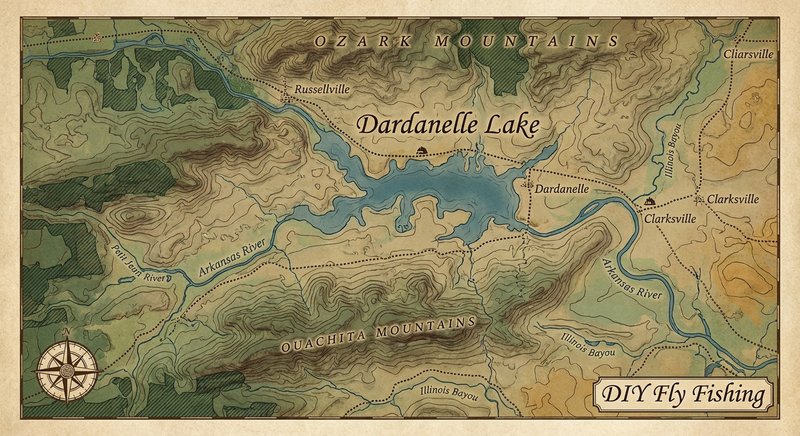
Dardanelle Lake
Fly fishing in Arkansas · Intermediate · Best seasons: Spring, Summer, Fall
Target Species
Largemouth Bass, Crappie, Blue Catfish
About This Water
Arkansas River impoundment with diverse fishing. Bass, crappie, and catfish.
Fishing Recommendations
Welcome to the "Natural State." As your guide, I’m excited to break down Lake Dardanelle, a massive 34,300-acre reservoir on the Arkansas River. While many associate this lake with professional bass boats and heavy conventional tackle, it is a sleeper hit for fly anglers who know how to navigate its murky backwaters and riverine currents.
🎣 Location Overview
Lake Dardanelle is an impoundment of the Arkansas River, stretching nearly 50 miles from the Dardanelle Dam to the Ozark-Jeta Taylor Lock and Dam. What makes this water special is its dual identity: it behaves like both a massive lowland lake and a powerful river.
The water is generally stained to murky, which is a significant factor for fly choice. The lake is characterized by vast fields of water justicia (water willow), lily pads, flooded cypress trees, and rocky jetties. Anglers love it because it offers "power fishing" opportunities—big fish in shallow cover—where a well-placed fly can trigger explosive strikes.
🐟 Target Species & Behavior
Largemouth Bass
Dardanelle is a factory for 3- to 6-pound bass. They are ambush predators here, holding tight to "fluff" (vegetation) and wood. Because it’s a river lake, the bass are highly attuned to current. When the dams are pulling water, the bass move to the points and the upstream sides of jetties to intercept shad.
Crappie
The lake holds both Black and White Crappie. They congregate around submerged brush piles and dock pilings. In the spring, they move into the "willow flies" (aquatic insects) and shallow structure, making them prime targets for a 4-weight fly rod.
Blue Catfish
While usually a "bottom-dweller" target for bait anglers, Dardanelle’s Blue Cats are aggressive. They frequently chase schools of Threadfin Shad. To catch them on the fly, you have to target them when they are active on flats or near the dams where they feed on stunned baitfish.
📅 Best Times to Fish
- Spring (March – May): The Prime Window. Bass move into the shallows to spawn. Crappie are in the brush in 4-8 feet of water. Look for water temperatures hitting 58°F–65°F.
- Summer (June – August): Focus on the "Golden Hours"—dawn and dusk. Mid-day heat pushes fish deep or into the thickest shade. This is peak "Frog" season for topwater bass.
- Fall (September – November): As temperatures drop, shad migrate to the back of the creeks (like Illinois Bayou). The bass follow. This is the best time for streamer fishing.
- Pro Window: Always check the generation schedule at the Dardanelle Dam. "Moving water is happy water." When the current is flowing, the bite turns on.
🪰 Recommended Flies & Techniques
For Largemouth Bass
- Topwater: Poppers and Divers. Use large blocked-head poppers in Black/Yellow or Chartreuse. The BoogleBug is a local favorite.
- Sub-surface: Gamechangers or Clouser Minnows in White/Chartreuse to mimic shad.
- The "Jig" Fly: Weighted crawfish patterns (like the Near Nuff Craw) bounced off rocky jetties or dropped into holes in the lily pads.
- Technique: Use an 8-weight rod with a weight-forward floating line. Don't be afraid to "slap" the fly onto the water—the splash often attracts bass in murky water.
For Crappie
- Patterns: Wooly Buggers (Size 8-10) in White or Pink; Micro-Jig flies under a small strike indicator.
- Technique: "Tight-lining" a fly vertically next to bridge pilings or using a slow, twitchy retrieve over submerged brush.
For Blue Catfish
- Patterns: Large, heavy weighted streamers (4-6 inches) in purple or black.
- Technique: Use a heavy sink-tip line (250-350 grain). You need to get the fly to the bottom in the current. It’s a "dredging" game.
💡 Pro Tips & Local Knowledge
- The "Water Willow" Secret: The thick grass lining the banks is called Water Justicia. Bass love to tuck inside the pockets of this grass. Don't just fish the edge; cast into the pockets. You will need a weedguard on every fly you tie or buy.
- Color Palette: Because the water is stained, "Match the Hatch" matters less than "Match the Visibility." Black and Blue or Chartreuse are the most productive colors. If the water is unusually clear, switch to "Ghost" or translucent shad patterns.
- Focus Areas:
- Illinois Bayou: Great for kayak fly fishing and protected from heavy winds.
- Shoal Bay: Excellent for spring spawning bass.
- The Jetties: The rock walls near the state park are magnets for current-oriented fish.
⚠️ Important Information
- Access: Lake Dardanelle State Park (Russellville side) has world-class facilities, boat ramps, and plenty of bank access. The Dardanelle Rock area offers great views and access to river-style fishing.
- Regulations: An Arkansas Fishing License is required. Check the Arkansas Game and Fish Commission (AGFC) for current creel limits and length requirements, as Lake Dardanelle often has specific "slot limits" for bass.
- Safety: This is a commercial waterway. Barges have the right of way and they cannot stop quickly. Keep a safe distance from the main navigation channels. Also, be wary of sudden wind; the lake is shallow and can get "choppy" very fast.
Guide’s Final Word: Dardanelle is a blue-collar fishery. It’s not about delicate presentations; it’s about find-and-grind. Bring your heavy rods, stout leaders (20lb fluorocarbon), and be ready for a fight!
Bug Hatches & Matching Flies
| Hatch | Type | Peak months | Time of day | Hook sizes | Matching flies |
|---|---|---|---|---|---|
| Giant Mayfly (Hex) Hexagenia limbata | mayfly | June, July | Evening/Night | #6-10 | Hexagenia Spinner #6-8, Burrowing Mayfly Nymph #8-10, Hex Paradox #8 |
| Midges Chironomidae | midge | March, April, October, November | Morning/Evening | #18-24 | Zebra Midge #18-22, Griffith's Gnat #20-22, Palomino Midge #20 |
| Spotted Sedge Hydropsyche | caddis | May, June, September | Evening | #14-18 | Elk Hair Caddis #14-16, Hydropsyche Larva #14-16, Sparkle Pupa #16 |
| Speckled Dun Callibaetis | mayfly | May, June, September | Late Morning | #14-16 | Callibaetis Spinner #14-16, Hare's Ear Nymph #14-16, Callibaetis Cripple #16 |
| White Mayfly Ephoron leukon | mayfly | August | Evening/Night | #12-14 | White Wulff #12-14, Ephoron Spinner #14 |
| Tricos Caenis | mayfly | July, August, September | Early Morning | #20-24 | Trico Male Dun #22-24, Trico Spinner #22-24 |
| Grasshoppers Melanoplus | terrestrial | July, August, September | Afternoon | #8-12 | Dave's Hopper #10-12, Morrish Hopper #8-10 |
| Annual Cicada Neotibicen canicularis | terrestrial | July, August | Day | #4-8 | Black Cicada #6-8, Project Cicada #6 |