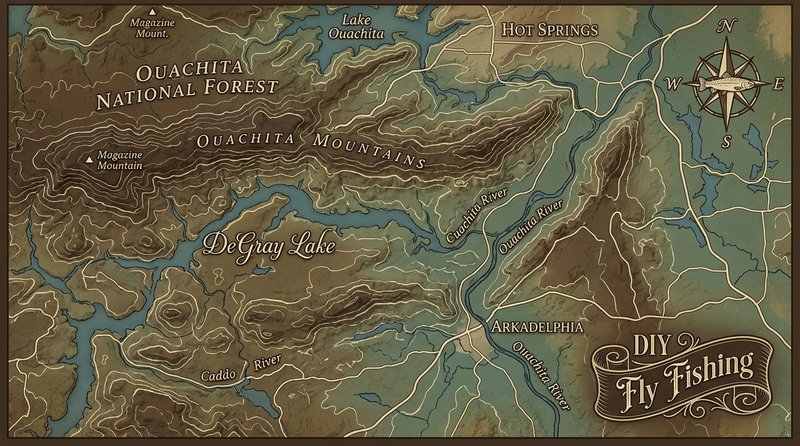
DeGray Lake
Fly fishing in Arkansas · Intermediate · Best seasons: Spring, Summer, Fall
Target Species
Largemouth Bass, Hybrid Striped Bass, Crappie
About This Water
Ouachita Mountain reservoir with excellent bass fishing. Hybrid striped bass popular.
Fishing Recommendations
DeGray Lake is one of Arkansas’s "Diamond Lakes," known for its remarkably clear water and pristine shoreline. Unlike many southern reservoirs, DeGray remains largely undeveloped, offering a wilderness feel just a short drive from Arkadelphia and Hot Springs. For the fly angler, it offers a diverse challenge: from sight-casting to cruising Largemouth in the shallows to chasing "blitzing" Hybrids in open water.
🎣 Location Overview
DeGray Lake is a 13,800-acre impoundment of the Caddo River. What makes it special for fly fishing is its water clarity. In many areas, visibility can exceed 10 feet, which allows for exhilarating sight-fishing but also demands stealthy presentations and lighter leaders than you might use in murkier Arkansas waters.
The lake is characterized by deep rocky points, submerged timber, and hundreds of secondary coves. Because it is an Army Corps of Engineers lake, the shoreline is protected from private development, meaning you aren’t dodging dock lines; instead, you are casting toward fallen logs, sandstone shelves, and stands of flooded willow.
🐟 Target Species & Behavior
Largemouth Bass
- Behavior: In the clear water of DeGray, Largemouth are highly structure-oriented. In the spring, they move into the "flats" of the secondary coves to spawn. In summer and fall, they move to deeper points and the edges of submerged timber.
- Diet: Primarily Gizzard and Threadfin Shad, but they are opportunistic eaters of crawfish and bluegill.
Hybrid Striped Bass
- Behavior: These are the "freight trains" of DeGray. They are open-water roamers that school up to hunt shad. They are most famous for "schooling" on the surface, where they drive baitfish up and create a visible frenzy (the "boil").
- Diet: Almost exclusively shad.
Crappie
- Behavior: Crappie on DeGray congregate around brush piles and submerged standing timber. During the spring "spawn," they move into surprisingly shallow water (2–6 feet) near buckbrush.
- Diet: Small minnows and aquatic insects.
📅 Best Times to Fish
- Spring (March – May): Prime Time. As water temps hit 55°F, Crappie move shallow. At 62°F+, Largemouth move to the beds. This is the best window for shallow-water fly fishing.
- Summer (June – August): Best for Hybrid Striped Bass. Early morning and late evening are the "power hours." Look for surface activity at dawn. During the day, fish deep under the shade of overhanging trees for Largemouth.
- Fall (September – November): As the water cools, shad migrate into the backs of the creeks. The Bass and Hybrids follow them. This is the best time for "searching" with streamers in the creek arms.
Best Times of Day:
- Dawn/Dusk: Essential for topwater action.
- Night: DeGray is a fantastic night-fishing lake for Bass using dark-colored poppers or "mouse" patterns during a full moon.
🪰 Recommended Flies & Techniques
For Largemouth Bass
- Flies: BoogleBugs (Poppers) in Chartreuse or White; Game Changers (3-4 inch) in shad patterns; Clouser Minnows (Red/White); and Rubber-legged Dragonflies.
- Technique: Use an 8-weight rod with a weight-forward floating line. Target the "shadow line" of the trees. In clear water, a long leader (9–12 ft) is often necessary to avoid spooking fish.
For Hybrid Striped Bass
- Flies: EP Shad, Cowen’s Baitfish, and Murdich Minnows.
- Technique: You need an intermediate sinking line or a sink-tip. When you see a "boil," cast into the edges of the activity. Strip fast—you cannot outrun a Hybrid.
For Crappie
- Flies: Micro-jig flies, Wooly Buggers (Size 8-10) in White or Pink, and "Crappie Candy" patterns.
- Technique: Use a 3-weight or 4-weight rod. Fish a slow, vertical strip near submerged brush. A "strike indicator" (bobber) can be used to keep your fly suspended at the exact depth where fish are holding.
💡 Pro Tips & Local Knowledge
- The "Iron Mountain" Area: The points around Iron Mountain are legendary for Hybrid Bass. Keep your binoculars handy; if you see birds (gulls/terns) diving, get there immediately. That signals a baitfish school being pushed to the surface.
- The Caddo River Arm: The upper end of the lake (where the Caddo flows in) stays cooler and often holds more active fish during the heat of the summer. It also has more "riverine" characteristics which fly anglers often find more intuitive to fish.
- Stealth is Key: Because DeGray is clear, your boat's trolling motor can spook fish in the shallows. If you are targeting bedding Bass in the spring, cut the motor early and drift into the coves or use a push pole.
- The "DeGray Twitch": When using poppers for Bass, less is often more. Give the fly a tiny twitch, let the rings dissipate completely, then wait. Many of the biggest DeGray Bass hit a completely stationary fly.
⚠️ Important Information
- Access: The DeGray Lake Resort State Park offers excellent boat ramps and even some limited bank access near the lodge. Iron Mountain Marina and Arlie Moore Landing are the best hubs for accessing the mid-lake points.
- Regulations: An Arkansas Fishing License is required. DeGray has specific length and creel limits (especially for Largemouth and Hybrids). Always check the latest Arkansas Game and Fish Commission (AGFC) regulations before heading out.
- Safety: DeGray can get "big" quickly if a south wind kicks up. If you are in a kayak or small boat, stay tucked into the secondary coves if the wind exceeds 15 mph.
- Permits: Day-use fees apply at many Corps of Engineers parks and ramps. Carrying a few dollars in cash or having an America the Beautiful pass is recommended.
Guide’s Final Word: DeGray is a thinking-man’s lake. Don’t just pound the bank; look for the transitions where rock meets wood. Match your fly size to the "Young of the Year" shad (usually 2–3 inches), and you'll have a banner day on the water.
Bug Hatches & Matching Flies
| Hatch | Type | Peak months | Time of day | Hook sizes | Matching flies |
|---|---|---|---|---|---|
| Giant Mayfly (Hex) Hexagenia limbata | mayfly | June, July | Dusk/Night | #6-10 | Hexagenia Spinner #6-8, Burrowing Mayfly Nymph #8-10 |
| Chironomids (Midges) Chironomidae | midge | March, April, October | Morning/Evening | #18-24 | Zebra Midge #18-22, Griffith's Gnat #20-24 |
| Blue-Winged Olive (BWO) Baetis | mayfly | March, April, October, November | Mid-day/Afternoon | #16-20 | RS2 #18-20, Parachute BWO #16-18 |
| Damselfly Enallagma | mayfly | May, June, July | Mid-day | #10-14 | Marabou Damsel Nymph #10-12, Adult Damsel #12-14 |
| Dragonfly Anisoptera | mayfly | June, July, August | All Day | #4-8 | Dragonfly Nymph #4-8, Deer Hair Dragonfly #6-8 |
| Trico Tricorythodes | mayfly | August, September | Early Morning | #20-24 | Trico Spinner #22-24, Sunken Trico #20-22 |
| Grasshoppers Orthoptera | terrestrial | July, August, September | Afternoon | #8-12 | Dave's Hopper #8-12, Fat Albert #8-10 |
| Black Ants Formicidae | terrestrial | May, June, September | All Day | #14-18 | Chernobyl Ant #10-14, Black Foam Ant #14-18 |
| Speckled Peter (Caddis) Hydropsyche | caddis | April, May | Evening | #14-16 | Elk Hair Caddis #14-16, LaFontaine's Deep Sparkle Pupa #14-16 |