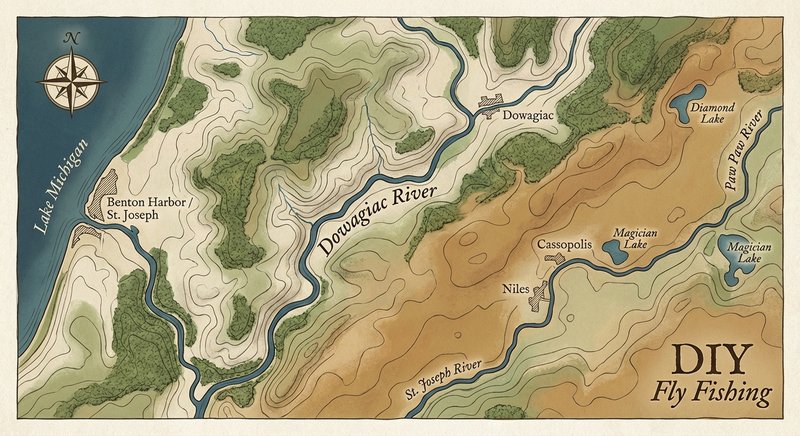
Dowagiac River
Fly fishing in Michigan · Beginner · Best seasons: Spring, Summer, Fall
Target Species
Brown Trout, Rainbow Trout
About This Water
Small southwest Michigan stream with quality brown trout. Spring-fed and clear.
Fishing Recommendations
As an expert guide who has spent years navigating the cold-water tributaries of the Great Lakes, I can tell you that the Dowagiac River in Southwestern Michigan is one of the most unique and rapidly improving trout fisheries in the Midwest.
Once hampered by industrial dams, the recent removal of the Pucker Street Dam has "unlocked" this river, restoring natural flow and allowing migratory fish to reach cold-water spawning gravel that hasn't been accessible for over a century.
🎣 Location Overview
The Dowagiac (the "Dow") is a spring-fed river that stays remarkably cold even during the heat of a Michigan summer. Unlike many Midwestern rivers that turn into "bath water" in July, the Dowagiac remains a viable trout sanctuary.
The river is characterized by a moderate gradient, a primarily sandy bottom with patches of gravel, and—most importantly—heavy woody debris. This is a "log jam" river. It is intimate, often shrouded in overhanging canopy, and requires precise casting. It feels less like a classic wide-open Western river and more like a tactical jungle. Since the dam removal, the river is currently "re-sorting" its sediment, revealing new holes and gravel bars every season.
🐟 Target Species & Behavior
- Brown Trout: The "stars" of the resident fishery. These fish are wary, dark-colored, and highly predatory. They live under the "sweepers" (fallen trees) and undercut banks. The Dow is known for producing surprisingly large browns (18”–22”+) for its size.
- Rainbow Trout: You will find resident rainbows (often smaller and more aerial) and Steelhead (migratory rainbows).
- The "Bonus" Species: Depending on the season, you may hook into Skamania (summer-run steelhead), Chinook salmon, or Coho salmon.
Behavior: These fish are ambush predators. Because the water is relatively clear and the river is narrow, they are easily spooked. They rarely sit in the middle of a sandy flat; they are almost always tucked tightly against wood or in the deep "buckets" formed behind log jams.
📅 Best Times to Fish
- Spring (April – May): This is the prime window for both resident trout and the tail-end of the winter steelhead run. You'll see the first major hatches (Hendricksons and Black Quills).
- Summer (June – August): This is when the Dowagiac shines. While other rivers are too warm to fish, the Dow stays cool. Late June is "Hex" season—the giant Hexagenia limbata mayflies hatch at night, bringing the biggest browns in the river to the surface.
- Fall (September – November): The most exciting time for streamer anglers. Resident browns become aggressive and territorial as they prepare to spawn. You also get the influx of Pacific Salmon, which provides an "egg bite" for the trout.
- Best Time of Day: Low light is your friend. Early morning (first light) and the "witching hour" (dusk) are the most productive times for big fish.
🪰 Recommended Flies & Techniques
1. Dry Fly Fishing (The Evening Game)
When the bugs are moving, focus on the seams right next to log jams.
- Patterns: Hexagenia (Size 4-6), Roberts Yellow Drake (Size 12-14), Adams Parachute, and foam-bodied Terrestrials (Beetles/Ants) in mid-summer.
- Technique: Use a 5-weight rod with a shorter leader (7.5 ft) to help turn over larger flies and maintain accuracy in tight quarters.
2. Nymphing (The Consistency Game)
Nymphing is effective year-round, especially when there is no surface activity.
- Patterns: Pheasant Tails (14-16), Prince Nymphs, and Gold-Ribbed Hare’s Ears. During salmon/steelhead runs, use Egg Patterns (beads or Glo-bugs) and San Juan Worms.
- Technique: High-stick nymphing or using a small, sensitive strike indicator. You must get your flies deep into the "buckets" behind the wood.
3. Streamer Fishing (The Trophy Game)
If you want the 20-inch brown, you need to "chuck meat."
- Patterns: Kelly Galloup’s Sex Dungeon, Sparkle Minnows, and Wooly Buggers (Olive or Black).
- Technique: Cast as close to the wood as you dare. Give the fly a lot of erratic movement. Be prepared for a "reaction strike" the moment the fly hits the water or begins its first strip.
💡 Pro Tips & Local Knowledge
- Pound the Wood: If your fly isn't within 6 inches of a log, you aren't fishing. Experienced Dowagiac anglers expect to lose a few flies; if you aren't getting hung up occasionally, you aren't casting close enough to the fish.
- The "Skamania" Factor: In July, if it rains heavily, "Skamania" steelhead will run up the Dow. These are incredibly powerful fish that will snap a 5x tippet instantly. If you're fishing in July after a rain, carry an 8-weight rod just in case.
- Stealth is Mandatory: The river is small enough that heavy wading will shut down a pool for an hour. Wade slowly and avoid pushing a "wake" downstream.
- Focus Areas: The stretch through Arthur Dodd Memorial Park is the classic fly fishing water. Since the Pucker Street Dam removal, exploring the section downstream of M-139 has become very productive as the river settles into its new channel.
⚠️ Important Information
- Access:
- Arthur Dodd Memorial Park: Excellent wading access and a great place to start.
- Russ Forest: Another good spot for public access further upstream.
- Pucker Street: The site of the old dam now offers new access points.
- Regulations: Most of the Dowagiac is classified as Type 4 Water by the Michigan DNR. This means it is open all year, but you must check the specific possession seasons for trout and salmon. A Michigan Fishing License (All-Species) is required.
- Safety: The Dowagiac has many "deadfalls" and can be dangerous for kayakers and waders alike. Be careful of "soft sand" holes where the current has scoured out the bottom near logs.
- Conservation: This river is a delicate ecosystem. Practice Catch and Release for resident brown trout to ensure the trophy potential continues to grow following the dam removal.
Bug Hatches & Matching Flies
| Hatch | Type | Peak months | Time of day | Hook sizes | Matching flies |
|---|---|---|---|---|---|
| Hendrickson Ephemerella subvaria | mayfly | April, May | Afternoon | #12-14 | Red Quill #12-14, Hendrickson Emerger #12-14, Pheasant Tail #12-14 |
| Blue Winged Olives Baetis spp. | mayfly | March, April, September, October | Afternoon | #18-22 | BWO Sparkle Dun #18-22, RS2 #18-22, Olive Micro Mayfly #18-20 |
| Grannom Caddis Brachycentrus | caddis | April, May | Morning/Afternoon | #14-16 | Elk Hair Caddis (Olive/Tan) #14-16, Deep Sparkle Pupa #14-16, Peacock Caddis #16 |
| Sulphurs Ephemerella invaria/dorothea | mayfly | May, June | Evening | #14-18 | Sulphur Parachute #14-18, Sulphur Cripple #14-16, Mercer's Poxy Back Sulphur #16-18 |
| Spotted Sedge Hydropsyche | caddis | June, July, August | Evening | #14-18 | LaFontaine Sparkle Pupa #14-18, X-Caddis #14-16, Hydropsyche Larva #14-16 |
| Slate Drake Isonychia bicolor | mayfly | June, July, August, September | Afternoon/Evening | #10-12 | Iso Parachute #10-12, Isonychia Nymph #10-12, Zug Bug #10-12 |
| Trico Tricorythodes spp. | mayfly | July, August, September | Morning | #20-24 | Trico Polywing Spinner #20-24, Trico Parachute #22, Sunken Trico Spinner #22 |
| Giant Michigan Mayfly (Hex) Hexagenia limbata | mayfly | June, July | Night | #4-8 | Hexagenia Spinner #4-6, Hex Wiggle Nymph #6-8, Roberts Yellow Drake #8 |
| Terrestrials Various | terrestrial | July, August, September | All Day | #8-16 | Dave's Hopper #8-12, Chernobyl Ant #8-12, Black Foam Beetle #14-16 |