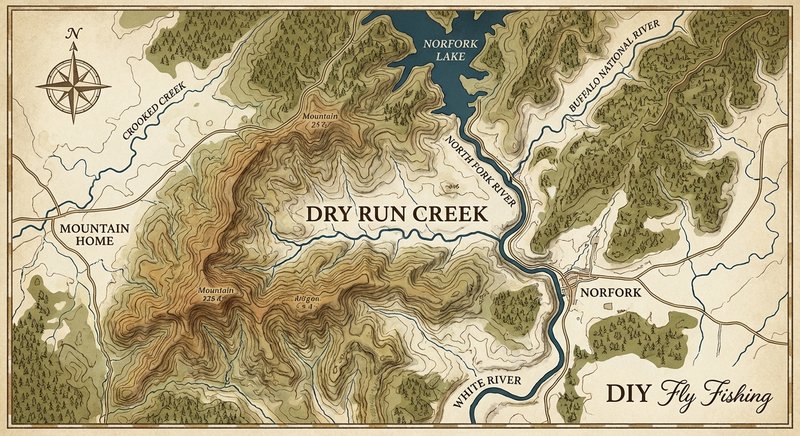
Dry Run Creek
Fly fishing in Arkansas · Beginner · Best seasons: Spring, Summer, Fall, Winter
Target Species
Rainbow Trout, Brown Trout
About This Water
Unique accessible fishing area for mobility-impaired anglers. Stocked with large trout.
Fishing Recommendations
Welcome to one of the most unique and productive trout fisheries in the world. As a guide, I often call Dry Run Creek the "Disneyland of Fly Fishing," but there is a catch: this water is strictly reserved for youth anglers (under 16) and mobility-impaired anglers.
Located in Salesville, Arkansas, right next to the Norfork National Fish Hatchery, this small tributary flows into the North Fork River. Because it carries the nutrient-rich effluent from the hatchery, it is a high-protein "trout factory" where fish grow to monstrous proportions at an accelerated rate.
🎣 Location Overview
Dry Run Creek is a small, spring-fed stream that runs for less than a mile. Despite its size, it holds a higher concentration of trophy-sized trout per square foot than almost anywhere else in North America.
- The Setting: It features a mix of shallow riffles, deep limestone ledges, and slow-moving pools.
- The Draw: It is designed to foster a love for fishing in children. It provides a rare opportunity for a 10-year-old to hook into a 10-pound Rainbow or a 15-pound Brown Trout in a stream that is barely 20 feet wide.
- Accessibility: The stream features excellent boardwalks and platforms, making it highly accessible for wheelchairs and young children who may struggle with wading.
🐟 Target Species & Behavior
While the creek holds Rainbow, Brown, Cutthroat, and Brook trout, the primary targets are the massive Rainbows and Browns.
- Rainbow Trout: These are the most common. They are opportunistic and often sit in the faster "runs" or at the head of pools waiting for food to wash down from the hatchery pipes.
- Brown Trout: The "kings" of the creek. They are more secretive and tend to hold under the overhanging banks, near submerged logs, or in the deepest shadows of the pools.
- Behavior: These fish are "hatchery smart." They are accustomed to human presence but are very sensitive to poor presentations and heavy tippet. Because they are fed so well by the hatchery overflow, they can be selective but are generally active feeders.
📅 Best Times to Fish
Dry Run Creek is a year-round fishery thanks to the consistent water temperatures (around 55°F) provided by the hatchery.
- Spring (March - May): Excellent. Higher water levels in the main river can push more fish up into the creek. Rainbows are often in a spawning mindset and very active.
- Summer (June - August): A great escape. While other rivers might get too warm, Dry Run stays cool. It’s a perfect time for kids on summer break.
- Fall (September - November): Prime Time for Giants. This is when the massive Brown Trout move up from the North Fork River to spawn. This is your best chance at a true "fish of a lifetime."
- Winter (December - February): Very productive and much less crowded. The fish remain active even in the snow.
Time of Day: Early morning (just after sunrise) is best to beat the crowds and find the fish most relaxed.
🪰 Recommended Flies & Techniques
Since this is a high-nutrient environment, "junk" flies and crustaceans are the staples.
Top Fly Patterns
- Scuds & Sowbugs (Sizes 14–18): These are the primary natural food source. Gray, tan, or olive "Ray Charles" patterns are local favorites.
- Egg Patterns: Since there are always fish spawning or eggs drifting from the hatchery, a "Y2K" or a simple Glo-Bug in peach or orange is lethal.
- San Juan Worms / Mop Flies: High visibility is key in the deeper pools. Red or pink worms work wonders after a rain.
- Soft Hackles: Specifically the "Pheasant Tail" or "Partridge and Orange." Swinging these in the riffles is a blast for kids.
Effective Techniques
- Nymphing with an Indicator: This is the bread and butter of Dry Run Creek. Use a small, sensitive strike indicator.
- Sight Fishing: Because the water is crystal clear, you can often pick out a specific fish. This is a great way to teach children about trout behavior.
- The "Short Line" Technique: Because the creek is narrow, you rarely need to cast more than 15 feet. High-sticking through the deep slots is very effective.
💡 Pro Tips & Local Knowledge
- Tippet Management: While the fish are big, the water is clear. I recommend 4X or 5X Fluorocarbon. 6X is too light—these fish will snap it in the roots. 3X is often too thick for them to bite.
- The "Hatchery Pipe" Secret: The areas near the green hatchery outflow pipes are "hot spots" because food is constantly entering the water there.
- Stealth Matters: Even though there are boardwalks, tell your young anglers to move slowly. Vibrations on the boards can spook the big Browns.
- Netting: Bring a large landing net. You will see people try to land 25-inch trout in small "trout nets" and lose them. A large, rubber-mesh net is safer for the fish and the angler.
⚠️ Important Information
🛑 The "Golden Rule"
You cannot fish here if you are 16 or older (unless you are a mobility-impaired angler with the proper permit). Adults are encouraged to assist (netting the fish, rigging the rod), but you cannot cast or hook the fish for the child.
Regulations
- Catch and Release Only: All fish must be returned to the water immediately.
- Tackle: Artificial lures/flies only. Single, barbless hooks only. (Use pliers to pinch the barbs before you start).
- Permits: Anglers under 16 do not need a license, but they must be accompanied by an adult who has a valid Arkansas fishing license (if that adult is assisting).
- Mobility Impaired: Must have a specific permit from the Arkansas Game and Fish Commission.
Ethics
This is a classroom for the next generation. Keep the fish in the water as much as possible, use wet hands when handling them, and take your photos quickly. This resource stays world-class only if we treat the fish with extreme care.
Bug Hatches & Matching Flies
| Hatch | Type | Peak months | Time of day | Hook sizes | Matching flies |
|---|---|---|---|---|---|
| Midges Chironomidae | midge | January, February, March, December | All Day | #18-24 | Zebra Midge #18-22, Griffith's Gnat #20-22, Palomino Midge #20-24 |
| Scuds Gammarus lacustris | crustacean | March, April, May, June | All Day | #14-18 | Ray Charles #14-18, UV Scud #16-18, Simple Scud #14-16 |
| Sowbugs Isopoda | crustacean | February, March, April, October | All Day | #14-18 | Soft Hackle Sowbug #14-18, Tailwater Sowbug #16-18 |
| Blue Winged Olive Baetis | mayfly | February, March, October, November | Late Morning/Afternoon | #18-22 | RS2 #18-22, Parachute Adams #18-22, Pheasant Tail #18-20 |
| Caddis Hydropsyche | caddis | April, May | Evening | #14-18 | Elk Hair Caddis #14-16, Holy Grail #16-18, LaFontaine Sparkle Pupa #16-18 |
| Sulphurs Ephemerella invaria | mayfly | May, June | Evening | #14-16 | Sulphur Parachute #14-16, Split Case Sulphur #16 |
| Crane Flies Tipulidae | other | August, September | Afternoon | #10-14 | Crane Fly Larva #10-12, Daddy Long Legs #12-14 |
| Terrestrials (Ants/Beetles) Formicidae/Coleoptera | terrestrial | June, July, August | Midday | #12-18 | Black Foam Beetle #14-16, Chernobyl Ant #12-14, Cinnamon Ant #16-18 |