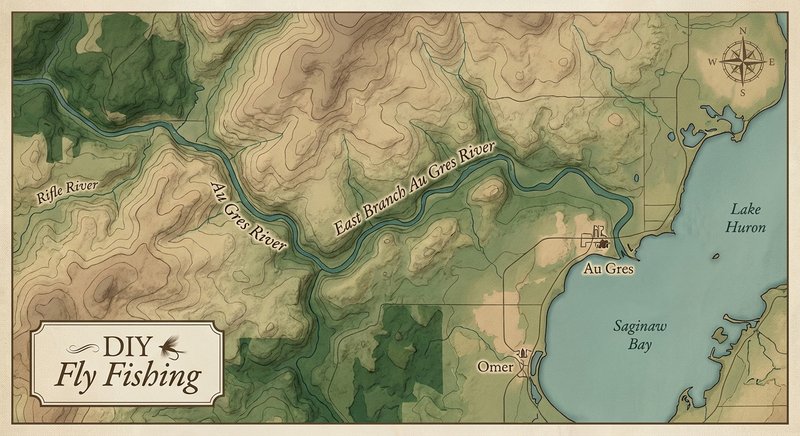
East Branch Au Gres River
Fly fishing in Michigan · Intermediate · Best seasons: Spring, Summer, Fall
Target Species
Brook Trout, Brown Trout
About This Water
Quality brook trout fishing in northeast Michigan. Remote and less pressured.
Fishing Recommendations
The East Branch of the Au Gres River is one of Michigan’s "hidden gems." While many anglers flock to the famous Au Sable or Manistee, the East Branch Au Gres offers a more intimate, secluded experience within the Huron-Manistee National Forest. It is a classic Northern Michigan freestone-style stream with a significant groundwater influence that keeps the water cold and the trout happy.
🎣 Location Overview
Located primarily in Iosco County, the East Branch Au Gres is characterized by its crystal-clear water, sandy substrate interspersed with gravel runs, and an abundance of "woody debris" (fallen logs and sweepers).
What makes this river special is its seclusion and character. It is a small-to-medium-sized stream that requires stealth and precision. Unlike the wide-open reaches of the Main Stream Au Sable, the East Branch is often tightly canopied by cedar, hemlock, and alder. It feels wilder and more rugged. Because it is slightly off the beaten path for the "trout tourists," you can often find long stretches of water all to yourself.
🐟 Target Species & Behavior
The East Branch is a premier destination for wild Brook Trout and Brown Trout.
- Brook Trout: Found predominantly in the upper reaches and near the confluences of cold-fed tributaries. They are opportunistic feeders but remain wary. Look for them in the swifter riffles and at the "heads" of pools where oxygen levels are highest.
- Brown Trout: These are the kings of the river. The East Branch is famous for holding surprisingly large Browns in very tight, woody cover. They are highly structure-oriented; if you find a submerged log jam or an undercut bank with deep water, there is a Brown Trout living there. They become much more active and aggressive during low-light periods (dawn, dusk, and night).
📅 Best Times to Fish
Spring (Late April – May)
This is "Early Season." As the water warms into the 50s, the fish become active. You’ll see the first major hatches (Hendricksons). This is also the best time for nymphing before the heavy weed growth sets in.
Summer (June – August)
- The Hex: Late June and early July bring the legendary Hexagenia limbata hatch. This is the best chance to land a "trophy" Brown Trout on a dry fly at night.
- Terrestrials: In August, the "hopper-dropper" combo is deadly.
Fall (September – October)
The Brookies and Browns are preparing to spawn. They become aggressive and strike out of territorial instinct. This is prime streamer season. The fall colors in the Huron-Manistee National Forest make this the most scenic time to be on the water.
Best Times of Day:
- Summer: 6:00 AM – 10:00 AM and 7:00 PM – Dark.
- Spring/Fall: Mid-day (11:00 AM – 4:00 PM) as the sun warms the water.
🪰 Recommended Flies & Techniques
Dry Flies
- Adams (Standard and Parachute): #12-18. The ultimate "searcher" fly for Michigan.
- Elk Hair Caddis: #14-16. Excellent for the frequent caddis bursts in the evening.
- Roberts Yellow Drake: #12-14. A local Michigan favorite.
- Hex Patterns: #4-6. Oversized, buoyant flies for the night hatch.
Nymphs
- Pheasant Tail: #14-18. Mimics many of the small mayflies in the system.
- Prince Nymph: #12-16. Great as an attractor when nothing is hatching.
- Gold-Ribbed Hare’s Ear: #14-16.
Streamers
- Wooly Bugger (Olive or Black): #6-10.
- Muddler Minnow: #8-12. Mimics the sculpins common in the Au Gres.
- Zoo Cougar: For those targeting the largest Browns in the wood.
Techniques
- The "Tight-Quarter" Cast: You will rarely have room for a 50-foot backcast. Master the roll cast and the sidearm cast to get under overhanging branches.
- The Michigan Twitch: When fishing a dry fly, a subtle "twitch" of the rod tip can often trigger a strike from a Brookie that is undecided.
💡 Pro Tips & Local Knowledge
- Focus on the "Wood": In Michigan, "wood is good." Don't be afraid to lose a fly. If you aren't casting within inches of the logs and sweepers, you aren't fishing where the big Browns live.
- Stealth is Mandatory: The water is exceptionally clear. Wear earthy tones (camo or tan), keep a low profile, and avoid splashing. If you see the fish, they have likely already seen you.
- Guiley Pond Area: Be aware of the Guiley Pond area. This is a unique, managed section where a dam creates a pond, and large Lake Huron-run fish are sometimes trapped or managed. Fishing near the confluence of Guiley Creek and the East Branch can be very productive.
- Wading: The bottom is mostly sand and gravel. It is generally easy wading, but watch out for "stump holes"—deep pockets created by the current swirling around sunken logs.
⚠️ Important Information
Access
- Much of the river flows through the Huron-Manistee National Forest. Look for forest road crossings (like Sand Lake Rd or Wickes Rd). Public access is excellent, but you may have to hike through the brush to find the best water.
Regulations
- Check the Michigan DNR Trout Map: Most of the East Branch is classified as Type 1 (Standard regulations, 7-inch/8-inch minimums, open last Saturday in April through Sept 30).
- Always carry a valid Michigan Fishing License and an All-Species entry if you plan to keep fish.
Special Considerations
- Bugs: In June and July, the mosquitoes and "no-see-ums" are ferocious. Bring heavy-duty repellent and a head net if you plan to fish the evening hatch.
- Cell Service: It is very spotty in the National Forest. Download your maps for offline use before heading out.
The East Branch Au Gres is a "fisherman's river." It rewards those who are willing to bushwhack, cast accurately, and fish into the dark. Tight lines!
Bug Hatches & Matching Flies
| Hatch | Type | Peak months | Time of day | Hook sizes | Matching flies |
|---|---|---|---|---|---|
| Blue Winged Olive Baetis / Pseudocloeon | mayfly | April, May, September, October | Afternoon | #18-22 | BWO Sparkle Dun #18-22, Pheasant Tail Nymph #18-20 |
| Hendrickson Ephemerella subvariabilis | mayfly | May | Afternoon | #12-14 | Red Quill #12-14, Hendrickson Emerger #12-14 |
| Sulphur Ephemerella invaria/rotunda | mayfly | May, June | Evening | #14-16 | Sulphur Parachute #14-16, CDC Sulphur Emerger #14-16 |
| Brown Drake Ephemera simulans | mayfly | June | Evening | #10-12 | Brown Drake Cripple #10-12, Brown Drake Spinner #10-12 |
| Hex Hexagenia limbata | mayfly | June, July | Night | #4-8 | Hexagenia Spinner #4-6, Hex Nymph #6-8 |
| Spotted Sedge Hydropsyche | caddis | May, June, July | Evening | #14-18 | Elk Hair Caddis #14-16, LaFontaine Sparkle Pupa #14-18 |
| Trico Tricorythodes | mayfly | July, August, September | Morning | #20-24 | Trico Spinner #20-24, Zebra Midge #20-22 |
| Grannom Caddis Brachycentrus | caddis | April, May | Morning/Afternoon | #12-16 | Peacock Caddis #14-16, Holy Grail Caddis #12-16 |
| Terrestrials Formicidae / Orthoptera | terrestrial | July, August, September | All Day | #8-16 | Chernobyl Ant #8-12, Black Foam Beetle #14-16 |