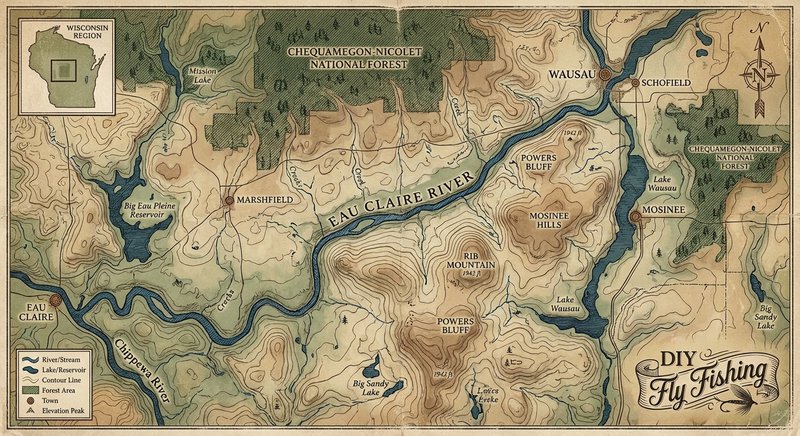
Eau Claire River
Fly fishing in Wisconsin · Beginner · Best seasons: Spring, Summer, Fall
Target Species
Brook Trout, Brown Trout, Smallmouth Bass
About This Water
Central Wisconsin stream with trout in headwaters. Flows through diverse habitats.
Fishing Recommendations
The Eau Claire River in Central Wisconsin (primarily Marathon County) is a hidden gem that offers a unique "dual-identity" fishery. Unlike many rivers that specialize in one species, the Eau Claire transitions beautifully from a cold-water trout sanctuary in its upper reaches to a world-class Smallmouth Bass fishery as it nears its confluence with the Wisconsin River.
Here is your guide to mastering the "River of Clear Water."
🎣 Location Overview
The Eau Claire River is characterized by its diversity. It consists of three main branches—the North, East, and South—which converge to form the main stem.
- The Upper Reaches: Characterized by cold, spring-fed runs, gravel bottoms, and heavy woody debris. This is classic "big wood" trout water.
- The Dells Area: At the Dells of the Eau Claire County Park, the river carves through ancient bedrock and massive boulders. It is visually stunning and serves as the transition zone where trout water meets bass water.
- The Lower River: Becomes wider and warmer with a mix of rock shelves and deep pools, creating a paradise for Smallmouth Bass.
Anglers love this river because it is less crowded than the famous Driftless Area streams to the south, offering a more "northwoods" wilderness experience.
🐟 Target Species & Behavior
Brook Trout (Native)
- Behavior: Found mostly in the headwaters and the North Branch. They are opportunistic but wary.
- Holding Water: They tuck tight into "the junk"—log jams, undercut banks, and overhanging alders.
- Feeding: Highly responsive to terrestrials in the summer and small nymphs year-round.
Brown Trout (Wild & Holdover)
- Behavior: These are the apex predators of the middle sections. They are notoriously light-shy and become most active during "the gloaming" (dusk) or on overcast days.
- Holding Water: Deep outside bends and the "dark water" behind submerged timber.
- Feeding: Small browns eat insects; big browns eat other fish. If you want a trophy, you must fish streamers.
Smallmouth Bass
- Behavior: Aggressive and hard-fighting. As the water warms in the main stem, these fish become the dominant species.
- Holding Water: Look for "seams" where fast water meets slow water, and the eddies behind large boulders in the Dells area.
- Feeding: They key in on crayfish and hellgrammites. During mid-summer evenings, they will smash large surface patterns.
📅 Best Times to Fish
- Spring (Mid-April – May): The best time for trophy Brown Trout. As the water hits 50°F, fish become active. Look for the Hendrickson hatch in late May.
- Summer (June – August):
- Trout: Focus on early mornings or late evenings. The Hexagenia (Hex) hatch in late June/early July provides the best chance to catch a massive trout on a dry fly.
- Smallmouth: This is prime time. Mid-day fishing is excellent with sub-surface streamers, while evenings are reserved for topwater poppers.
- Fall (September – October): Pre-spawn activity makes Brown Trout aggressive. Smallmouth begin to school up in deeper holes to prepare for winter. The fall colors at the Dells make this the most scenic time to be on the water.
🪰 Recommended Flies & Techniques
For Trout
- Dry Flies: Elk Hair Caddis (#14-18), Light Cahill (#14-16), and Stimulators (#10-14). For the Hex hatch, use a #4-6 Hexagenia pattern.
- Nymphs: Bead-head Pheasant Tails and Prince Nymphs. Pro Tip: Use a "Hopper-Dropper" rig in August—a foam grasshopper on top with a small scud or nymph tied 18 inches below it.
- Streamers: Black or Olive Woolly Buggers, or "The Sparkle Minnow."
For Smallmouth Bass
- Topwater: Hard-body poppers or foam "Gurglers" in white, chartreuse, or black.
- Sub-surface: Clouser Minnows (Tan/White is a local favorite to mimic crawfish) and Murdich Minnows.
- Nymphing: Large black stonefly nymphs or "Hellgrammite" imitations crawled along the bottom.
💡 Pro Tips & Local Knowledge
- The "Dells" Transition: If you are fishing the Dells of the Eau Claire County Park, bring two rods: a 4wt for the trout pockets and a 6wt for the bass in the larger pools.
- Fear the Wood: On the Eau Claire, if you aren't losing a fly occasionally, you aren't fishing where the big fish are. You must cast tight to the fallen timber.
- Stealth Matters: The river's name means "Clear Water." In the summer low-flow periods, these fish can see you from a distance. Wear drab clothing and keep a low profile.
- The "Night Shift": Many of the largest Brown Trout in this system are nocturnal. Local experts fish large black streamers or mouse patterns after the sun goes down.
⚠️ Important Information
- Access:
- Dells of the Eau Claire County Park: Excellent trail access and wade fishing.
- Bridge Crossings: Most bridges have public right-of-way access, but be respectful of private land boundaries.
- Navigability: Much of the river is wadable, but some lower stretches are best fished by kayak or canoe.
- Regulations: Wisconsin DNR trout regulations change by color-coded category (Green, Yellow, Red).
- The Eau Claire typically has specific bag limits and size restrictions for trout. Always check the current WI DNR Trout Tool (online map) before heading out.
- Safety: The rocks in the Dells area are extremely slippery and the current can be deceptive. I highly recommend studded wading boots and a wading staff.
- Permits: A valid Wisconsin Fishing License with an Inland Trout Stamp is mandatory.
Bug Hatches & Matching Flies
| Hatch | Type | Peak months | Time of day | Hook sizes | Matching flies |
|---|---|---|---|---|---|
| Blue Winged Olive (BWO) Baetis | mayfly | April, May, September, October | Midday | #18-22 | RS2 #20-22, Parachute Adams #18-22, BWO Sparkle Dun #18-20 |
| Hendrickson Ephemerella subvaria | mayfly | April, May | Afternoon | #12-14 | Red Quill #12-14, Hendrickson Nymph #12-14, Pheasant Tail #14 |
| Grannom Caddis Brachycentrus | caddis | April, May | Morning/Afternoon | #14-16 | Peacock Caddis #14-16, Deep Sparkle Pupa #14-16, Elk Hair Caddis #14-16 |
| Sulphurs Ephemerella invaria | mayfly | May, June | Evening | #14-18 | Sulphur Parachute #16-18, Sulphur Cripple #16, Hare's Ear Nymph #14-16 |
| Light Cahill Stenacron | mayfly | June, July | Evening/Dusk | #12-14 | Light Cahill #12-14, Gold Ribbed Hare's Ear #12-14 |
| Giant Michigan Mayfly (Hex) Hexagenia limbata | mayfly | June, July | Night | #4-8 | Hexagenia Spinner #4-6, Hex Nymph #6-8 |
| Trico Tricorythodes | mayfly | July, August, September | Morning | #20-24 | Trico Spinner #22-24, Zebra Midge #20-22 |
| Slate Drake Isonychia bicolor | mayfly | June, July, August, September | Afternoon/Evening | #10-12 | Isonychia Parachute #10-12, Zug Bug #10-12, Prince Nymph #10-14 |
| Cinnamon Caddis Hydropsyche | caddis | June, July, August | Evening | #14-18 | Tan Elk Hair Caddis #16, LaFontaine Sparkle Pupa #14-18 |
| Terrestrials Formicidae/Gryllidae | terrestrial | July, August, September | Midday/Afternoon | #8-16 | Chernobyl Ant #8-12, Black Foam Beetle #14-16, Cinnamon Ant #16-18 |