Eleven Point River
Fly fishing in Arkansas · Intermediate · Best seasons: Spring, Summer, Fall
Target Species
Rainbow Trout, Smallmouth Bass
About This Water
National Wild and Scenic River with trout and smallmouth bass. Spring-fed clear water.
Fishing Recommendations
The Eleven Point River is one of the hidden gems of the Ozarks. While its Missouri counterpart is famous for its "Blue Ribbon" trout status, the Arkansas stretch offers a unique, wild transition where cold-water trout territory meets world-class Smallmouth Bass habitat. It is a National Wild and Scenic River, characterized by its remote nature, lush forests, and stunning limestone bluffs.
Here is your comprehensive guide to fly fishing the Eleven Point River in Arkansas.
🎣 Location Overview
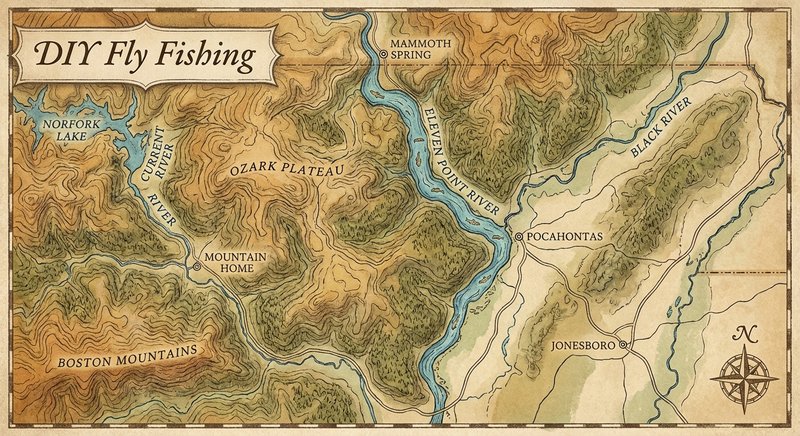
The Eleven Point River flows from the Missouri Ozarks into Randolph County, Arkansas. What makes this river special is its spring-fed nature. The massive influx of cold water from Greer Spring (in Missouri) keeps the upper reaches of the river cool enough to support trout, even as it flows across the state line.
The water is remarkably clear and moves through a series of deep pools, fast riffles, and long "dead water" stretches lined with water willow and cypress knees. Unlike the tailwaters of the White River, the Eleven Point feels truly "wild." It is less crowded, requires more effort to access, and rewards the angler who appreciates solitude and natural beauty.
🐟 Target Species & Behavior
Rainbow Trout
In the Arkansas portion, Rainbows are primarily found in the uppermost section near the Missouri border (the Billmore area).
- Behavior: These fish are often migrants from the colder Missouri waters. They hold in the oxygenated water at the base of riffles and in the "buckets" behind large submerged boulders.
- Feeding: They rely heavily on aquatic invertebrates like scuds, sowbugs, and midge larvae.
Smallmouth Bass
As you move further south from the state line, the water warms slightly, and the Smallmouth Bass become the dominant predators.
- Behavior: These are "Bronzebacks" in their truest form—hard-fighting and opportunistic. They hide near structure: root balls, undercut limestone ledges, and the edges of weed beds (water willow).
- Feeding: Their diet consists largely of crawfish, hellgrammites, and emerald shiners.
📅 Best Times to Fish
- Spring (March – May): This is the prime window for both species. The water levels are usually higher, and the trout are active before the summer heat. This is also when Smallmouth begin their pre-spawn and spawn movements.
- Summer (June – August): Focus heavily on Smallmouth Bass. The early morning and late evening topwater action is legendary. Trout fishing becomes difficult in the Arkansas stretch during late summer as they retreat to the deepest, coldest holes or move back north toward the springs.
- Fall (September – November): My favorite time. The crowds vanish, the leaves turn, and the Smallmouth feed aggressively to bulk up for winter. The lower water levels make for excellent sight-fishing opportunities.
Prime Window: Low-light conditions (dawn and dusk) are always best, particularly for Smallmouth. On overcast days, the "bite window" can stay open all day.
🪰 Recommended Flies & Techniques
For Rainbow Trout
- Nymphing: A two-fly rig is standard. Use a Size 14-16 Pheasant Tail or Gold Ribbed Hare’s Ear as a lead fly, with a Size 18-20 Zebra Midge or a Grey Scud as a dropper.
- Streamers: A Size 8 Woolly Bugger in Olive or Black, swung through deep runs, can entice larger holdover trout.
For Smallmouth Bass
- Topwater: Boogle Bugs or foam poppers in yellow, orange, or black. Twitch them near the bank and let the rings dissipate before moving them again.
- Sub-surface: Clouser Minnows (Chartreuse/White) are the gold standard here.
- The "Craw" Factor: Use heavy-eyed flies like the Near Nuff Craw or Schmidt’s Redneck Craw. Fish these on the bottom with a "strip-strip-pause" retrieve to mimic a fleeing crawfish.
Presentation Tips
- Stealth is Key: Because the water is so clear, use long 9-foot leaders. For trout, 5X or 6X fluorocarbon is necessary. For Smallmouth, 12lb-15lb fluorocarbon is fine, as they aren't as leader-shy but will spook if they see the boat or a clumsy wade-fisherman.
💡 Pro Tips & Local Knowledge
- The "Elm Store" Stretch: Focus on the area between the Missouri state line (Billmore) and the Elm Store access. This is the "sweet spot" where you have the highest chance of a "Grand Slam" (Trout and Bass in the same day).
- Look for the "Blue Holes": The river has deep limestone pockets that appear turquoise. These are often thermal refuges for trout and holding pens for big Smallmouth. Sink your fly deep into these holes.
- The Myatt Creek Confluence: Where Myatt Creek enters the Eleven Point, the mixing of waters creates excellent oxygen levels and attracts baitfish. It is a high-traffic area for predators.
- Wading vs. Floating: While there are wadeable spots near accesses, the Eleven Point is best fished from a canoe or kayak. It allows you to cover miles of river that rarely see a fly.
⚠️ Important Information
- Access Points:
- Billmore (MO/AR Line): Rough road access, but puts you in the best trout water.
- Elm Store: A popular local access point for day trips.
- Woodruff/Black Rock: Further downstream, primarily Smallmouth and Walleye water.
- Regulations:
- An Arkansas Fishing License is required.
- If you are targeting or keeping trout, you must have a Trout Permit.
- Be aware of the Missouri/Arkansas state line; if you cross into MO, you need a MO license.
- Safety: The Eleven Point is remote. Cell service is non-existent in the canyon stretches. Always bring a map, plenty of water, and a basic first-aid kit. Watch out for "sweepers" (fallen trees) in the tight bends of the river.
Guide’s Final Word: The Eleven Point isn't a numbers river like the White; it's a "quality and scenery" river. Slow down, observe the water, and enjoy one of the last truly wild places in the Natural State.
Bug Hatches & Matching Flies
| Hatch | Type | Peak months | Time of day | Hook sizes | Matching flies |
|---|---|---|---|---|---|
| Blue Winged Olive (BWO) Baetis spp. | mayfly | March, April, October, November | Late Morning/Afternoon | #18-22 | RS2 #20-22, Parachute Adams #18-22, BWO CDC Emerger #20-22 |
| Midges Chironomidae | midge | January, February, March, December | All Day | #18-24 | Zebra Midge #18-22, Griffith's Gnat #20-22, Top Secret Midge #20-24 |
| Grannom Caddis Brachycentrus spp. | caddis | April, May | Late Afternoon/Evening | #14-16 | Elk Hair Caddis #14-16, Holy Grail Caddis #14-16, Pupa-X #14-16 |
| Sulfurs Ephemerella dorothea | mayfly | May, June | Evening | #16-18 | Sulfur Parachute #16-18, Pheasant Tail Nymph #16-18, Sulfur CDC Emerger #16-18 |
| Golden Stonefly Acroneuria spp. | stonefly | May, June, July | Morning/Evening | #6-10 | Pat's Rubber Leg #6-10, Golden Stimulator #8-12, Kaufmann's Stone #8-10 |
| Trico Tricorythodes spp. | mayfly | July, August, September | Early Morning | #22-26 | Trico Spinner #22-24, Trico Parachute #22-24 |
| Tan Caddis Hydropsyche spp. | caddis | June, July, August | Evening | #14-18 | Soft Hackle Hare's Ear #14-16, LaFontaine's Deep Sparkle Pupa #14-18, Tan Elk Hair Caddis #14-18 |
| Terrestrials Formicidae / Orthoptera | terrestrial | July, August, September | Mid-day/Afternoon | #10-18 | Chernobyl Ant #8-12, Black Foam Beetle #14-18, Dave's Hopper #10-12 |