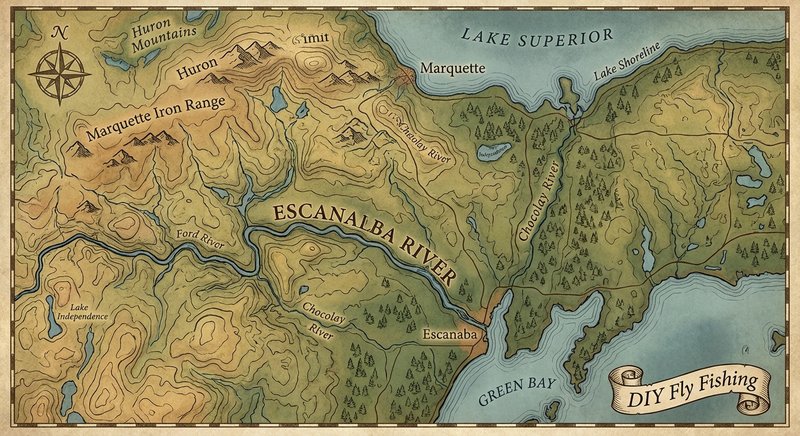
Escanaba River
Fly fishing in Michigan · Intermediate · Best seasons: Spring, Summer, Fall
Target Species
Brook Trout, Steelhead, Brown Trout
About This Water
Upper Peninsula river with diverse fishery. Brook trout in headwaters, steelhead in lower sections.
Fishing Recommendations
The Escanaba River, or "The Esky" as locals call it, is a legendary piece of water in Michigan’s Upper Peninsula. Immortalized by John Voelker (writing as Robert Traver) in Trout Madness, this river carries a sense of history and "Big North" mystique. It is a diverse system, offering everything from intimate brook trout water to big-river streamer sessions for trophy browns and seasonal runs of chrome steelhead.
🎣 Location Overview
The Escanaba is unique among Upper Peninsula rivers. While many UP rivers are sandy and acidic, parts of the Escanaba flow over limestone bedrock. This alkalinity creates a more fertile environment with superior insect life compared to its neighbors.
The river is divided into the East Branch, the Middle Branch, and the Mainstem.
- The Middle Branch is the heart of the trout water, characterized by rocky riffles, deep limestone shelves, and classic "pocket water."
- The Mainstem becomes larger, deeper, and more powerful, eventually flowing into Lake Michigan at Green Bay.
- The East Branch is smaller, colder, and offers a more intimate wilderness experience.
The scenery is rugged—think cedar swamps, granite outcroppings, and total solitude.
🐟 Target Species & Behavior
Brook Trout (Native)
Found predominantly in the upper reaches and the East Branch. They are opportunistic but wary. They hold in the cold "spring holes" during the heat of summer and tight to undercut banks and fallen timber.
- Feed on: Terrestrials (ants/beetles), small nymphs, and sculpin.
Brown Trout
The Esky is famous for its "log-dwelling" browns. These fish can reach impressive sizes (20"+). They are notoriously nocturnal or "low-light" hunters. They hold in the deep slots created by limestone ledges and behind large woody debris.
- Feed on: Large Hexagenia mayflies, crayfish, and smaller trout/minnows.
Steelhead
Found in the lower sections of the river below the dams in the spring (and occasionally late fall). These are hard-fighting Lake Michigan fish that use the river's gravel runs to spawn.
- Feed on: While in the river, they are triggered by egg patterns, beads, and swung streamers.
📅 Best Times to Fish
Spring (April – May)
- Focus: Steelhead in the lower river; early season trout.
- Conditions: High water and cold.
- Window: Mid-day when the water warms a few degrees. Look for Blue Winged Olives (BWO) on overcast days.
Summer (June – July)
- Focus: The "Golden Age" of dry fly fishing.
- Conditions: The Hexagenia (Hex) hatch usually occurs from late June through early July. This is world-class night fishing for giant browns.
- Window: Late evening and into the dark. During the day, fish terrestrials in the shadows.
Fall (September – October)
- Focus: Pre-spawn Brown Trout and "Resident" Brookies.
- Conditions: Cooling water temps trigger aggressive predatory behavior.
- Window: All day. This is prime streamer season. The bigger the fly, the better.
🪰 Recommended Flies & Techniques
Dry Flies (The Classics)
- Hexagenia Limbata (Size 4-6): Essential for late June nights.
- Robert Traver’s Favorites: The Adams (Parachute or Traditional) and the Muddler Minnow (fished as a hopper or dry).
- Terrestrials: Fat Albert, Chernobyl Ant, and Dave’s Hopper (August).
Nymphs
- Prince Nymph (12-16): Highly effective in the limestone riffles.
- Pheasant Tail (14-18): Best for mimicking the prolific Hendrickson and BWO hatches.
- Pat’s Rubber Legs: For the deeper slots in the Middle Branch.
Streamers
- Kelly Galloup’s Sex Dungeon (White or Olive): For trophy browns.
- Woolly Buggers (Black/Olive): A staple for all UP waters.
- Sculpin Patterns: The limestone bottom is home to many sculpins.
Techniques
- The "Esky Twitch": When fishing a dry fly in slow water, a tiny twitch can often trigger a strike from a brook trout.
- Night Fishing: If you are chasing the Hex hatch, you must be comfortable casting in total darkness. Use a heavier leader (0X or 1X) because you won't see the fish, you'll only hear the "gulp."
- Swinging: For steelhead, use a switch or spey rod to swing intruders and leeches through the lower runs.
💡 Pro Tips & Local Knowledge
- Beware the Bedrock: The limestone shelves are incredibly slippery. Studded wading boots are mandatory. A wading staff is highly recommended, especially in the Middle Branch where the "drop-offs" between ledges can be sudden.
- The Power of Stealth: The water is often stained (tannin-colored like tea), but the fish are still spooky. Avoid wading through the "buckets" where fish hold; fish the water before you step into it.
- Local Secret: Focus on the "confluence" areas where cold tributaries enter the main river during July and August. Brook trout will stack up here to find thermal refuge.
- Log Jams: On the Escanaba, if there isn't wood, there usually isn't a big fish. Be prepared to lose some flies to the "lumber" to get to the trophy browns.
⚠️ Important Information
- Access: Much of the river flows through State Forest land, but there are private parcels. Use an app like OnX Maps to ensure you are on public ground. Key access points include bridges on M-35 and various forest roads.
- Regulations: The Escanaba has varying regulations depending on the branch and section (Type 1, Type 4, etc.).
- Always check the current Michigan DNR Fishing Guide. Some sections are artificial lures only.
- Bugs: The UP is famous for black flies and mosquitoes in June/July. Bring high-quality repellent or a bug net shirt—they can be brutal.
- Cell Service: Expect zero bars once you leave the main roads. Tell someone your plan and when you expect to be back.
Guide’s Final Word: The Escanaba isn't a river that gives up its secrets easily. It requires hiking, navigating thick brush, and careful wading. But when that 20-inch brown trout sips a Hex fly in the pitch black of a July night, you’ll understand why it’s a sacred place for fly anglers.
Bug Hatches & Matching Flies
| Hatch | Type | Peak months | Time of day | Hook sizes | Matching flies |
|---|---|---|---|---|---|
| Blue-Winged Olive (BWO) Baetis / Acerpenna | mayfly | April, May, September, October | Midday | #18-22 | RS2 #18-22, BWO Parachute #18-20, WD-40 #20-22 |
| Hendrickson Ephemerella subvaria | mayfly | May | Afternoon | #12-14 | Red Quill #12-14, Hendrickson Sparkle Dun #12-14, Pheasant Tail Nymph #12-14 |
| Sulphur Ephemerella invaria / dorothea | mayfly | June | Evening | #14-18 | Sulphur Parachute #14-16, Rusty Spinner #14-18, Sulphur Emerger #16-18 |
| Brown Drake Ephemera simulans | mayfly | June | Dusk | #10-12 | Brown Drake Cripple #10-12, Brown Drake Spinner #10-12, Hare's Ear Nymph #10-12 |
| Hex Hexagenia limbata | mayfly | June, July | Night | #4-8 | Hexagenia Dun #6-8, Robert's Yellow Drake #6-8, Wiggle Hex Nymph #4-8 |
| Isonychia / Slate Drake Isonychia bicolor | mayfly | July, August, September | Afternoon/Evening | #10-12 | Iso Parachute #10-12, Prince Nymph #10-12, Zug Bug #10-12 |
| Grannom Caddis Brachycentrus | caddis | May | Morning/Afternoon | #14-16 | Elk Hair Caddis (Olive) #14-16, Peacock Caddis #14-16, Holy Grail Caddis #14-16 |
| Golden Stonefly Acronuria / Hesperoperla | stonefly | June, July | Evening/Night | #6-10 | Pats Rubber Legs #6-10, Golden Stone Dry #8-10, 20 Incher #8-12 |
| Trico Tricorythodes | mayfly | August, September | Morning | #20-24 | Trico Spinner #22-24, Griffith's Gnat #20-22, Zebras Midge #20-22 |
| Terrestrials (Grasshoppers/Ants) Orthoptera / Formicidae | terrestrial | July, August, September | Midday | #8-16 | Dave's Hopper #8-12, Black Foam Ant #14-16, Chernobyl Ant #8-12 |