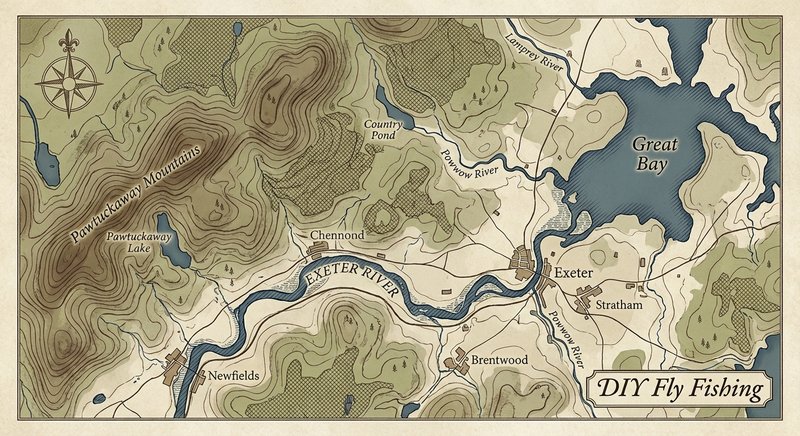
Exeter River
Fly fishing in New Hampshire · Beginner · Best seasons: Spring, Fall
Target Species
Brown Trout, Brook Trout
About This Water
Seacoast area stream with trout. Good spring fishing.
Fishing Recommendations
The Exeter River is a hidden gem of southeastern New Hampshire. While it doesn't carry the national fame of the Swift or the Pemigewasset, it offers a classic New England "lowland" trout fishing experience. It meanders through the coastal plain, offering a mix of pastoral scenery and technical pocket water.
Here is your guide to fly fishing the Exeter River.
🎣 Location Overview
The Exeter River is a low-gradient waterway that flows through the towns of Sandown, Danville, Fremont, Brentwood, and finally into Exeter, where it becomes the tidal Squamscott River.
What makes it special is its tannic, tea-colored water and its accessibility to anglers in the Seacoast region. It is a "transitional" river—the upper reaches in Brentwood and Fremont feature gravel runs, riffles, and classic pools, while the lower sections deepen and slow down. Because it is a coastal plain river, it feels intimate and "brushy," rewarding anglers who have a proficient roll cast and an eye for reading subtle current breaks.
🐟 Target Species & Behavior
The NH Fish & Game Department stocks the Exeter River heavily with Brook Trout and Brown Trout.
- Brook Trout: These are the primary targets in the spring. They are aggressive and often school up near stocking points (usually bridges). They hold in the softer water, often right against the bank or behind larger boulders.
- Brown Trout: The Browns in the Exeter tend to be more elusive. They seek out the deeper, darker undercut banks and submerged woody debris. Unlike the brookies, the Browns will often hold over in the deeper, cooler holes if the summer isn't excessively dry.
- Feeding Habits: Due to the tannic nature of the water, visibility can be lower. These fish rely heavily on vibration and silhouette. They feed on a steady diet of scuds, caddis larvae, and small minnows (dace and shiners).
📅 Best Times to Fish
Seasons
- Spring (Late April – June): This is the prime window. Stocking usually begins in late April. The water levels are high, and the fish are most active before the summer heat sets in.
- Fall (September – October): Once the water temperatures drop back below 65°F, the river sees a resurgence. The Brown Trout become more aggressive as they prepare for their spawning window, and the Brook Trout display vibrant colors.
Conditions & Time of Day
- Time of Day: In the spring, midday is often best as the sun warms the water slightly. In the fall, early morning and "golden hour" before sunset are most productive.
- Ideal Window: Focus on the 2–3 days after a light rain. The extra water movement stirs up nymphs, but too much rain can turn the tannic water into "chocolate milk," making fly fishing nearly impossible.
🪰 Recommended Flies & Techniques
Top Fly Patterns
- Nymphs:
- Bead-Head Pheasant Tail (#14-18): A staple for imitating small mayfly nymphs.
- Gold-Ribbed Hare’s Ear (#12-16): Great for the murkier water of the Exeter.
- Pat’s Rubber Legs (#8-12): Use this in high spring water to get down deep.
- Streamers:
- Woolly Bugger (Black or Olive, #6-10): The #1 producer on this river. The movement of the marabou is highly visible in tannic water.
- Muddler Minnow (#8-12): Excellent for imitating the small sculpins and dace found in the gravel sections.
- Dry Flies:
- Elk Hair Caddis (Tan, #14-16): The most common hatch on the Exeter.
- Blue Winged Olive (BWO) (#18-20): Best for overcast, drizzly spring days.
Techniques
- The "Deep Swing": In the deeper bends of the river through Brentwood, swing a weighted streamer across the current and let it hang in the "soft" water near the bank.
- Tight-Line Nymphing: In the riffles near the bridge crossings, use a heavy nymph to tick the bottom. If you aren't bumping the gravel, you aren't deep enough.
- The Roll Cast: Much of the Exeter is lined with alders and maples. Practice your roll cast and side-arm cast to avoid the "tree trout."
💡 Pro Tips & Local Knowledge
- Focus on Brentwood: The stretch of river through Brentwood (specifically near Pickard Park and the various bridge crossings like Route 111A) offers the best "trout water" characteristics with better oxygenation and gravel bottoms.
- The Bridge Strategy: Most stocking occurs at bridge crossings. While these areas get pressured, the fish move. Walk 200–300 yards upstream or downstream from any bridge to find less-educated fish.
- Color Selection: In the tea-colored water, Black is often more visible than olive or brown because it creates a sharper silhouette. Don't be afraid to use flies with a bit of "flash" (bead heads or crystal flash) to help the fish track the fly.
- Check the Temps: By July, the Exeter often gets too warm for trout (reaching 70°F+). At this point, please stop fishing for trout to avoid mortality, or switch to the excellent Smallmouth Bass and Redbreast Sunfish fishing available in the same stretches.
⚠️ Important Information
- Access: Much of the Exeter River flows through private land. NH law allows fishing in the riverbed, but please be respectful when entering and exiting. Stick to public bridge rights-of-way and town-owned conservation lands.
- Regulations:
- A New Hampshire fishing license is required for anyone 16 or older.
- The Exeter River is generally under General Law for New Hampshire (check the current NH Fish & Game Digest for specific bag limits and seasons).
- Safety: The river bottom can be silty and slippery. Felt-soled boots or studs are recommended, even in the shallower sections. Be wary of "sweepers" (fallen trees) in high water, as the current can be stronger than it looks.
Tight lines, and enjoy the quiet beauty of the Exeter!
Bug Hatches & Matching Flies
| Hatch | Type | Peak months | Time of day | Hook sizes | Matching flies |
|---|---|---|---|---|---|
| Blue-Winged Olive Baetis | mayfly | April, May, September, October | Midday/Afternoon | #18-22 | RS2 #20-22, Parachute Adams #18-22, Pheasant Tail #18-20 |
| Hendrickson Ephemerella subvaria | mayfly | May | Afternoon | #12-14 | Red Quill #12-14, Hendrickson Emerger #14, Hare's Ear Nymph #12-14 |
| Grannom Caddis Brachycentrus | caddis | May | Morning/Afternoon | #14-16 | Elk Hair Caddis (Black) #14-16, Peacock Caddis Larva #14-16 |
| Spotted Sedge Hydropsyche | caddis | June, July | Evening | #14-18 | Tan Elk Hair Caddis #14-16, LaFontaine's Deep Sparkle Pupa #16 |
| Light Cahill Stenacron interpunctatum | mayfly | June, July | Evening | #12-14 | Light Cahill #12-14, Gold Ribbed Hare's Ear #14 |
| Trico Tricorythodes | mayfly | July, August, September | Early Morning | #22-26 | Trico Spinner #22-24, Zebra Midge #22 |
| Terrestrials (Ants and Beetles) Formicidae / Coleoptera | terrestrial | July, August, September | All Day | #12-18 | Black Foam Ant #16-18, Cinnamon Ant #14-16, Crowe Beetle #12-14 |
| White Miller Ephoron leukon | mayfly | August | Late Evening/Dusk | #12-14 | White Wulff #12-14, White Miller Spinner #14 |
| Midges Chironomidae | midge | March, April, October, November | Midday | #20-24 | Griffith's Gnat #20-22, Zebra Midge (Red/Black) #20-24 |
| Common Stonefly Acroneuria | stonefly | June | Night/Late Evening | #8-12 | Pat's Rubber Legs #8-12, Golden Stone Nymph #10-12 |