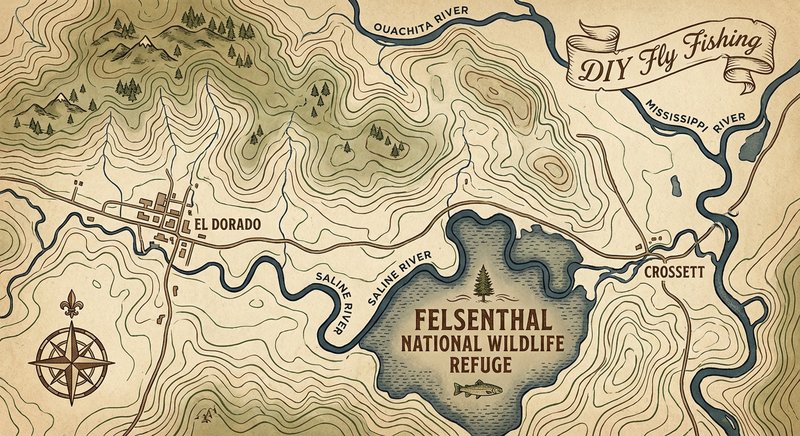
Felsenthal National Wildlife Refuge
Fly fishing in Arkansas · Intermediate · Best seasons: Spring, Fall, Winter
Target Species
Largemouth Bass, Crappie, Catfish
About This Water
South Arkansas bottomland with excellent bass and crappie. Flooded timber fishing.
Fishing Recommendations
As an expert guide who has navigated the backwaters of the Arkansas Delta and the Ouachita River basin, I can tell you that Felsenthal National Wildlife Refuge is a crown jewel of the South. Spanning over 65,000 acres, it contains the world's largest block of bottomland hardwood forest.
For the fly angler, this is "Jurassic Park" fishing. It is a complex labyrinth of sloughs, brakes, bayous, and oxbow lakes surrounding the confluence of the Saline and Ouachita Rivers.
🎣 Location Overview
Felsenthal is defined by its pulsing water levels. The refuge is dominated by the 15,000-acre shallow pool created by the Felsenthal Lock and Dam. This is "low and slow" water—stained to murky, filled with cypress knees, standing timber, and lily pads.
What makes it special is the interconnectivity. When the water rises, fish move into the hardwood flats to feed; when it recedes, they concentrate in the deeper cypress sloughs. It is a wild, primitive environment where you are more likely to see an alligator or a bald eagle than another fly fisherman.
🐟 Target Species & Behavior
Largemouth Bass
These are "cover-oriented" predators. In Felsenthal, they aren't looking for current; they are looking for shade and structure. They hold tight to cypress trunks and underneath floating vegetation. They feed primarily on crawfish, shad, and sunfish.
- Fly Behavior: They are ambush predators here. You must put the fly within inches of the wood to trigger a strike.
Crappie (Speckled Perch)
While usually targeted with minnows, Felsenthal crappie are aggressive fly-takers, especially during the spring spawn. They school heavily around submerged brush piles and "tops" (fallen trees).
- Fly Behavior: They prefer a vertical or slow-sinking presentation. They look "up" to feed, so keeping your fly slightly above their holding depth is key.
Catfish (Channel and Flathead)
While unusual for many fly anglers, the shallow flats of Felsenthal allow for sight-casting to "cruising" cats or targeting them in the ripples of the Ouachita.
- Fly Behavior: They rely on vibration and scent. Large, dark streamers stripped slowly along the bottom will often entice a Channel cat.
📅 Best Times to Fish
- Spring (March – May): The Peak. As the water warms to 60°F, Bass and Crappie move into the shallow "flats" and cypress fringes to spawn. This is the best time for topwater action.
- Fall (October – November): As the water cools, shad move into the creeks and bayous. Bass follow them and become highly aggressive. The "drawdown" (lowering of water levels) often concentrates fish in the main channels.
- Winter (December – February): Focus on the deeper sloughs and the main river channel. Fishing is slower, but this is when the largest "Wallhanger" Bass are often caught on slow-moving streamers.
- Prime Window: Early morning and late evening are legendary here, but on overcast days, the bite can remain electric all day due to the stained water.
🪰 Recommended Flies & Techniques
For Largemouth Bass
- Topwater: BoogleBugs (specifically in "Solar Flare" or "Baby Bass") and Deer Hair Poppers.
- Subsurface: Game Changers (Shad patterns) and Clouser Minnows (Black/Blue or Chartreuse/White).
- Technique: The "Splat and Sit." Cast your popper against a cypress knee. Let the rings disappear. Twitch it once. If no strike, strip it back with an aggressive "chug."
For Crappie
- Patterns: Micro-Jig Flies, Wooly Buggers (Size 8-10 in White or Pink/White), and Crappie Candy.
- Technique: Use a slow-sinking intermediate line. Count the fly down to the brush pile and use tiny, 2-inch strips to mimic a dying minnow.
For Catfish
- Patterns: Black Coffee Gurgler (dragged on bottom) or heavy Dahlberg Divers.
- Technique: Dredge the bottom near creek mouths where there is a slight current.
💡 Pro Tips & Local Knowledge
- Fear the "Knee": The cypress knees extend much further underwater than they appear. Use a heavy weed guard on every fly you tie. If you aren't bouncing your fly off the wood, you aren't in the strike zone.
- The "Saline Rise": Keep an eye on the Saline River gauge. A slight rise in the Saline often pushes fresh, oxygenated water into the north end of the refuge, which can trigger a massive feeding frenzy.
- Color Palette: The water is tannin-stained. Gold, Black, and Chartreuse are your best friends. If the sun is high, use gold flash; if it’s cloudy, go solid black.
- Boat Selection: While some areas are bank-accessible, a kayak or a flat-bottomed jon boat is almost essential. The backwaters are too silty for wading.
⚠️ Important Information
- Access: The main access points are the Grand Marais recreation area and Crossett Harbor. Use a GPS; it is incredibly easy to get turned around in the flooded timber.
- Regulations: You need an Arkansas Fishing License. Felsenthal has specific "Slot Limits" for Bass to encourage trophy growth—check the current year’s AGFC (Arkansas Game and Fish Commission) guidebook before keeping fish.
- Safety: This is a true wilderness. Alligators are present—give them distance. During the fall and winter, hunting is very popular on the refuge. If fishing during deer or duck season, wear hunter orange and be mindful of your surroundings.
- Supplies: The nearest major town is Crossett. Ensure you have plenty of fuel and water, as there are no services once you enter the refuge gates.
Bug Hatches & Matching Flies
| Hatch | Type | Peak months | Time of day | Hook sizes | Matching flies |
|---|---|---|---|---|---|
| Giant Mayfly (The Hex) Hexagenia limbata | mayfly | June, July | Dusk/Night | #6-10 | Hexagenia Spinner #6-8, Burrowing Mayfly Nymph #8-10 |
| Blue-Winged Olive Baetis spp. | mayfly | March, April, October, November | Late Morning/Afternoon | #18-22 | Parachute BWO #18-20, Pheasant Tail #18-22 |
| Damselfly Enallagma spp. | terrestrial | May, June, July, August | All Day | #10-14 | Adult Damselfly #10-12, Marabou Damsel Nymph #12-14 |
| Spotted Sedge Hydropsyche spp. | caddis | April, May, June | Evening | #14-16 | Elk Hair Caddis (Tan) #14-16, Gold Ribbed Hare's Ear #14-16 |
| Dragonfly Anisoptera | terrestrial | June, July, August | Morning/Afternoon | #4-8 | Dragonfly Popper #6-8, Dragonfly Nymph (Articulated) #4-8 |
| Chironomid (Midges) Chironomidae | midge | February, March, November | All Day | #18-24 | Zebra Midge #18-22, Griffith's Gnat #20-24 |
| Grasshopper Melanoplus spp. | terrestrial | July, August, September | Mid-day/Afternoon | #6-12 | Dave's Hopper #8-10, Fat Albert #6-12 |
| Black Carpenter Ant Camponotus pennsylvanicus | terrestrial | May, June | All Day | #12-16 | Chernobyl Ant #12-14, Black Foam Ant #14-16 |
| White Miller Ephoron leukon | mayfly | August | Late Evening/Night | #12-14 | White Wulff #12-14, White Miller #12 |
| Hellgrammite (Dobsonfly Larva) Corydalus cornutus | terrestrial | April, May, June | All Day | #4-8 | Bitch Creek Nymph #6-8, Murray's Hellgrammite #4-8 |