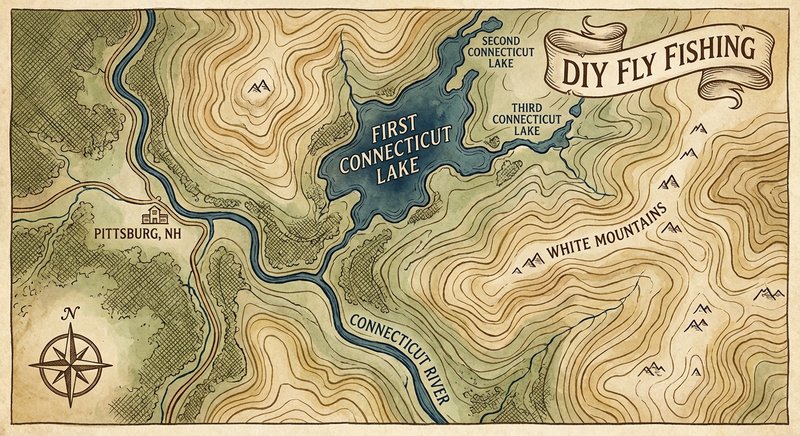
First Connecticut Lake
Fly fishing in New Hampshire · Intermediate · Best seasons: Spring, Summer, Fall
Target Species
Landlocked Salmon, Brook Trout, Lake Trout
About This Water
Pittsburg lake with landlocked salmon and brook trout. Connecticut River headwaters.
Fishing Recommendations
Welcome to the "Great North Woods." As a guide in this region, I can tell you that First Connecticut Lake in Pittsburg, New Hampshire, is the crown jewel of the state’s cold-water fisheries. At over 3,000 acres, it is the largest of the four Connecticut Lakes and serves as the gateway to some of the most remote and rewarding fly fishing in the Eastern United States.
Here is your comprehensive guide to mastering First Connecticut Lake.
🎣 Location Overview
First Connecticut Lake is a high-elevation, deep, nutrient-rich glacial lake. It is characterized by its crystal-clear water, rugged shoreline, and depths reaching over 160 feet. What makes this water special is its stability; because it is the headwaters of the Connecticut River, the water remains cold enough year-round to support a world-class landlocked salmon and trout population.
Anglers love it because it offers a "big water" experience while remaining accessible. You can fish from a motorized boat, a kayak, or even wade the mouths of the many inlets. It’s a place where you can catch a trophy salmon in the morning and be surrounded by moose and loons by evening.
🐟 Target Species & Behavior
Landlocked Salmon
The stars of the show. These fish are aggressive, aerial, and highly migratory.
- Behavior: They follow the schools of Rainbow Smelt, their primary food source. In early spring, they cruise the surface and shorelines. As the water warms in summer, they drop into the thermocline (20–40 feet down). In the fall, they congregate near the inlets and the dam in preparation for their spawning run.
Brook Trout
Both wild and stocked "Brookies" inhabit the lake.
- Behavior: They prefer structure—fallen logs, rocky points, and submerged boulders. They are more insect-oriented than salmon, often found rising during evening hatches near the "fingers" and coves of the lake.
Lake Trout (Togue)
These are the giants of the depths.
- Behavior: For most of the year, they stay deep (50+ feet). However, immediately after ice-out, they cruise the shallow flats and rocky shorelines to feed, offering a rare window for fly anglers to hook a 10-pound+ fish on a streamer.
📅 Best Times to Fish
- Spring (Ice-out to Mid-June): The Prime Window. When the ice leaves (usually early to mid-May), the salmon and lake trout are in the top 10 feet of water. This is the best time for fly anglers to use floating or intermediate lines.
- Summer (July - August): The fishing moves deeper. Focus on the "Inlet" where the Connecticut River flows in, or fish very early in the morning and late in the evening when fish move toward the surface to feed on Hexagenia (Mayflies).
- Fall (September - October 15): The "Second Peak." Salmon begin to color up and move toward the mouth of the Magalloway River and the main Connecticut River inlet. They become aggressive and territorial.
- Best Time of Day: "Low light is right." From dawn until 9:00 AM and from 6:00 PM until dark. On overcast, "sporty" days with a light chop on the water, fish may feed all day.
🪰 Recommended Flies & Techniques
Streamer Fishing (The Traditional Method)
In Pittsburg, the Tandem Streamer (two hooks joined by wire) is king. This mimics the elongated profile of a smelt.
- Patterns: Grey Ghost, Black Ghost, Mickey Finn, Maynard’s Marvel, and the Governor Aiken (a local legend).
- Technique: Trolling a streamer from a boat or kayak is highly effective. If casting, use a "strip-strip-pause" retrieve to mimic a wounded smelt.
Dry Fly Fishing
- Patterns: Blue Winged Olives (size 18-22), Adams (size 14-16), and the Hexagenia Limbata (size 6-8) in late June/July.
- Technique: Look for "dimples" in the calm coves at dusk. Brook trout will be keyed into small caddis or midges.
Nymphing
- Patterns: Pheasant Tail (size 14-18), Prince Nymph, and Zebra Midges.
- Technique: Best used near the inlets or when fishing the "Trophy Stretch" just downstream of the lake. Use a strike indicator and fish the seams where the moving water meets the lake stillwater.
💡 Pro Tips & Local Knowledge
- Follow the Wind: On First Lake, the wind often blows baitfish toward a specific shore. If the wind has been blowing into a point for three hours, the salmon will be there feeding on the disoriented smelt.
- The "Inlet" Secret: The area where the Connecticut River enters First Lake is a magnet for fish. Even in the heat of summer, this moving water is highly oxygenated and holds fish when the rest of the lake seems "dead."
- Use a Sinking Tip: Even in the spring, a Type 3 or Type 5 sinking tip line is invaluable. It gets your fly down just those few extra feet where the larger, more cautious salmon reside.
- Match the Smelt: If you see birds diving, get there. The loons and gulls are chasing smelt, and the salmon are right underneath them. Use a white/silver streamer and move it fast.
⚠️ Important Information
- Access: There are several public boat launches. The most popular is off Route 3 near the southern end of the lake.
- Regulations: New Hampshire Fish & Game regulations are strict here.
- Salmon: Minimum length is typically 15 inches.
- Lakers: Minimum length is typically 18 inches.
- Note: Always check the current NH Freshwater Fishing Digest as rules can change annually regarding "Fly Fishing Only" zones in the connecting streams.
- Safety: This is the North Woods. Weather can turn from sunny to a dangerous thunderstorm in 20 minutes. Always wear a PFD, and if you see whitecaps forming, head for the nearest shore.
- Permits: You need a valid New Hampshire freshwater fishing license, which can be purchased online or at local shops like Young's Store or Lopstick.
Guide’s Final Word: First Connecticut Lake is a place of patience. You might go two hours without a hit, and then have 20 minutes of the most heart-pounding salmon action of your life. Keep your fly in the water, watch the birds, and enjoy the scenery. Tight lines!
Bug Hatches & Matching Flies
| Hatch | Type | Peak months | Time of day | Hook sizes | Matching flies |
|---|---|---|---|---|---|
| Hendrickson Ephemerella subvaria | mayfly | May | Afternoon | #12-14 | Red Quill #12-14, Hendrickson Emerger #12-14, Pheasant Tail #12-14 |
| Blue-Winged Olive Baetis | mayfly | May, September, October | Afternoon | #18-22 | BWO Sparkle Dun #18-22, RS2 #20-22, Cdc Baetis #18-20 |
| The Hex (Giant Michigan Mayfly) Hexagenia limbata | mayfly | June, July | Evening/Dusk | #6-8 | Hexagenia Dry #6-8, Hex Nymph #6-10, Wiggle Hex #8 |
| Green Drake Ephemera guttulata | mayfly | June | Evening | #10-12 | Coffin Fly #10-12, Green Drake Cripple #10-12, Green Drake Nymph #10-12 |
| Grannom Caddis Brachycentrus | caddis | May | Morning/Afternoon | #14-16 | Elk Hair Caddis (Black) #14-16, Deep Sparkle Pupa #14-16, Holy Grail #14-16 |
| Little Yellow Sally Isoperla | stonefly | June, July | Afternoon/Evening | #14-16 | Yellow Sally Dry #14-16, Little Yellow Sloan #14-16, Stimulator (Yellow) #14-16 |
| Spotted Sedge Hydropsyche | caddis | June, July, August | Evening | #14-18 | Iris Caddis #16-18, Tan Elk Hair Caddis #14-18, LaFontaine's Pupa #16 |
| Flying Ants Formicidae | terrestrial | August, September | Afternoon | #16-20 | Flying Ant (Cinnamon or Black) #16-20, Cdc Ant #18-20, Fur Ant #16 |
| Giant Black Stonefly Pteronarcys dorsata | stonefly | June | Evening/Night | #4-8 | Pat's Rubber Leg #4-8, Kaufmann Stone #6-8, Black Stimulator #8 |