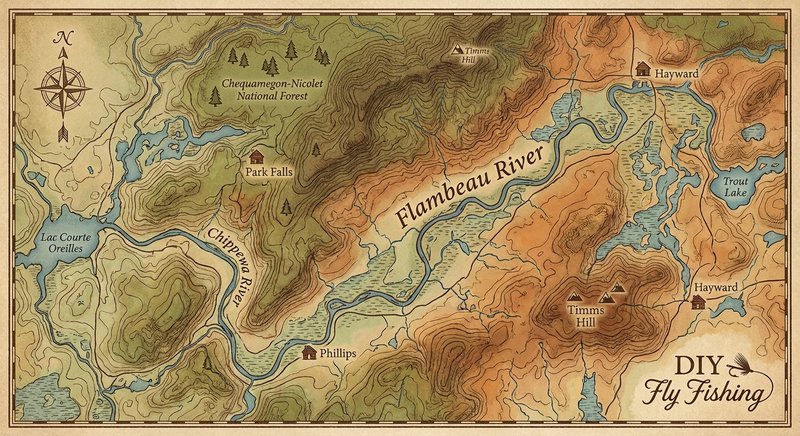
Flambeau River
Fly fishing in Wisconsin · Intermediate · Best seasons: Summer, Fall
Target Species
Smallmouth Bass, Musky, Walleye
About This Water
Northern Wisconsin river with smallmouth bass and musky. Wild river sections.
Fishing Recommendations
The Flambeau River is legendary among Midwestern anglers. Winding through the rugged, heavily forested landscape of North-Central Wisconsin, it offers a "wild river" experience that feels more like the remote reaches of Canada than the lower 48. Whether you are chasing "The Fish of Ten Thousand Casts" or looking for 50-fish days on Smallmouth, the Flambeau is a crown jewel of Northwoods fly fishing.
🎣 Location Overview
The Flambeau River, specifically the stretches within the Flambeau River State Forest, is a premier destination for fly anglers seeking solitude and aggressive warm-water species. The river is divided into the North Fork and South Fork, which eventually merge into the main stem.
- The Character: The water is "tannic" (tea-colored) due to the surrounding hemlock and cedar forests. It features a diverse mix of habitat: fast-moving boulder gardens, Class I-II whitewater rapids, deep slow-moving pools, and undercut banks.
- The Vibe: This is a drift boat or raft river. While some wading is possible during low water, the Flambeau is best experienced by floating. It is remote, scenic, and home to bald eagles, black bears, and wolves.
🐟 Target Species & Behavior
Smallmouth Bass (The Bronze Back)
The Flambeau is an elite Smallmouth fishery. These fish are remarkably aggressive due to the competitive nature of the river.
- Behavior: They hold behind "soft" water behind boulders, in the seams of rapids, and along woody debris.
- Feeding: They gorge on crayfish, hellgrammites, and emerald shiners.
Musky (The Water Wolf)
Wisconsin is the home of Musky fishing, and the Flambeau is one of its most storied rivers.
- Behavior: These are apex predators. They hold in ambush points—deep holes adjacent to weed beds or massive downed timber.
- Feeding: They eat whatever they want, including suckers, small bass, and even ducklings. In the fly fishing world, we use "meaty" 8–12 inch streamers to trigger their predatory instinct.
Walleye
While often thought of as a gear-fishing target, Flambeau Walleyes are highly susceptible to the fly, especially in the evening.
- Behavior: They are light-sensitive. During the day, they sit in the deepest holes or under heavy overhead cover.
- Feeding: They focus on minnows and leeches near the river bottom.
📅 Best Times to Fish
Summer (June – August)
- Smallmouth Peak: This is the prime time for topwater Smallmouth action. Warm water temperatures keep their metabolism high.
- Conditions: Stable water levels are key. Mid-summer "dog days" are actually excellent for bass on the Flambeau.
- Time of Day: Early morning and the "golden hour" before sunset are best for topwater; mid-day is great for subsurface streamers.
Fall (September – October)
- Musky Prime: As water temperatures drop, Muskies go into "pre-winter gorge" mode. This is the best time to land a trophy on a fly.
- Smallmouth: They begin to school up in deeper pools. The fish are fat and hard-fighting.
- Conditions: Crisp mornings and overcast days are ideal. Once the water hits the 50°F range, the Musky fishing gets electric.
🪰 Recommended Flies & Techniques
For Smallmouth Bass
- Topwater: BoogleBugs (Size 4), Sneaky Petes, and large Deer Hair Poppers.
- Technique: Cast tight to the bank or into eddies. Give it a "pop-pop-pause" rhythm. The hit usually comes during the pause.
- Subsurface: Murdich Minnows, Clouser Minnows (Chartreuse/White), and Game Changers.
- Technique: Swing these through riffles or strip them aggressively through deeper runs.
For Musky
- Flies: Bufford’s (for water displacement), T-Bones, and Double 8-inch Game Changers. Colors: Black/Orange (the "Halloween" combo) or Natural Sucker patterns.
- Technique: Use 10-12 weight rods with intermediate or sink-tip lines. The Figure-8 is mandatory. Always complete a figure-8 maneuver with your fly at the side of the boat before lifting for the next cast; Flambeau Muskies are notorious for following the fly all the way to the boat.
For Walleye
- Flies: Wooly Buggers (Black or Olive), Dredge Rabbits, or heavy Clouser Minnows.
- Technique: Use a sinking tip line. You must get the fly down to the bottom. A slow "strip-strip-pause" twitch near the riverbed in the deep pools is most effective.
💡 Pro Tips & Local Knowledge
- The "North Fork" Advantage: If you are new to the river, focus on the North Fork. It has more consistent water levels due to the upstream dams, making it safer for rowing and more predictable for fishing.
- Color Palette: Because the water is tannic (dark), high-contrast colors work best. Black/Blue, Chartreuse/White, and Orange/Gold are the local favorites.
- The "Heavy Side" of the Log: On the Flambeau, don't just fish the downstream side of fallen trees. Bass and Musky often sit on the upstream side of the timber, tucked into the pocket where the current creates a "cushion."
- Short Leaders for Musky: Don't use a standard trout leader. Use 4-5 feet of 40lb fluorocarbon to a wire bite tippet. The fish aren't leader-shy; they are toothy.
⚠️ Important Information
- Access: Key boat launches include Ninemile Canoe Base, Camp 41, and Beaver Dam. Be aware that some stretches (like Cedar Rapids) require whitewater rowing skills. Know your limits.
- Regulations: Wisconsin DNR regulations apply. Musky seasons and size limits are strictly enforced. Many sections are "Catch and Release" by choice among the local guide community to preserve the trophy quality.
- Safety: The Flambeau is remote. Cell service is spotty to non-existent. Always carry a physical map, a first aid kit, and plenty of water.
- Permits: You will need a standard Wisconsin Fishing License. If you are camping at the river-side sites, you must follow Flambeau River State Forest camping regulations.
Guide’s Final Word: The Flambeau is a "working" river. You have to cast hard and cover water, but the reward is a wild, prehistoric-looking fish in one of the most beautiful settings in the American Midwest. Tight lines!
Bug Hatches & Matching Flies
| Hatch | Type | Peak months | Time of day | Hook sizes | Matching flies |
|---|---|---|---|---|---|
| Hendrickson Ephemerella subvaria | mayfly | May | Afternoon | #12-14 | Red Quill #12-14, Hendrickson Emerger #12-14, Pheasant Tail #12-14 |
| Grannom Caddis Brachycentrus | caddis | May | Morning/Afternoon | #14-16 | Elk Hair Caddis (Olive) #14-16, Pupa-can #14-16, Holy Grail #14-16 |
| Sulphur Ephemerella invaria | mayfly | May, June | Evening | #14-18 | Sparkle Dun #16-18, Sulphur Parachute #14-16, Sulphur Spinner #14-18 |
| Golden Stonefly Acroneuria | stonefly | June, July | Afternoon/Evening | #6-10 | Golden Stimulator #8-10, Pat's Rubber Leg #6-10, Kaufmann's Stone #8-12 |
| Giant Michigan Mayfly (Hex) Hexagenia limbata | mayfly | June, July | Late Evening/Night | #4-8 | Hexagenia Parachute #6-8, Hex Wiggle Nymph #4-8, Large Deer Hair Cripple #6 |
| Isonychia Isonychia bicolor | mayfly | July, August, September | Evening | #10-12 | Iso Parachute #10-12, Zug Bug #10-12, Iso Cripple #10-12 |
| White Miller Ephoron leukon | mayfly | August | Late Evening | #12-14 | White Wulff #12-14, Snowshoe Dun #12-14, White Miller Spinner #12-14 |
| Blue-Winged Olive Baetis | mayfly | April, September, October | Afternoon | #18-22 | BWO Sparkle Dun #18-20, RS2 #20-22, WD-40 #20-22 |
| Trico Tricorythodes | mayfly | July, August | Morning | #20-24 | Trico Spinner #22-24, Drowned Trico #22-24, Griffith's Gnat #20-22 |