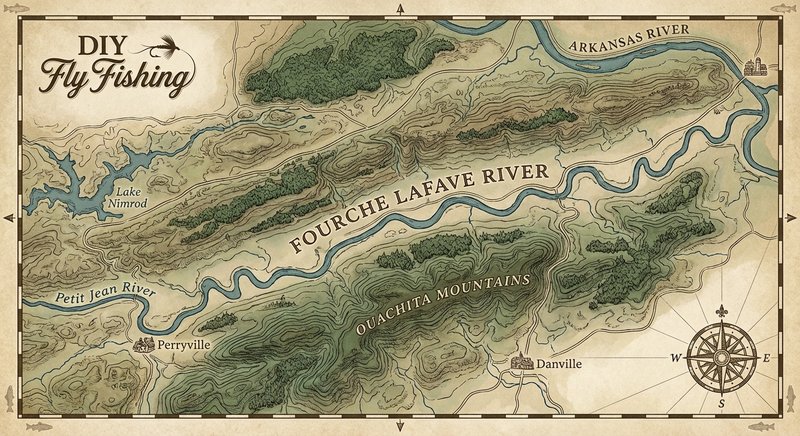
Fourche LaFave River
Fly fishing in Arkansas · Intermediate · Best seasons: Spring, Summer, Fall
Target Species
Smallmouth Bass, Spotted Bass
About This Water
Central Arkansas stream with smallmouth and spotted bass. Scenic mountain fishing.
Fishing Recommendations
The Fourche LaFave River is one of the Ouachita Mountains' best-kept secrets. While the Buffalo and the Kings River get all the glory in the Ozarks, the "Fourche" (pronounced "Fosh") offers a rugged, remote, and highly productive fishery for the fly angler looking for hard-fighting stream bass without the flotillas of rental canoes.
Here is your comprehensive guide to fly fishing the Fourche LaFave.
🎣 Location Overview
The Fourche LaFave River originates in the high ridges of the Ouachita National Forest in western Arkansas and winds its way eastward to the Arkansas River. It is a classic upland stream characterized by dramatic sandstone bluffs, long deep pools, and gravel-bottomed riffles.
What makes this river special is its transitionary nature. The upper reaches are quintessential "mountain water"—clear, cool, and rocky. As it moves toward the valley, it slows down and becomes more structurally complex with fallen timber and deep cut-banks. For the fly angler, it offers a diverse playground where you can switch from dragging a crawfish pattern through a rocky run to chugging a popper over a sunken log in the same afternoon.
🐟 Target Species & Behavior
Smallmouth Bass (The "Bronzeback")
The Smallmouth is the king of the upper Fourche. These fish are lean, mean, and perfectly adapted to current.
- Behavior: They hold in the "seams" (where fast water meets slow water) and behind large boulders.
- Feeding: They are opportunistic but lean heavily on crawfish and hellgrammites.
Spotted Bass (Kentucky Bass)
As you move into the middle and lower sections, the Spotted Bass becomes more prevalent.
- Behavior: "Spots" prefer slightly slower water than smallmouths. You will find them tucked tightly into root balls, submerged timber, and along the shady side of steep bluffs.
- Feeding: They are highly piscivorous, meaning they love to chase baitfish (shiners and dace).
📅 Best Times to Fish
Spring (April – Early June)
This is trophy season. As water temperatures hit the 55–60°F mark, the fish become extremely aggressive.
- Conditions: Watch the USGS gauges. Spring rains can blow the river out quickly. You want a "dropping and clearing" trend.
Summer (Late June – August)
Summer is "Topwater Heaven." While the middle of the day can be slow and hot, the low-light hours are magical.
- Prime Window: 30 minutes before sunrise to 10:00 AM, and 6:00 PM to dusk.
- Strategy: Focus on the oxygenated water at the heads of pools (the "riffle-in").
Fall (September – November)
Arguably the best time for fly anglers. The water is low and clear, the humidity drops, and the fish are fattening up for winter.
- Conditions: The fish are spookier in clear water. Use longer leaders and stealthy approaches.
🪰 Recommended Flies & Techniques
Topwater (The Most Exciting Way)
- Patterns: BoogleBugs (size 4-6) in Solar Flare or Black, Stealth Bombers, and Umpqua’s Swimming Frog.
- Technique: Cast tight to the bank or structure. Let it sit until the rings disappear. Give it two sharp "chugs," then let it sit again. Most strikes happen on the pause.
Streamers (Covering Water)
- Patterns: Clouser Minnows (Chartreuse/White or Olive/White), Game Changers (Small), and Woolly Buggers (Black or Olive with rubber legs).
- Technique: Use a 200-grain sinking tip line in deeper pools. Strip fast and erratically to mimic a fleeing baitfish.
Subsurface/Nymphing (The "Food" Approach)
- Patterns: Near-Nuff Crawfish, Girdle Bugs (Pat’s Rubber Legs), and Hellgrammite imitations.
- Technique: "Dead-drift" these through riffles or "hop" them along the bottom of rocky pools. If you aren't feeling the bottom occasionally, you aren't deep enough.
💡 Pro Tips & Local Knowledge
- The "Shadow Line": In the heat of summer, bass will hug the shade provided by the high bluffs. If a bluff is casting a shadow over the water, that’s where the fish are, even if it’s only 2 feet deep.
- Kayaks are King: The Fourche is difficult to wade extensively due to deep "holes" between riffles. A kayak or canoe allows you to move between the productive runs.
- The "Drag" Factor: During July and August, the river can get very low. Be prepared to get out of your boat and drag it over shallow gravel bars. Wear sturdy wading boots, not flip-flops.
- Match the Craw: Arkansas crawfish often have orange or bright red tips on their claws. Flies with a hint of orange trigger more strikes here.
⚠️ Important Information
Access
- Upper River: Access is best found near the town of Gravelly and the various bridge crossings in the Ouachita National Forest.
- Middle River: The area around Steve’s Creek and the Hwy 28 bridge offers good put-in/take-out options for day floats.
Regulations
- License: An Arkansas Resident or Non-Resident Fishing License is required.
- Smallmouth Regs: The Fourche LaFave is part of the Ozark/Ouachita Smallmouth Management zone. Check the current Arkansas Game and Fish Commission (AGFC) guidebook for specific length and creel limits, as they can change seasonally.
Safety
- Flash Floods: This is a mountain-drainage river. If heavy rain is falling upstream, the river can rise several feet in an hour. Always check the weather for the entire watershed.
- Cell Service: Expect zero service in the canyons. Download your maps for offline use before you leave home.
Guide’s Final Word: The Fourche LaFave rewards the observant angler. Don't just cast at the middle of the river. Aim for the "junk"—the logs, the shadows, and the weird swirling eddies behind rocks. That’s where the 18-inch smallmouths are waiting.
Bug Hatches & Matching Flies
| Hatch | Type | Peak months | Time of day | Hook sizes | Matching flies |
|---|---|---|---|---|---|
| Blue-Winged Olive Baetis | mayfly | March, April, October, November | Afternoon | #18-22 | Parachute BWO #18-20, Pheasant Tail Nymph #18-22 |
| Spotted Sedge Hydropsyche | caddis | April, May, June, September | Evening | #14-18 | Elk Hair Caddis #14-16, LaFontaine's Deep Sparkle Pupa #16 |
| Light Cahill Stenacron interpunctatum | mayfly | May, June, July | Evening | #12-16 | Light Cahill #14-16, Gold Ribbed Hare's Ear #12-14 |
| March Brown Maccaffertium vicarium | mayfly | March, April | Afternoon | #10-14 | March Brown American #12-14, March Brown Wet Fly #12 |
| Golden Stonefly Acroneuria | stonefly | June, July | Evening/Night | #6-10 | Pat's Rubber Legs #8-10, Golden Stimulator #8-12 |
| Trico Tricorythodes | mayfly | July, August, September | Morning | #20-24 | Trico Spinner #22-24, RS2 #20-22 |
| Common Grasshopper Melanoplus | terrestrial | July, August, September | All Day | #8-12 | Dave's Hopper #10-12, Morrish Hopper #8-10 |
| Black Carpenter Ant Camponotus | terrestrial | May, June, August | Afternoon | #12-18 | Black Foam Ant #14-16, Fur Ant #16-18 |