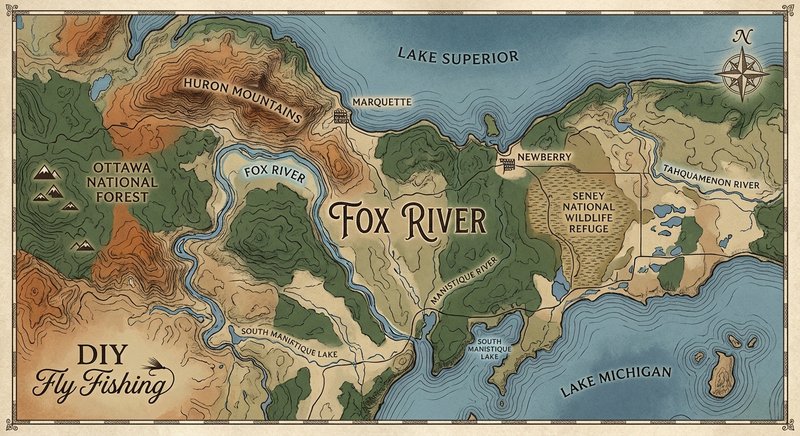
Fox River
Fly fishing in Michigan · Intermediate · Best seasons: Summer, Fall
Target Species
Brook Trout
About This Water
Upper Peninsula stream in pristine wilderness. Wild brook trout and grayling history.
Fishing Recommendations
The Fox River in Michigan’s Upper Peninsula is legendary, not just for its fishing, but for its place in American literary history. While Ernest Hemingway titled his famous short story Big Two-Hearted River, he was actually writing about his experiences on the Fox. This is a quintessential "Northwoods" stream—wild, remote, and filled with native gems.
🎣 Location Overview
The Fox River flows through the heart of the Upper Peninsula near the town of Seney. It is divided into the Main Branch and the East Branch.
What makes the Fox special is its character: it is a cold, spring-fed system with tea-colored (tannic) water. The riverbed is primarily sand and gravel, punctuated by an immense amount of "woody debris"—fallen cedar trees and log jams that provide the perfect habitat for brook trout. Anglers love it because it remains cold even in the heat of summer, and it offers a true wilderness experience where you are more likely to see a black bear or a moose than another fisherman.
🐟 Target Species & Behavior
The Brook Trout is the king of the Fox. These are wild, native fish, known for their brilliant orange bellies and white-edged fins.
- Behavior: Fox River brookies are opportunistic but incredibly "spooky." Because the water is clear (despite the tan tint) and the river is relatively small, they are highly sensitive to shadows and bank vibrations.
- Holding Patterns: They are "structure-oriented." Look for them tucked tight under overhanging tag alders, inside the shadows of log jams, or in the deep "scoured out" holes on the bends of the river.
- Feeding: They are aggressive predators. While they eat small aquatic insects, they are famous for smashing large terrestrials (grasshoppers/ants) and small baitfish or leeches.
📅 Best Times to Fish
Optimal Seasons
- Summer (Late June – August): This is the prime window for dry fly enthusiasts. When the rest of the Midwest's trout streams get too warm, the Fox stays cool. This is the season of the "Hex" hatch and terrestrial fishing.
- Fall (September): This is arguably the most beautiful time. The brook trout begin to dawn their vibrant spawning colors (vivid reds and oranges). They become more aggressive as they prepare for the spawn, making them more likely to chase large streamers.
Prime Windows
- Early Morning: Best for nymphing and streamers before the sun hits the water.
- Late Evening: The Fox is famous for its evening "rise." The hour before and after sunset is when the largest fish emerge from the log jams to feed on the surface.
- Cloudy Days: On the Fox, a gray, drizzly day is a blessing. It cuts the glare and makes the fish feel secure enough to leave their woody cover.
🪰 Recommended Flies & Techniques
Top Fly Patterns
- Dry Flies:
- The Michigan Hopper (Size 8-12): A staple for summer.
- Royal Wulff or Humpy: High visibility in the tannic water.
- Chernobyl Ant: Great for "splatting" near the banks.
- Hexagenia Limbata: For those late June/early July nights.
- Nymphs:
- Bead-head Prince Nymph (Size 14-16).
- Pheasant Tail: Mimicking the various mayflies.
- Streamers:
- Black or Olive Woolly Bugger: The gold standard for the UP.
- Muddler Minnow: Mimicking the sculpins found in the sandy runs.
Effective Techniques
- The "Dap and Drop": The banks are thick with tag alders. Often, you won't be able to make a traditional back-cast. You'll need to poke your rod through the brush and "dap" your fly onto the water.
- Pounding the Banks: When using terrestrials, don't be afraid to let the fly hit the water with a "thud." This mimics a grasshopper falling off a blade of grass and triggers an instinctual strike.
- Twitching Streamers: Cast a Woolly Bugger slightly upstream of a log jam and strip it back with erratic twitches.
💡 Pro Tips & Local Knowledge
- Wade with Caution: The Fox has a sandy bottom, but it can be "soft." There are also deep holes immediately adjacent to shallow sandbars. Use a wading staff.
- The East Branch vs. Main Branch: The East Branch is generally smaller, brushier, and better for the "blue line" adventurer seeking smaller, high-density brook trout. The Main Branch (north of Seney) is wider and holds the larger "trophy" brookies.
- Stealth is Mandatory: If you can see the fish, they have likely already seen you. Wear earthy tones (olive or tan), move slowly, and try to stay low.
- Bug Protection: This cannot be overstated. In the summer, the "Seney Black Flies" and mosquitoes are brutal. Bring high-percentage DEET and a head net.
⚠️ Important Information
Access
- The Fox River State Forest Campground: A great starting point with good river access.
- M-28 Bridge: A common access point near Seney.
- County Road 450: Provides several access points to the upper reaches.
Regulations & Permits
- License: A valid Michigan Fishing License is required.
- Type 1 Stream: Most of the Fox is designated as a Type 1 trout stream. This means the season generally runs from the last Saturday in April to September 30th.
- Size/Creel Limits: Check the current Michigan DNR Fishing Guide, as regulations can change regarding daily limits and minimum sizes (usually 7 or 8 inches for brook trout).
Special Considerations
- Cell Service: Expect zero bars once you leave the main road. Download your maps for offline use or carry a GPS/delorme.
- Bear Country: You are in black bear territory. Store food properly if camping.
Bug Hatches & Matching Flies
| Hatch | Type | Peak months | Time of day | Hook sizes | Matching flies |
|---|---|---|---|---|---|
| Blue-Winged Olive Baetis | mayfly | April, May, September, October | Mid-day | #18-22 | BWO Sparkle Dun #18-20, Pheasant Tail #18-22, RS2 #20 |
| Hendrickson Ephemerella subvaria | mayfly | May | Afternoon | #12-14 | Hendrickson Pink Lady #12-14, Red Quill #14, Hendrickson Wet Fly #12-14 |
| Sulphur Ephemerella invaria/rotunda | mayfly | June | Evening | #14-16 | Sulphur Parachute #14-16, Sulphur Emerger #16, Gold Ribbed Hare's Ear #14-16 |
| Brown Drake Ephemera simulans | mayfly | June | Dusk | #8-12 | Brown Drake Cripple #10-12, Parachute Brown Drake #10-12, Brown Drake Nymph #10 |
| Giant Michigan Mayfly (Hex) Hexagenia limbata | mayfly | June, July | Night | #4-8 | Hexagenia Spinner #4-6, Robert's Yellow Drake #6-8, Hex Wigglers #6-8 |
| Slate Drake Isonychia bicolor | mayfly | July, August, September | Afternoon/Evening | #10-12 | Isonychia Parachute #10-12, Zug Bug #10-12, Iso Wet Fly #12 |
| American Grannom Brachycentrus | caddis | May | Morning/Afternoon | #14-16 | Elk Hair Caddis (Olive) #14-16, Deep Sparkle Pupa #14-16, Peacock Caddis #16 |
| Terrestrials Various | terrestrial | July, August, September | All Day | #8-18 | Chernobyl Ant #8-12, Black Foam Beetle #14-18, Joe's Hopper #10-12 |