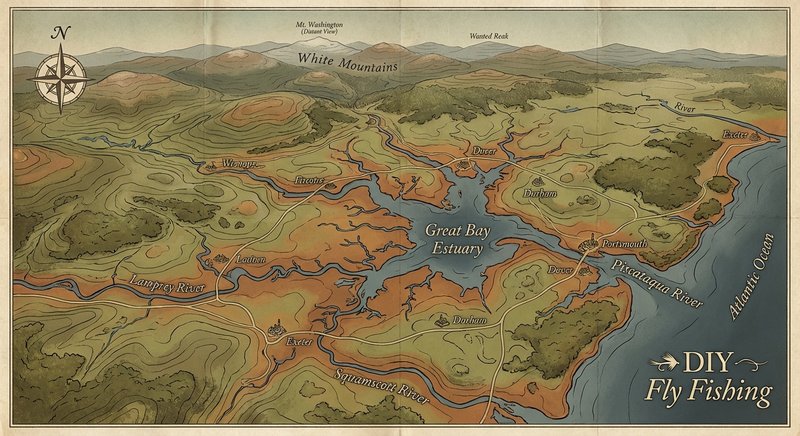
Great Bay Estuary
Fly fishing in New Hampshire · Intermediate · Best seasons: Summer, Fall
Target Species
Striped Bass, Bluefish
About This Water
Seacoast estuary with striped bass. Fly fishing the flats.
Fishing Recommendations
Welcome to one of the most dynamic and challenging fly fishing environments in New England. As your guide, I’m excited to break down the Great Bay Estuary. Located just inland from Portsmouth, New Hampshire, this is a massive, tidally-driven "inland sea" where the Piscataqua River meets seven different freshwater rivers.
It is a place of extreme tides, massive bait migrations, and some of the most technical saltwater fly fishing you will find on the Atlantic coast.
🎣 Location Overview
Great Bay is a 6,000-acre tidal estuary. What makes it special is the sheer volume of water moving through the "Little Bay" and into the "Great Bay" via the Piscataqua River—one of the fastest-flowing navigable waterways in the United States.
The water characteristics vary from deep, turbulent channels with 4-knot currents to expansive, quiet eelgrass flats and mudbanks that resemble the backcountry of the Florida Keys. Anglers love it because it offers a "choose your own adventure" experience: you can sight-fish to cruising stripers in two feet of water or dredge deep channels for "cows" (large striped bass) holding in the current.
🐟 Target Species & Behavior
Striped Bass (Morone saxatilis)
The primary draw. In Great Bay, stripers behave differently depending on the structure:
- Flat Crawlers: On the shallow flats (like those near the mouth of the Lamprey or Exeter rivers), bass act like bonefish, cruising for green crabs and shrimp.
- Current Feeders: In the main channels, they hold behind rock piles and bridge pilings, waiting for the tide to sweep baitfish (herring, silversides) toward them.
- Behavior: They are highly tide-dependent. They move with the water—entering the estuary on the flood tide and dropping back toward the ocean on the ebb.
Bluefish (Pomatomus saltatrix)
Usually appearing in mid-to-late summer, "choppers" enter the bay following schools of menhaden (pogy). They are aggressive, fast, and will destroy delicate flies. They often "blitz" on the surface, creating visible surface activity.
📅 Best Times to Fish
Optimal Seasons
- Late Spring/Early Summer (June): This is the peak for "river herring" runs. Large bass follow the bait deep into the estuary.
- Summer (July - August): The "flats" fishery is at its best. Early morning sessions are required to beat the heat and boat traffic.
- Fall (September - October): The "Fall Blitz." Bass and blues gorge on "peanut" (juvenile) menhaden and silversides before migrating south. This is often the most productive time for sheer numbers.
Tides & Time of Day
- The Golden Rule: In Great Bay, the tide is more important than the time of day.
- The "Moving Water" Window: The best fishing usually occurs during the middle two hours of a tide (rising or falling). Dead low or dead high "slack" water often shuts the bite down.
- Low Light: Striped bass are light-sensitive. Dawn and dusk are prime for topwater action.
🪰 Recommended Flies & Techniques
Top Fly Patterns
- Clouser Minnow: (Chartreuse/White or Olive/White). The undisputed king of Great Bay. Use heavy lead eyes to get down in the fast Piscataqua current.
- Hollow Fleyes / Bob’s Banger: For the fall blitz when bass are keyed in on larger menhaden.
- Gurglers & Creasers: Essential for topwater action in the early morning or when fish are boiling.
- Crab Patterns: Small, weighted epoxy crabs for sight-casting on the flats.
- Ray’s Fly: A local classic for mimicking the slim profile of a silverside.
Effective Techniques
- The "Swing": In the fast channels, cast across the current with a heavy sinking line (300-400 grain) and let the fly swing through the column, similar to steelhead fishing.
- Sight Casting: On the flats, use a floating line and a long leader (9-12 feet). Stealth is key; look for "muds" (clouds of silt kicked up by feeding fish) or "v-wakes."
- Dredging: Use an intermediate or fast-sink line along the edges of the channel drop-offs.
💡 Pro Tips & Local Knowledge
- Watch the "Lobster Pots": The buoys in the Piscataqua River don't just mark traps; they show you exactly which way the current is ripping. Fish the "seams" of calmer water created behind any structure.
- The "Fruit Street" and "Adams Point" Areas: Adams Point is a legendary shore-access spot. The current rips past the point, creating a natural ambush spot for stripers.
- Temperature Matters: In mid-August, the back-bay water can get too warm (above 70°F), which stresses the fish. During heatwaves, focus your efforts closer to the coast (Portsmouth Harbor) where the water is oxygenated and cooler.
- Match the Hatch: If you see tiny, 1-inch bait jumping, it’s likely "rain bait." Switch to a very small, sparse fly. If you use a large fly, they will ignore it.
⚠️ Important Information
Access
- Boat/Kayak: The best way to fish the Bay. Public launches are available at Chapman’s Landing (Stratham) and Great Bay Marine (Newington).
- Shore Access: Limited but available at Adams Point Wildlife Management Area and Hilton Park (Dover).
Regulations & Permits
- Saltwater License: You need a New Hampshire Recreational Saltwater Fishing License (even if fishing from shore).
- Striped Bass Regs: New Hampshire follows Atlantic States Marine Fisheries Commission (ASMFC) standards. As of current regulations, there is a strict slot limit (typically 1 fish between 28" and 31"). Many local fly anglers practice 100% catch and release to protect the fishery.
- Circle Hooks: If you decide to use bait (though we are fly purists here!), remember that circle hooks are mandatory for striped bass in NH.
Special Considerations
- Safety: The currents in the Piscataqua can be dangerous for small kayaks or underpowered boats. Always check the tide charts and wind forecasts. A "wind against tide" condition can create standing waves that are treacherous.
- Mud Flats: If wading, be careful of "blue mud." It is extremely soft and can act like quicksand. Stick to firmer sandy or gravelly patches.
Tight lines, and enjoy the salt!
Bug Hatches & Matching Flies
| Hatch | Type | Peak months | Time of day | Hook sizes | Matching flies |
|---|---|---|---|---|---|
| Midges Chironomidae | midge | April, May, September, October | All Day | #18-24 | Zebra Midge #18-22, Griffith's Gnat #20-24 |
| Sulfurs Ephemerella invaria | mayfly | May, June | Evening | #14-16 | Sulfur Parachute #14-16, Pheasant Tail #14-16 |
| Cinnamon Caddis Hydropsyche | caddis | June, July | Evening | #14-18 | Elk Hair Caddis #14-16, Pupa Emerger #16 |
| Giant Mayfly (Hex) Hexagenia limbata | mayfly | June, July | Dusk/Night | #6-10 | Hexagenia Dry #6-8, Hex Nymph #8-10 |
| Blue Winged Olive Baetis | mayfly | April, May, September, October | Afternoon | #18-22 | BWO Sparkle Dun #18-20, RS2 #20-22 |
| Flying Ants Formicidae | terrestrial | August, September | Afternoon | #16-20 | Black Flying Ant #16-18, Cinnamon Ant #18 |
| Salt Marsh Grasshoppers Melanoplus | terrestrial | July, August | Afternoon | #8-12 | Dave's Hopper #10-12, Letort Hopper #12 |
| Micro-Caddis Hydroptilidae | caddis | July, August | Morning/Evening | #20-24 | CDC Micro Caddis #22, Z-Lon Midge/Caddis #20-24 |