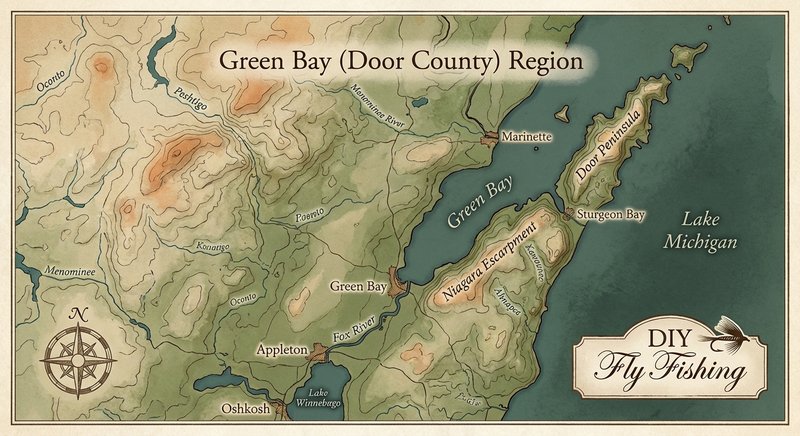
Green Bay (Door County)
Fly fishing in Wisconsin · Intermediate · Best seasons: Spring, Summer, Fall
Target Species
Smallmouth Bass, Chinook Salmon, Walleye
About This Water
Great Lakes fishing with smallmouth bass and salmon. Door County peninsula access.
Fishing Recommendations
Welcome to the "Cape Cod of the Midwest." Door County, Wisconsin, is a peninsula flanked by the waters of Green Bay to the west and Lake Michigan to the east. For the fly angler, this is one of the most diverse and high-quality freshwater fisheries in North America, offering everything from technical sight-fishing on limestone flats to brawling with Great Lakes salmon.
🎣 Location Overview
Green Bay and the surrounding Door County waters are defined by the Niagara Escarpment, a massive limestone ridge that creates dramatic underwater ledges, rocky reefs, and vast shallow flats.
What makes this area special is the clarity and scale. On the Green Bay side, the water is often gin-clear, allowing for saltwater-style sight fishing for trophy Smallmouth Bass. The diversity of the habitat—ranging from the urban river settings of the Fox and Menominee Rivers to the secluded cobble beaches of Newport State Park—means there is a "home water" for every type of fly fisher.
🐟 Target Species & Behavior
Smallmouth Bass (The Crown Jewel)
Door County is consistently ranked as one of the top Smallmouth destinations in the world.
- Behavior: In spring, they migrate from deep wintering holes to the shallow rocky flats to spawn. In summer, they move to deeper offshore reefs and "humps."
- Diet: Primarily Round Gobies (an invasive but vital food source), Alewives, and Crayfish.
Chinook Salmon (The "Kings")
These are the heavyweights of the Great Lakes.
- Behavior: Pelagic for most of the year, they enter the harbors and "tributary" areas (like Strawberry Creek or the Baileys Harbor area) in late summer and fall to spawn.
- Diet: They stop feeding once they enter the run, but they strike out of aggression and instinct.
Walleye
While traditionally a gear-fisherman's fish, the "Green Bay Giants" are highly susceptible to the fly, especially in the spring and during low-light periods.
- Behavior: They move into the Fox, Menominee, and Oconto rivers in massive numbers in early spring. During summer, they hold on deep rock edges and weed lines.
- Diet: Gizzard Shad, Emerald Shiners, and Yellow Perch.
📅 Best Times to Fish
- Spring (Mid-May – June): The Prime Window. This is when the Smallmouth are on the flats. It is arguably the best sight-fishing for bass in the country. Walleye runs in the rivers also peak in late March/April.
- Summer (July – August): Great for "big water" Smallmouth on the deeper reefs. Early mornings and late evenings are best. This is also when Chinook Salmon begin staging near harbor mouths.
- Fall (September – October): The "Run." Chinook Salmon move into the shallows and harbors. Smallmouth move to steep breaks and feed heavily (bulking up) before winter.
- Conditions: A light south or west wind is ideal for the Green Bay side. Avoid heavy "onshore" winds, as they stir up the marl and limestone dust, killing the visibility.
🪰 Recommended Flies & Techniques
For Smallmouth Bass
- Top Patterns: Murdich Minnow (white/silver), Clouser Minnow (chartreuse/white), and goby imitations like the Gob-E-Gone. For surface action, use BoogleBugs or Dahlberg Divers in olive/orange.
- Technique: On the flats, use an intermediate sinking line. Strip-strip-pause. The "pause" is when the bass usually inhales the fly.
For Chinook Salmon
- Top Patterns: Egg sucking leeches, Wooly Buggers (electric pink, purple, or black), and Comet patterns. Large Game Changers in white/chartreuse can work for aggressive harbor fish.
- Technique: Use a 9wt or 10wt rod with a heavy sinking tip. You need to get the fly down into the "zone" (bottom 2–4 feet of water).
For Walleye
- Top Patterns: Large, sparse streamers like Leftist Deceivers or SF Blends. Colors: Purple/Black (night) or Chartreuse/White (day).
- Technique: Slow, methodical retrieves near the bottom. Walleyes are less likely to chase a "burned" fly than a bass.
💡 Pro Tips & Local Knowledge
- The "Flats" Approach: When fishing the flats for Smallmouth, move slowly. These fish are spooky in 3 feet of clear water. Wear high-quality polarized glasses (amber or copper lenses are best for the limestone bottom).
- Wind is Your Friend and Enemy: If the Green Bay side is too rough or turbid, drive 15 minutes to the Lake Michigan side (and vice versa). One side is almost always fishable.
- The Goby Factor: If you aren't catching fish, go darker and smaller. A size 4 mottled brown/olive streamer that puffs "dust" off the bottom mimics a goby and is often irresistible.
- Night Shift for Walleye: In the summer, the biggest Walleyes move into the shallow rocky shallows after dark. Casting large black streamers on a floating line can result in the fish of a lifetime.
⚠️ Important Information
Access
- Public Parks: Peninsula State Park, Newport State Park, and Potawatomi State Park offer excellent shoreline access.
- Boating: A boat (skiff or bass boat) is a major advantage for reaching offshore reefs, but wading is very productive in the spring.
Regulations
- Licenses: A Wisconsin fishing license is required, along with a Great Lakes Salmon/Trout Stamp if you are targeting Chinook.
- Smallmouth Seasons: Note that the northern zone has specific "Catch and Release Only" dates during the spring spawn (usually early May to mid-June). Always check the current WDNR Fishing Regulations.
Safety
- The Great Lakes are Dangerous: Do not underestimate the power of Lake Michigan. Small boats should be extremely cautious of north winds, which can kick up 4-6 foot waves in an hour.
- Wading: The limestone can be incredibly slick. Studded wading boots and a wading staff are highly recommended.
Bug Hatches & Matching Flies
| Hatch | Type | Peak months | Time of day | Hook sizes | Matching flies |
|---|---|---|---|---|---|
| Chironomids (Midges) Chironomidae | midge | April, May, September | All Day | #18-24 | Zebra Midge #18-22, Griffith's Gnat #20-24, Smoke Jumper #18-20 |
| Giant Mayfly (Hex) Hexagenia limbata | mayfly | June, July | Dusk/Night | #6-10 | Hexagenia Spinner #6-8, Bear's Hex #8-10, Crippled Hex #8 |
| Grannom Caddis Brachycentrus | caddis | April, May | Morning/Afternoon | #14-16 | Peacock Caddis #14-16, Deep Sparkle Pupa #14-16, Holy Grail #14-16 |
| Blue-Winged Olive (BWO) Baetis | mayfly | May, September, October | Afternoon | #18-22 | RS2 #20-22, Parachute BWO #18-22, WD-40 #20-22 |
| Tan Caddis Hydropsyche | caddis | June, July, August | Evening | #14-18 | Elk Hair Caddis #14-18, LaFontaine's Emerger #16, Gold Ribbed Hare's Ear #14-16 |
| Trico Tricorythodes | mayfly | July, August, September | Morning | #22-26 | Trico Spinner #22-24, Sunken Trico #22-24 |
| White Mayfly Ephoron leukon | mayfly | August | Dusk | #12-14 | White Wulff #12-14, Ephoron Spinner #12-14 |
| Terrestrials (Ants/Beetles) Formicidae / Coleoptera | terrestrial | July, August, September | Afternoon | #12-18 | Cinnamon Ant #16-18, Foam Beetle #14-16, Chernobyl Ant #10-12 |