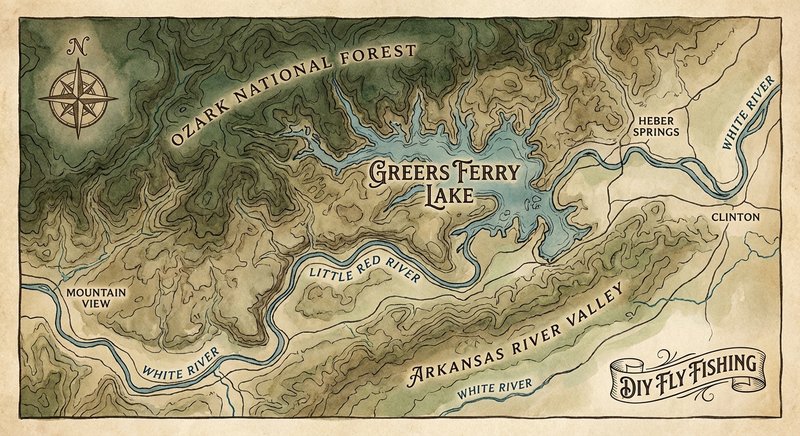
Greers Ferry Lake
Fly fishing in Arkansas · Intermediate · Best seasons: Spring, Summer, Fall
Target Species
Largemouth Bass, Striped Bass, Walleye
About This Water
Beautiful Ozark lake with trophy bass potential. Clear water and diverse fishing.
Fishing Recommendations
Greers Ferry Lake is a 40,000-acre highland reservoir nestled in the Ozark foothills of north-central Arkansas. While many fly anglers flock to the tailwaters of the Little Red River below the dam for trout, the lake itself is a world-class warm-water fly fishing destination. Known for its incredible water clarity—often ranking as one of the cleanest lakes in the United States—Greers Ferry offers a "sight fishing" appeal that is rare in the South.
🎣 Location Overview
Greers Ferry is characterized by its deep, blue waters, towering bluff walls, and a rugged shoreline consisting of sandstone slabs and submerged timber. What makes this water special for the fly angler is the diversity of habitat. You have the expansive main body for "big water" tactics and the "Four Forks" (the Upper Little Red River’s North, Middle, South, and West forks) which provide a more intimate, riverine experience.
The lake is famous for its record-breaking fish (it once held the world record for both Walleye and Hybrid Striped Bass), but for the fly fisher, the draw is the surface activity. When the shad are pushed to the top, the lake becomes a playground for aggressive predators.
🐟 Target Species & Behavior
Striped Bass
The "kings" of the lake. These fish roam the open water following massive schools of Threadfin Shad.
- Behavior: They are highly migratory. In the spring, they head toward the tributaries. In summer and fall, they school up in the main body. They are most susceptible to a fly when they "bust" bait on the surface (the blitz).
Largemouth Bass
Greers Ferry is a classic highland bass fishery.
- Behavior: They hold tight to structure—specifically standing timber, buck brush, and the numerous boat docks. Because of the water clarity, they often hold deeper (15–25 feet) during the day but move into the shallows to hunt during low-light periods.
Walleye
A challenging but rewarding target for the fly rod.
- Behavior: They are photophobic (sensitive to light). During the day, they hide in deep rock crevices or near the bottom of points. During the spring (late Feb–March), they migrate up the Four Forks to spawn in shallow, rocky shoals, which is the best time to catch them on a fly.
📅 Best Times to Fish
- Spring (March – May): Prime Time. Walleye move into the tributaries in March. Stripers follow in April. Largemouth move to the beds in late April/May. This is the best window for shallow-water fly fishing.
- Summer (June – August): Best at dawn and dusk. The heat drives fish deep during the day. However, night fishing with large black surface flies (for Bass) can be incredibly productive.
- Fall (September – November): The "Shad Bust" season. As water temperatures drop, shad move to the surface in the backs of creeks. Look for diving gulls; where there are birds, there are Stripers.
🪰 Recommended Flies & Techniques
For Striped Bass
- Flies: Clouser Minnows (White/Chartreuse or Blue/White), Lefty’s Deceivers, and the Game Changer. For surface action, use large Pole Dancers or Gurglers.
- Technique: Use an 8wt or 9wt rod. If fish are deep, use a 300-grain sinking line and a "count down" method. If they are surfacing, a floating line with a quick, erratic strip is key.
For Largemouth Bass
- Flies: BoogleBugs (poppers), Dahlberg Divers, and Murdich Minnows. For deeper fish, use weighted Crawfish patterns or large wooly buggers in olive/orange.
- Technique: Target "steep-to-flat" transitions. Cast poppers right against the bluff walls or into the pockets of standing timber. Let the ripples dissipate before your first twitch.
For Walleye
- Flies: Heavy-eyed Bunny Leeches (Purple, Black, or White) and Clousers.
- Technique: You must get the fly to the bottom. Use a sink-tip line and "bounce" the fly off the rocks in the river bends of the Four Forks during the spring run.
💡 Pro Tips & Local Knowledge
- Follow the Birds: In the fall, buy a pair of good binoculars. Scan the horizon for gulls. If you see them diving, get there as fast as possible (but cut your motor 100 yards out and drift in) to intercept schooling Stripers.
- The "Shadow" Factor: Because the water is so clear, fish are spooky. On sunny days, fish the "shadow side" of bluff walls. The shade provides cover for predators to ambush bait.
- Intermediate Lines: If you only bring one line, make it an intermediate (slow sink) line. It keeps your fly in the "strike zone" (3–6 feet down) longer than a floating line and avoids the surface tension that can spook fish in clear water.
- Go Small for Bass: While big flies are fun, Greers Ferry bass often key in on tiny young-of-the-year shad. Don't be afraid to drop down to a Size 6 or 8 streamer if you are getting "refusals."
⚠️ Important Information
- Access: There are numerous public launch ramps (Dam Site, Eden Isle, Sugar Loaf). For the riverine "Forks," look for low-water bridges or access points in towns like Clinton (South Fork) or Shirley (Middle Fork).
- Regulations: An Arkansas Fishing License is required. There are specific length and creel limits for Stripers and Walleye that change periodically—check the Arkansas Game and Fish Commission (AGFC) website before heading out.
- Safety: Greers Ferry is a large, deep lake. It can get extremely choppy when the wind kicks up from the south. If you are in a kayak or a small boat, stick to the coves or the upper river arms.
- The "Trout Extension": If the lake fishing is slow, the Little Red River tailwater starts right at the dam in Heber Springs. It is one of the top brown trout fisheries in the world—always have a 5wt rod rigged with a midge just in case.
Bug Hatches & Matching Flies
| Hatch | Type | Peak months | Time of day | Hook sizes | Matching flies |
|---|---|---|---|---|---|
| Midges Chironomidae | midge | January, February, March, December | All Day | #18-24 | Zebra Midge #18-22, Griffith's Gnat #20-24, Palomino Midge #20-22 |
| Blue Winged Olive Baetis | mayfly | March, April, October, November | Late Morning/Afternoon | #16-20 | RS2 #18-20, Parachute Adams #16-20, Pheasant Tail #16-18 |
| Sulphurs Ephemerella dorothea | mayfly | May, June, July | Evening | #14-18 | Sulphur Parachute #14-16, CDC Sulphur Emerger #16-18, Frenchie #14-16 |
| Grannom Caddis Brachycentrus | caddis | April, May | Morning/Evening | #12-16 | Elk Hair Caddis #14-16, LaFontaine's Deep Sparkle Pupa #14-16, Holy Grail #14-16 |
| Hex Hexagenia limbata | mayfly | June, July | Dusk/Night | #6-10 | Hexagenia Spinner #6-8, Hearth's Hex Nymph #8-10 |
| Light Cahill Stenacron canadense | mayfly | June, August | Late Afternoon/Evening | #12-14 | Light Cahill #12-14, Gold Ribbed Hare's Ear #12-14 |
| Terrestrials (Hopper/Ant/Beetle) Various | terrestrial | July, August, September | Afternoon | #10-18 | Dave's Hopper #10-12, Black Foam Ant #16-18, Fat Albert #8-12 |
| Trico Tricorythodes | mayfly | August, September, October | Early Morning | #20-24 | Trico Spinner #22-24, Sunken Trico Spinner #22-24 |