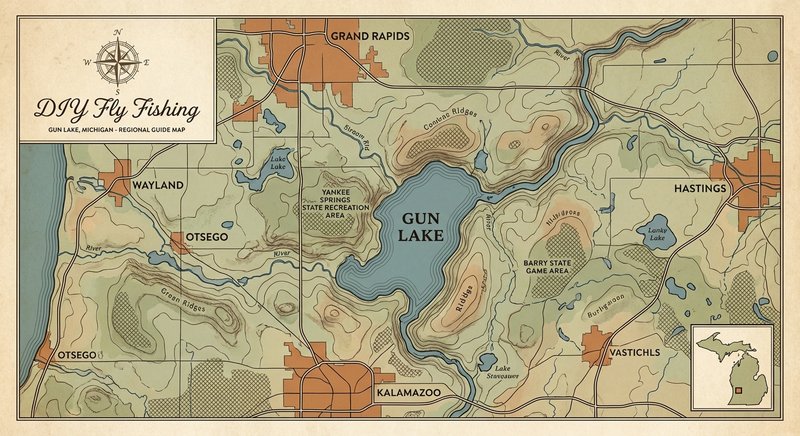
Gun Lake
Fly fishing in Michigan · Beginner · Best seasons: Spring, Summer, Fall
Target Species
Largemouth Bass, Smallmouth Bass, Bluegill
About This Water
Large natural lake in Southwest Michigan. Warm water fishing with bass and panfish.
Fishing Recommendations
Welcome to Gun Lake, a premier warm-water fishery located in Barry and Allegan counties, Michigan. As a guide in the Great Lakes region, I consider Gun Lake one of the most diverse and rewarding fly fishing destinations for bass and panfish in Southwest Michigan.
Spanning over 2,680 acres, it is a large, relatively shallow lake characterized by clear water, expansive weed beds, and unique structural features that make it a playground for fly anglers.
🎣 Location Overview
Gun Lake is a "kettle lake" with a complex layout consisting of several distinct basins (East, West, and Robbins Bay) and a large island (Murphy’s Island). What makes it special for the fly angler is its clear water and vast shallow flats. Unlike many deep, murky Michigan lakes, Gun Lake offers "sight casting" opportunities that feel more like flats fishing in the salt than inland lake fishing.
The lake is a mosaic of sandy shallows, dense lily pad fields, and steep drop-offs. It is part of the Yankee Springs Recreation Area, surrounded by beautiful state land, making it as scenic as it is productive.
🐟 Target Species & Behavior
Largemouth Bass
The Largemouth are the kings of the "slop" here. They congregate around the heavy vegetation and the thousands of boat docks lining the shore. They feed primarily on bluegill, frogs, and crayfish. In the heat of summer, they tuck deep into the lily pads and milfoil.
Smallmouth Bass
Gun Lake has a surprisingly robust Smallmouth population. They prefer the harder bottom areas—sandbars, rock piles near Murphy’s Island, and the deeper edges of the East Basin. They are highly migratory, moving from the shallows in the spring to deeper "humps" as the water warms.
Bluegill (Panfish)
Gun Lake is a "Bluegill factory." These fish reach impressive sizes here. In the spring, they swarm the sandy shallows to spawn. In the summer, they move to the "weed walls" in 6–10 feet of water. They are aggressive and provide non-stop action on light fly gear.
📅 Best Times to Fish
- Spring (May - June): This is the prime window. As the water hits 55–60°F, bass move into the shallows for the pre-spawn. Late May brings the Bluegill spawn—look for "craters" in the sand in 2–4 feet of water.
- Summer (July - August): Fishing is best at dawn and dusk. Because Gun Lake is a popular recreational lake, boat traffic becomes heavy by 10:00 AM. Low-light periods offer the best topwater action and the quietest water.
- Fall (September - October): My personal favorite. As the water cools and the pleasure boaters disappear, the bass go on a feeding binge. Smallmouths move back onto the sandbars to chase emerald shiners.
- Optimal Conditions: Overcast days with a light "chop" on the water are perfect. The cloud cover keeps the fish from being "spooky" in the clear water.
🪰 Recommended Flies & Techniques
For Bass (Largemouth & Smallmouth)
- Topwater: BoogleBugs (Size 4) or Dahlberg Divers. In the lily pads, use weedless foam frogs. The "pop-and-pause" technique is lethal here—often the strike happens when the fly is sitting perfectly still.
- Subsurface: Clouser Minnows (Chartreuse/White or Olive/White) to mimic minnows. Game Changers in smaller sizes (3-4 inches) work wonders for big bass near the drop-offs.
- Crayfish Patterns: Near Nuff Craws or Whitlock’s Near Nuff Sculpin. Bounce these along the sandy transitions for Smallmouth.
For Bluegill
- Dry Fly: Foam Spiders or Rubber-Legged Poppers (Size 10-12).
- Dropper Rig: Hang a Bead-head Prince Nymph or a Hare’s Ear 18 inches below your popper. This "hopper-dropper" style accounts for 70% of the fish in mid-summer.
Techniques
- The "Edge" Game: Target the "transition zone" where the shallow sand flats meet the deep weed line.
- Dock Skipping: If you can skip a fly under a pontoon boat or dock, you will find the biggest Largemouth in the lake.
💡 Pro Tips & Local Knowledge
- The "West Basin" Secret: While most people fish the main body, the West Basin has some of the best lily pad fields for fly rodders. It's generally shallower and more protected from the wind.
- Murphy’s Island: The shoals surrounding Murphy's Island are a Smallmouth magnet. Focus on the windward side of the island where baitfish get pushed against the rocks.
- Mid-Lake Sandbars: There are several "humps" in the middle of the lake that rise from 20 feet to 3 feet. These are gold mines in the fall for Smallmouth. Use a sinking tip line to get your streamers down quickly to the edges of these bars.
- Avoid the Weekend Crowd: If you must fish a weekend in July, be off the water by 10:30 AM. The "wake" from pleasure boats makes fly casting difficult and puts the fish down.
⚠️ Important Information
- Access: The Yankee Springs State Recreation Area provides excellent boat launches and even some wade-fishing access near the campgrounds (though a kayak or boat is highly recommended for this lake).
- Regulations: A valid Michigan All-Species Fishing License is required. Bass season generally opens the Saturday before Memorial Day (check current MDNR booklets for specific "catch and release" vs "possession" dates).
- Invasive Species: Gun Lake has Eurasian Watermilfoil and Starry Stonewort. Always Clean, Drain, and Dry your boat and wading gear to prevent spreading these to other Michigan waters.
- Wading: While much of the lake is sandy, there are "muck" pockets. Use caution when wading far from the shore of the State Park.
Guide’s Final Word: Gun Lake is a visual fishery. Bring a high-quality pair of polarized sunglasses (Amber or Copper lenses are best for this water color). Seeing a 4-pound Largemouth emerge from the pads to inhale a popper in 2 feet of water is an experience you won't soon forget!
Bug Hatches & Matching Flies
| Hatch | Type | Peak months | Time of day | Hook sizes | Matching flies |
|---|---|---|---|---|---|
| Hexagenia (The Hex) Hexagenia limbata | mayfly | June, July | Dusk/Night | #6-10 | Hexagenia Spinner #6-8, Hex Nymph #8-10, Floating Hex Wiggle Nymph #8 |
| Brown Drake Ephemera simulans | mayfly | May, June | Evening | #10-12 | Brown Drake Paradrake #10-12, Brown Drake Nymph #10-12 |
| Speckled Spinner (Callibaetis) Callibaetis | mayfly | May, June, August, September | Morning/Afternoon | #12-16 | Callibaetis Parachute #14-16, Hare's Ear Nymph #12-16, Callibaetis Spinner #14-16 |
| Cinnamon Sedge Ceraclea | caddis | June, July, August | Evening/Night | #14-18 | Elk Hair Caddis (Cinnamon) #14-18, LaFontaine's Deep Sparkle Pupa #14-16 |
| Midges (Chironomids) Chironomidae | midge | April, May, September, October | All Day | #18-24 | Zebra Midge #18-22, Griffith's Gnat #20-24, Snowshoe Midge #20 |
| Trico Tricorythodes | mayfly | July, August, September | Early Morning | #20-24 | Trico Spinner #22-24, Trico Parachute #20-22 |
| Great Red Spinner Ephemera varia | mayfly | June, July | Dusk | #10-12 | Michigan Red Spinner #10-12, Large Pheasant Tail #10-12 |
| Terrestrials (Ants & Beetles) Formicidae / Coleoptera | terrestrial | July, August | Afternoon | #12-18 | Black Foam Ant #14-18, Chernobyl Ant #8-12, Crowe Beetle #14-16 |