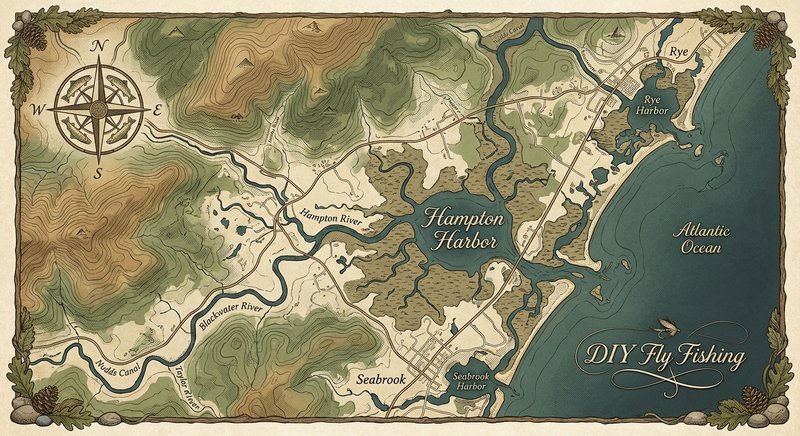
Hampton Harbor
Fly fishing in New Hampshire · Intermediate · Best seasons: Summer, Fall
Target Species
Striped Bass, Bluefish, Mackerel
About This Water
NH seacoast with striped bass and bluefish. Jetty and surf fishing.
Fishing Recommendations
Welcome to the Granite State’s premier saltwater playground. As your guide, I can tell you that Hampton Harbor is one of the most dynamic and productive tidal estuaries in New England. It is a high-energy environment where the Hampton and Blackwater Rivers converge and flush out into the Atlantic through a narrow, jetty-lined inlet.
Here is your professional guide to fly fishing Hampton Harbor.
🎣 Location Overview
Hampton Harbor is a classic New England tidal estuary characterized by expansive salt marshes, shifting sandbars, and high-velocity current. What makes it special is the "funnel effect." Because the entrance to the harbor is narrow, a massive volume of water is forced through a small opening, creating a "dinner belt" for predators.
Anglers love it because it offers diverse environments: you can sight-fish for stripers on the shallow flats of the back bay, swing streamers in the deep, fast-moving main channel, or target "blitzing" fish off the rocky jetties. It is a tactical fishery that rewards those who understand the relationship between tide and structure.
🐟 Target Species & Behavior
Striped Bass (Stripers)
The star of the show.
- Behavior: Early season (May/June) brings "schoolies" into the warm marsh waters. As summer progresses, larger "cows" hold in the deeper, cooler channel slots or under the Route 1A bridge.
- Holding Spots: Look for "seams" where fast water meets slow water, the edges of eelgrass beds, and the shadow lines of the bridge at night.
Bluefish
The "yellow-eyed devils" usually show up in mid-to-late summer.
- Behavior: Highly aggressive and fast-moving. They often enter the harbor on the incoming tide, pushing bait against the sea walls or jetties.
- Feeding: If you see birds diving and water "boiling," it’s likely blues. They will destroy soft fly patterns, so use wire tippet.
Mackerel
Usually seen as a precursor to the bass or as bait, but they are a blast on a 4-weight or 5-weight rod.
- Behavior: They move in schools and prefer the cooler, saltier water near the mouth of the harbor and the jetties.
📅 Best Times to Fish
Seasons
- Late Spring (May - June): The "Worm Hatch" occurs in the back marshes (Cinder worms). This is the best time for high-volume schoolie action.
- Summer (July - August): Best for night fishing or low-light conditions. Large bass seek the cooler oxygenated water of the incoming tide.
- Fall (September - October): The "Fall Run." Fish are migrating south and feeding heavily. This is peak time for both size and quantity.
Tides & Time of Day
- The Golden Rule: In Hampton, moving water is mandatory. The two hours before and after high tide are generally the most productive.
- The "Turn": The period when the tide switches from incoming to outgoing often triggers a feeding frenzy at the mouth of the harbor.
- Time: Dawn and dusk are prime. However, night fishing under the bridge lights is a local secret for trophy bass.
🪰 Recommended Flies & Techniques
Top Fly Patterns
- Clouser Minnow: (Chartreuse/White or Blue/White). The absolute staple. Use weighted eyes to get down in the fast current.
- Hollow Fleyes / Bob’s Banger: For surface action. When fish are busting bait, a popper or a large foam fly creates the vibration needed to get noticed.
- Deceivers: (White/Olive). Perfect for mimicking the Atlantic Silversides and Mackerel that frequent the harbor.
- Cinder Worm Patterns: (Red/Pink/Orange with black heads). Essential for the June marsh flats.
Techniques
- The "Swing": Cast 45 degrees up-current in the main channel with a sinking line. Let the fly sink and "swing" across the current. Stripers often strike at the end of the swing when the fly begins to rise.
- Sight Casting: On the back-bay flats during a rising tide, move slowly and look for "v-wakes" or dark shapes. Use a floating line and a long leader (9ft+) to avoid spooking fish in the shallows.
- The Night Strip: Use a large, dark-colored fly (black or purple) near the bridge pilings. The dark silhouette is easier for bass to see against the moonlit surface.
💡 Pro Tips & Local Knowledge
- The "State Park" Side: The South Jetty (accessible via Salisbury) often holds more fish on the outgoing tide, while the North Jetty (Hampton side) is great on the incoming.
- Bridge Shadow Lines: The Route 1A bridge creates a literal "wall" of shadow. Stripers sit in the dark and dart into the light to grab bait. Cast your fly into the light and strip it into the shadow.
- Match the Hatch: In early summer, the bait is tiny (rain bait). Use small flies. In the fall, the bait is large (Atlantic Herring/Mackerel). Switch to 6–8 inch flies.
- Gear Note: Use an 8-weight or 9-weight rod. The wind at Hampton can be brutal, and you need the backbone to pull a fish out of the heavy harbor current.
⚠️ Important Information
Access
- Hampton Beach State Park: Located at the south end of the beach. Provides excellent access to the north jetty and the harbor mouth.
- Wading Safety: Be extremely careful wading the flats. The tide in New Hampshire rises quickly (up to 9 feet). It is easy to get "cut off" from the shore by a rising tide in the marshes.
Regulations & Permits
- Saltwater Registry: You must register with the New Hampshire Recreational Saltwater Fishing Registry (or hold a valid saltwater license from ME or MA, as they have reciprocity). Registration is free/low-cost but mandatory.
- Striped Bass Limits: Regulations change yearly regarding "slot limits" (the size a fish must be to keep). Currently, it is a one-fish limit between 28" and less than 31". Check the NH Fish and Game website for the most current data.
Special Considerations
- Boater Traffic: Hampton Harbor is a busy commercial and recreational port. During summer weekends, the boat wakes can be dangerous for waders. Always keep an eye on the channel.
- Footwear: If fishing the jetties, wear cleated wading boots (Korkers). The rocks are covered in "black snot" algae and are incredibly slick.
Tight lines, and enjoy the salt!
Bug Hatches & Matching Flies
| Hatch | Type | Peak months | Time of day | Hook sizes | Matching flies |
|---|---|---|---|---|---|
| Cinder Worm Alitta succinea | midge | May, June | Evening | #10-14 | V-Rib Cinder Worm #12, Gamechanger Worm #10-12, Floating Foam Worm #12 |
| Salt Marsh Midge Chironomidae | midge | June, July, August | Morning/Evening | #18-24 | Zebra Midge #18-22, Griffith's Gnat #20-24 |
| Greenhead Fly Tabanus nigrovittatus | terrestrial | July | Afternoon | #10-14 | Deer Hair Fly #12, Black Foam Beetle #14 |
| Flying Ant Formicidae | terrestrial | August, September | Afternoon | #16-20 | Chernobyl Ant #16, Black Fur Ant #18 |
| Salt Marsh Grasshopper Melanoplus | terrestrial | August, September | Afternoon | #8-12 | Joe's Hopper #10, Dave's Hopper #8-12 |
| Brine Fly Ephydridae | midge | July, August | All Day | #18-22 | Brassie #20, RS2 #20 |
| Salt Marsh Beetle Coleoptera | terrestrial | June, July | All Day | #12-16 | Crowe Beetle #14, Foam Beetle #12-16 |
| Deer Fly Chrysops | terrestrial | June, July | Afternoon | #12-14 | Deer Hair Bug #14, Light Cahill (Alternative) #14 |