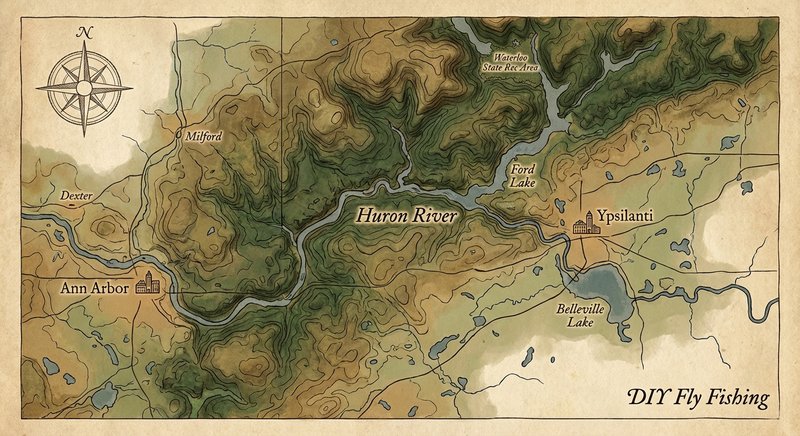
Huron River
Fly fishing in Michigan · Beginner · Best seasons: Spring, Summer, Fall
Target Species
Smallmouth Bass, Brown Trout, Northern Pike
About This Water
Southeast Michigan river through Ann Arbor. Diverse fishing with smallmouth and occasional trout.
Fishing Recommendations
The Huron River is one of Southeast Michigan’s most precious resources. It is a diverse, "split-personality" river that offers everything from cold-water trout fishing in the spring to world-class smallmouth bass action in the summer heat. Whether you are wading near Dexter or floating through Ann Arbor, the Huron provides a surprisingly wild experience just a short drive from the Detroit metro area.
🎣 Location Overview
The Huron River is a designated Country-Scenic River under Michigan’s Natural Rivers Act. It winds over 125 miles from its headwaters in Oakland County down to Lake Erie.
What makes it special is its accessibility and its variety. The upper reaches near Proud Lake and Island Lake Recreation Area are stocked with trout, while the middle sections—specifically from Dexter to Ann Arbor—are considered some of the finest Smallmouth Bass water in the Great Lakes region. The river features a mix of gravel runs, deep pools, and limestone ledges, providing the perfect habitat for predatory fish.
🐟 Target Species & Behavior
Smallmouth Bass (The Main Event)
The "Smallies" here are known for their aggression and acrobatics.
- Behavior: During the summer, they hold in oxygenated water—look for them at the heads of riffles and behind large boulders.
- Feeding: They are opportunistic. Their diet consists heavily of Crayfish, Hellgrammites (Dobsonfly larvae), and Baitfish (shiners and dace).
Brown and Rainbow Trout
These are primarily found in the "Type 1" and "Type 4" designated sections near Proud Lake and the Island Lake Recreation Area.
- Behavior: Because these are mostly stocked fish, they can be found in deeper holes or under overhanging banks.
- Feeding: They respond well to standard nymph patterns and small streamers. During April and May, they will rise for Hendricksons and Caddis.
Northern Pike
The "Water Wolves" of the Huron are found in the slower, weedy stretches and the "backwater" bays.
- Behavior: Ambush predators. They sit motionless near weed edges or fallen timber.
- Feeding: They want high-calorie meals. They target sunfish, frogs, and even small ducks.
📅 Best Times to Fish
- Spring (April – May): This is Trout Season. The DNR stocks Proud Lake and Island Lake in late March/early April. This is also a prime time for Pike, as they move into the shallows to spawn and are very protective.
- Summer (June – August): This is the Smallmouth Peak. As the water warms, the bass become highly active. This is the best time for topwater action.
- Fall (September – October): The "hidden gem" season. Smallmouth feed heavily before winter, and the Pike become aggressive again as water temperatures drop.
- Prime Window: For Smallmouth in the summer, the first two hours of light and the last two hours before dark are magical for topwater. For Trout in the spring, wait for the water to warm slightly in the mid-afternoon (1 PM - 4 PM).
🪰 Recommended Flies & Techniques
For Smallmouth Bass
- Topwater: Boogle Bugs, Gurglers, or Umpqua’s Swimming Frog. Technique: Cast toward the bank, let it sit until the rings disappear, then give it two sharp "chugs."
- Subsurface: Clouser Minnows (chartreuse/white), Murdich Minnows, and Near Nuff Crayfish. Technique: Strip-strip-pause. Most strikes happen on the pause.
- Nymphing: Pat’s Rubber Legs (size 6-8). Technique: Dead-drift these under an indicator through deep runs.
For Trout
- Dries: Elk Hair Caddis (size 14-16), Adams (size 14-18).
- Nymphs: Gold-ribbed Hare’s Ear, Pheasant Tail (size 16), and Prince Nymphs.
- Streamers: Black or Olive Woolly Buggers (size 8-10).
For Northern Pike
- Patterns: Barry’s Pike Fly, large Bunny Leech (6-8 inches), and any large streamer with a lot of "flash."
- Tip: Always use a wire tippet or 40lb fluorocarbon bite guard, or you will lose your fly in seconds.
💡 Pro Tips & Local Knowledge
- The "Dexter Drift": The stretch from Hudson Mills Metropark down to Dexter-Huron Metropark is the crown jewel for wading. Focus on the "pocket water"—small depressions behind rocks.
- The Hellgrammite Factor: The Huron has a massive population of Hellgrammites. If the fishing is slow, put on a large, dark, articulated nymph and bounce it along the bottom. It rarely fails.
- Stay Stealthy: In the summer, the Huron can run very clear. Long casts and a stealthy approach are necessary. If you can see the fish, they have likely already seen you.
- Floating is Better: While wading is possible, a kayak or canoe allows you to reach the "un-wadeable" deep holes where the 4lb+ Smallmouth and large Pike hide.
⚠️ Important Information
- Access:
- Hudson Mills, Dexter-Huron, and Delhi Metroparks offer excellent groomed access points (Metropark pass required).
- Island Lake Recreation Area offers great access for the trout sections (Recreation Passport required).
- Regulations:
- The Huron has specific Catch and Release seasons for trout in the spring (specifically at Proud Lake and Island Lake). Check the Michigan DNR Fishing Guide for exact dates, as they change slightly each year.
- Smallmouth Bass are generally C&R only until the Saturday before Memorial Day.
- Safety: The Huron can have surprising currents near the various dams (Argo, Barton, Geddes). Always scout downstream and wear a PFD if floating.
- Water Temps: During July and August, trout sections can become too warm (above 68°F). Please avoid targeting trout during these times to ensure their survival; switch to Smallmouth instead!
Bug Hatches & Matching Flies
| Hatch | Type | Peak months | Time of day | Hook sizes | Matching flies |
|---|---|---|---|---|---|
| Blue-Winged Olive (BWO) Baetis / Pseudocloeon | mayfly | April, May, September, October | Mid-day/Afternoon | #18-22 | RS2 #18-22, Parachute Adams #18-22, Pheasant Tail Nymph #18-20 |
| Hendrickson Ephemerella subvaria | mayfly | April, May | Afternoon | #12-14 | Red Quill #12-14, Hendrickson Emerger #12-14, Hare's Ear Nymph #12-14 |
| Sulphur Ephemerella invaria / dorothea | mayfly | May, June | Evening | #14-18 | Sulphur Parachute #14-16, Sulphur Spinner #14-18, Mercer's Poxyback Sulphur #16-18 |
| Giant Michigan Mayfly (Hex) Hexagenia limbata | mayfly | June, July | Dusk/Night | #4-8 | Hex Hagen #6-8, Bear's Hex #4-6, Hex Nymph #4-8 |
| White Miller Epheron leukon | mayfly | August | Late Evening | #12-14 | White Wulff #12-14, Epheron Dun #12-14 |
| Spotted Sedge Hydropsyche | caddis | May, June, July, August | Morning/Evening | #14-18 | Elk Hair Caddis #14-18, LaFontaine's Deep Sparkle Pupa #14-16, Holy Grail Caddis #14-16 |
| Trico Tricorythodes | mayfly | July, August, September | Early Morning | #20-24 | Trico Spinner #20-24, Griffith's Gnat #20-22 |
| Slate Drake Isonychia bicolor | mayfly | June, September | Afternoon/Evening | #10-12 | Isonychia Parachute #10-12, Zug Bug #10-12, Prince Nymph #10-14 |
| Terrestrials (Hopper/Ant/Beetle) Various | terrestrial | July, August, September | All Day | #8-16 | Chernobyl Ant #8-12, Dave's Hopper #10-12, Black Foam Beetle #14-16 |