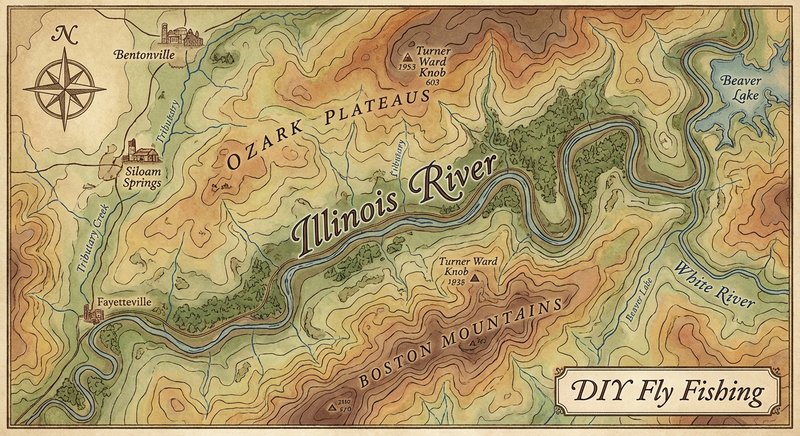
Illinois River
Fly fishing in Arkansas · Beginner · Best seasons: Spring, Summer, Fall
Target Species
Smallmouth Bass, Spotted Bass
About This Water
Northwest Arkansas stream with smallmouth bass. Clear Ozark water near Tenkiller Lake.
Fishing Recommendations
The Illinois River in Northwest Arkansas is one of the state's most cherished smallmouth gems. Flowing through the Ozark Mountains, it offers a classic "Ozark stream" experience: clear turquoise water, limestone bluffs, and extensive gravel bars. Unlike the tailwaters of the White or Little Red, the Illinois is a freestone-style river that relies on rainfall and springs, making it a dynamic and ever-changing fishery.
Here is your guide to fly fishing the Illinois River, Arkansas.
🎣 Location Overview
The Illinois River is a designated "Scenic River" in Arkansas. It is characterized by its relatively slow pace interspersed with quick riffles, deep holes beneath limestone bluffs, and long, willow-lined runs.
What makes it special is the Neosho Smallmouth Bass. This is a specific subspecies of smallmouth native to the Ozark Plateau. They are known for being exceptionally hardy, aggressive, and perfectly adapted to the warm, clear waters of the region. Anglers love this river because it offers a sense of solitude and a "wild" feel, despite being relatively close to the growing metropolitan areas of Fayetteville and Bentonville.
🐟 Target Species & Behavior
- Smallmouth Bass: The undisputed king of the Illinois. They are "structure-oriented." Look for them behind boulders, in the "seams" where fast water meets slow water, and deep under overhanging willow banks.
- Spotted (Kentucky) Bass: Often found in the slightly deeper, slower pools compared to smallmouth. They are aggressive hitters but tend to hold closer to submerged timber and root balls.
- Behavior & Diet: In the spring, they are looking for high-protein meals like crawfish and large minnows to gear up for the spawn. In the heat of summer, they move toward oxygenated water (riffles) and feed heavily on terrestrial insects and damselflies.
📅 Best Times to Fish
Optimal Seasons
- Spring (April – June): This is prime time. As water temps hit 55–60°F, the fish become highly active. Pre-spawn and post-spawn windows offer the best chance at a trophy (18"+).
- Summer (July – August): Best for "wet wading." Focus on early mornings and late evenings to avoid the heat. The fish move into the faster "bubbly" water for oxygen.
- Fall (September – early November): As temperatures drop, bass feed aggressively to bulk up for winter. The clarity is usually at its peak, and the topwater action can be legendary.
Prime Conditions
- Water Clarity: You want "green" water—not muddy, but not gin-clear. A little tint helps hide your leader.
- Time of Day: Low light is your friend. The first two hours of light and the last two hours before dark are when the biggest bass move out of the deep holes to hunt in the shallows.
🪰 Recommended Flies & Techniques
Top Fly Patterns
- Streamers:
- Clouser Minnow (Chartreuse/White or Tan/White) — The all-time classic for a reason.
- Gamechanger (Small sizes) — For mimicking the shad and shiners.
- Woolly Bugger (Olive or Black, beaded) — Mimics crawfish or hellgrammites.
- Crayfish Patterns:
- Near Nuff Craw or Whitlock’s Near Nuff — Fish these on the bottom with a "strip-strip-pause" motion.
- Topwater:
- BoogleBug Poppers (Yellow or Olive) — Durable and loud.
- Sneaky Pete — A more subtle slider for clear, calm water.
- Murdich Minnow — Great for fishing just below the surface.
Techniques
- The "Crayfish Hop": Use a weighted fly on a sink-tip line. Cast upstream at a 45-degree angle, let it sink to the bottom, and "hop" it back to you.
- The Swing: In riffles, swing a streamer through the current just like you would for trout. Smallmouth often sit right at the "tail out" of a pool.
- Popper-Dropper: In mid-summer, run a large popper with a small beaded nymph (like a rubber-legged stonefly) 18 inches below it.
💡 Pro Tips & Local Knowledge
- Focus on the Willow Banks: The Illinois is lined with willows. In the summer, damselflies and beetles live in these trees. Bass sit directly under the branches waiting for a "windfall" meal. Accurate casting is more important than long casting here.
- The "Neosho" Fight: Be prepared—these fish use the current. When you hook a 14-inch smallmouth in moving water, it will feel like a 5-pound largemouth. Use a 6-weight rod to ensure you can turn their heads before they wrap you around a log.
- Stealth Matters: Because the water can get very clear, wear natural colors (tan/sage) and try to avoid splashing. If you see a fish in a shallow pool, it has likely already seen you.
⚠️ Important Information
Access Points
- Siloam Springs Kayak Park: Excellent access for both wading and launching.
- Chamber Springs Access: A popular spot for wading upstream or downstream.
- Highway 16 Bridge (Savoy): A classic entry point for the upper section.
Regulations & Safety
- Permit: An Arkansas Fishing License is required.
- Keep/Release: While regulations allow for some harvest, Catch and Release is strongly encouraged for Smallmouth Bass on the Illinois to preserve the sensitive Neosho strain.
- Floater Traffic: During summer weekends, the river can get crowded with recreational floaters (canoes/tubes). To have the best fishing experience, fish on weekdays or start your float at sunrise to stay ahead of the "aluminum hatch."
- Private Property: Most of the land surrounding the river is private. Stay in the riverbed or on established gravel bars to avoid trespassing.
Guide’s Final Word: The Illinois River isn't about high fish counts; it's about the quality of the environment and the fight of the native bass. Slow down, watch the banks, and enjoy one of the best warm-water fly fishing experiences in the Mid-South.
Bug Hatches & Matching Flies
| Hatch | Type | Peak months | Time of day | Hook sizes | Matching flies |
|---|---|---|---|---|---|
| White Fly Ephoron leukon | mayfly | August, September | Evening/Night | #12-14 | White Wulff #12-14, White Drake Spinner #12-14 |
| Hex Hexagenia limbata | mayfly | June, July | Dusk/Night | #6-10 | Hex Hagen #6-8, Hex Emerger #8-10 |
| Spotted Sedge Hydropsyche | caddis | May, June, September | Evening | #14-18 | Elk Hair Caddis (Tan) #14-16, Soft Hackle Hare's Ear #14-18 |
| Slate Drake Isonychia bicolor | mayfly | May, June, September, October | Afternoon | #10-14 | Iso Parachute #12-14, Prince Nymph #10-14 |
| Trico Tricorythodes | mayfly | July, August, September | Morning | #20-24 | Trico Spinner #20-24, Trico RS2 #20-22 |
| Damselfly Calopteryx | terrestrial | June, July, August | Afternoon | #10-14 | Braided Butt Damsel #10-12, Marabou Damsel Nymph #12-14 |
| Hellgrammite Corydalus cornutus | stonefly | May, June, July | All day | #4-8 | Hellgrammite #4-8, Pat's Rubber Leg #6-10 |
| Grasshopper Acrididae | terrestrial | July, August, September | Afternoon | #6-12 | Dave's Hopper #8-12, Morrish Hopper #8-10 |
| Common Midge Chironomidae | midge | February, March, April | Morning/Afternoon | #18-24 | Zebra Midge #18-22, Griffith's Gnat #20-24 |